AI as Proposer, Not Authority
AI systems drafted this book, wrote much of its laboratory, transcribed its sources, proposed proofs and attacked its own evidence. Some of their best contributions and some of their worst errors are on the record. What they did, how each contribution was checked, and the one rule that makes the arrangement safe: an AI may propose anything, and its proposal establishes nothing until independent evidence or a person's recorded judgement does.
This book was made with a great deal of help from AI systems. They drafted chapters, wrote and reviewed code, transcribed historical tables and figures, proposed formal proofs, and attacked the evidence the laboratory produced. That makes the book itself a test case for the question it keeps asking: when a system that can be wrong proposes something, what turns the proposal into knowledge?
The answer this chapter defends is simple to state. An AI may propose anything. Its proposal establishes nothing until independent evidence or a person’s recorded judgement does. That rule is not a verdict on AI. It is the rule the laboratory applies to every proposal, including the author’s own. What is particular to AI is how often it is useful, and the specific ways it fails.
Five things AI did in this book
It found the laboratory’s most important defect. In the stage called
MATH-INV-02E, the Haraux evidence was handed to a separately invoked reviewer, a
model from a different family with no access to the earlier conversation. Its
partial draft raised an issue: what if a theorem were replaced by one with the
same name that states only True? That suggestion was not accepted on the
reviewer’s say-so. It was turned into a fixture, compiled with Lean, and fed to
the ingestion code. Lean accepted the file, correctly, and the ingestor credited
it to the original proposition. The defect was confirmed by execution, recorded
as E-TYPE-01, and repaired in MATH-INV-02F. Chapter 5 — The Wrong Theorem (Part I, Chapter 4) is built on that finding;
Chapter 4 — Two Clocks, Two Questions (Part I, Chapter 3) is the investigation whose evidence exposed the defect.
It proposed proofs, and they were checked. In an earlier experiment, a model with no access to the repository was asked for three strategies and three Lean proofs of the algebraic Lorentz interval theorem. The pinned Lean kernel accepted all three against the unchanged, frozen statement, with only the standard axioms. That is real evidence that the theorem was proved. It is not evidence of what the experiment hoped to show, which was three different mathematical routes. All three proofs used the same factorization. The experiment’s own measure of difference compared normalized text and wrongly reported three distinct shapes. A person reading the proofs found one route.
It transcribed sources, and said so. The kidney-stone counts in Part I,
Chapter 8 and the 25 regions and 69 boundaries of Heawood’s map in Chapter 7
were read from page images by an AI. Both records begin with the same sentence
in substance: prepared by an AI, a transcription and not a review, to be checked
by a person against the scan. Neither has been yet. That is why both
investigations end …_correspondence_pending, and why Kempe’s failure control
removes the one boundary that was hardest to read.
It wrote the code that checks it. Much of the proof runner, its controls and its tests were written by AI. That code is trusted no further than its tests and its failure controls, and the controls are themselves checked to fail for the right reason (Chapter 23). A test written by the same system as the code it tests is weaker evidence than an independent one.
It drafted the book, and made errors that review caught. The work’s history records several examples. A draft described Part I’s first investigation as being about Fermat’s last theorem, when it is about Fermat’s numbers. A draft called an approval settled before it was. A draft said a Lean file proved length contraction when it proved a one-line identity. A draft presented a 50-digit numerical check as exact symbolic arithmetic. An exercise asked readers to paint the inside of Gabriel’s horn with a coat of constant thickness, which is impossible far enough down the horn. Each error was fluent, plausible and confidently stated. Each was caught in a later pass that checked the text against the record, the code or the mathematics. Other problems, of wording and emphasis, were caught by a separate AI reviewer. None was caught by the text looking wrong.
How AI fails, in this record
The errors above have a pattern worth naming.
- Confident misattribution. The wrong Fermat, the wrong status, the wrong tool. The sentence is well formed and the fact is not.
- Overstating what was checked. “Proved length contraction”; “exact”. The gap between what a tool did and what the prose says it did is exactly the gap this book is about, and a fluent writer widens it easily.
- Measuring the wrong thing. Three distinct texts reported as three distinct proofs.
- Reading a source plausibly, not certainly. A transcription can be right in every cell and still need independent checking, because nobody has shown that it is right.
None of these is special to AI. People make every one of them. The difference is volume and fluency: an AI produces far more text, far faster, in prose that gives no sign of which sentences are weak.
How AI succeeds, in this record
- Adversarial imagination. The same-name substitution was an idea about how the laboratory could be fooled, and it was right.
- Construction at scale. Proofs that the kernel accepted, code that the controls exercise, drafts that a person could correct rather than write.
- Tireless rechecking. Several of the errors listed above were found by an AI rereading its own work against the record when asked to.
The rule, and where it is enforced
The laboratory does not ask whether a proposal came from an AI. It asks what established it. There are exactly two ways in.
- Through a check that could have failed. A proposed proof enters as
evidence only if a kernel accepts it as a proof of the contract’s statement,
with the allowed axioms, in a run whose controls fail as designed. A proposed
attack enters as a finding only when it has been executed and observed. The
early agent interface in the codebase states this in its own type: a
CandidateProposalis “untrusted model output that can never itself be verification evidence”. - Through a person’s recorded judgement. A correspondence, an
interpretation, a transcription’s fidelity: these are judgements, and only a
person can make them. The runner counts an approval only if its
reviewer_roleisuserorhuman(Chapter 24). No AI role exists that it counts. An AI can argue for a judgement, often well. The person answerable for the claim makes the judgement and records it.
Everything else an AI produces, however good, is a proposal.
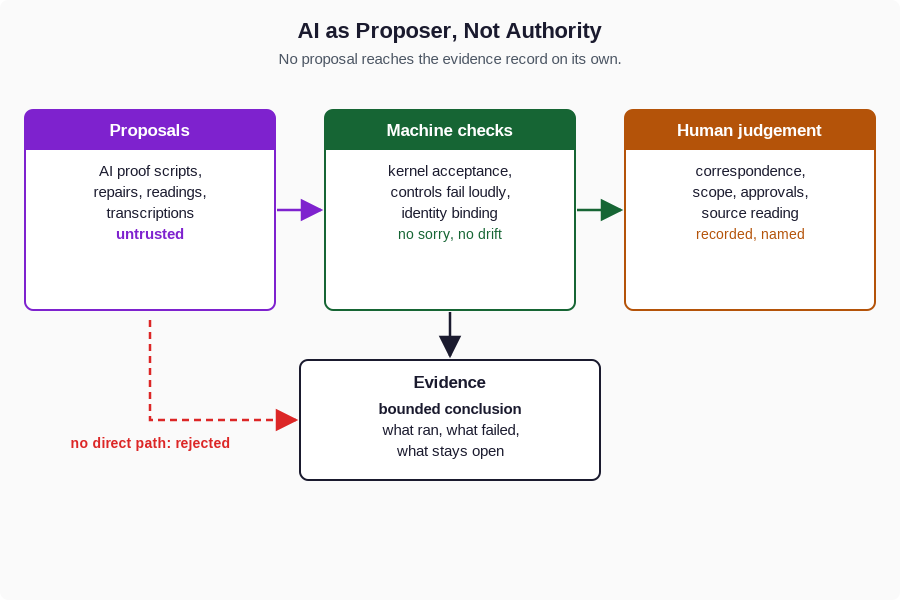
Two ways in, no way round. A proposal becomes evidence through a check that could have failed or through a recorded human judgement — never by arriving directly. The figure summarizes the rule above; the AlphaProof parallel below is a separate design that this book does not reproduce.
The same separation, at scale
Other laboratories have reached the same arrangement at much larger scale. AlphaProof Code, a Google DeepMind project reported in November 2026, used agents to write machine-checked Lean proofs about the Signal protocol’s implementation. As the project’s research record describes it, the agents could not edit the specification. Amendments went to a separate critic, and a gatekeeper accepted a proof only if a tool confirmed that its statement matched a copy no agent could write, it used only standard axioms, and the kernel accepted it. The design point is the one this chapter makes: the statement is locked, the proof is proposed, and acceptance is mechanical. Nothing in this book reproduces or tests that work, and its figures are not repeated here.
A second external case: OpenAI’s Ten Proofs
A further large-scale case is OpenAI’s Ten Proofs release of August 2026: ten announced advances, from sphere packing to Ramsey numbers, with the mathematical arguments reported as generated by an internal AI system, the manuscripts prepared by humans with the same model, and Lean formalizations released alongside. The human audit record (arXiv:2608.14673, latest edition September 2026) reports no confirmed substantive error in a principal result among the assessments it examined, with varying review depth — and its strongest reservation concerns compressed analytic arguments in the Ehrhart volume proof, which is a call for further justification, not a refutation.
The case earns its place here for one reason: it exercises the same boundary
this chapter defends. Generating a proof and checking a saved certificate are
different achievements; a passing kernel or Comparator run establishes the
artifact, not the manuscript’s fidelity or the argument’s digestion. This book
builds only the elementary footing — an exhaustive R(3,3) = 6 check and a
separate Lean witness for its lower bound — and leaves the advanced
multicolor bound source-inspected, not verified. Source fidelity is part of
that boundary: the dossiers record exactly which representation was read
(rendered page versus extracted text) and what was not
(docs/research/MATH-OAI10-00-source-audit.md,
docs/research/MATH-OAI10-comparator.md). The cited evidence is the OpenAI
announcement (https://openai.com/index/ten-advances-in-mathematics/) and the
independent human audit (arXiv:2608.14673).
What this chapter does not claim
It does not assess AI systems in general, rank models, or say how much of any future mathematics they will do. Its evidence is one book’s record: a handful of proof experiments on known mathematics, one adversarial review that found a real defect, two transcriptions that have not been independently checked, and a list of drafting errors that were caught. It also does not claim that every AI error in the book has been caught. The point of the rule is that the book should not need that claim: what the reader is asked to rely on is the evidence and the recorded judgements, not the prose.
Try it yourself
- Find the 02E adjudication’s record of the same-name substitution
(
docs/research/math-inv-02/02e/MATH-INV-02E-ADJUDICATION.md). At which point did the reviewer’s idea become evidence? - The proof experiment’s distinctness measure reported three shapes. Design a measure that would have reported one, and say what it still could not tell you.
- Choose one cell of the kidney-stone table in Chapter 8 — When Every Group Says Yes (Part I, Chapter 7) and say exactly what an independent check of the AI transcription would involve. What would make you trust the transcription less?
- Suppose an AI reviewer writes: “I have checked the correspondence and it is correct.” What should happen to that sentence in the laboratory’s records?
- Give an example, from this book or elsewhere, of a person making one of the four failures listed in this chapter. What caught it, if anything?
Worked answers: Chapter 35 — Appendix A: Solutions to the Exercises (Part IV, Appendix A)#chapter-8-ai-as-proposer-not-authority.
Evidence record
| Adversarial review | docs/research/math-inv-02/02e/MATH-INV-02E-REVIEW-MANIFEST.md (reviewer identity and isolation), MATH-INV-02E-ADJUDICATION.md (ISS-07 raised, ISS-09 confirmed) |
| Repair | MATH-INV-02F, docs/research/math-inv-02/02f/MATH-INV-02F-THEOREM-IDENTITY.md |
| Proof experiment | docs/research/MATH-AP-01-assessment.md (“three plans, one proof”) |
| AI transcriptions | docs/research/book-proofs/P06-KEMPE-01.md, P07-SOURCE-CHECK-01.md |
| Proposal boundary | src/math_engine/agents/interfaces.py (CandidateProposal); approval roles in src/math_engine/proofs/runner.py |
| Drafting errors and fixes | repository history; PART-II-INTEGRATION-REVIEW.md |
| AlphaProof Code | Chaudhuri et al., “AlphaProof Code: Verifying Signal’s Security at the Machine-Code Level”, Google DeepMind (2026); described from the project’s research record, not re-read here |
Further Reading
For deeper study; not sources for the chapter’s claims.
- Jeremy Avigad. “The Mechanization of Mathematics.” Notices of the American Mathematical Society 65(6) (2018), 681–690. DOI. Why read it: A thoughtful survey of automation, formal verification and the division of labour between humans and machines, directly relevant to the chapter’s proposal/authority distinction.
- Trieu H. Trinh, Yuhuai Wu, Quoc V. Le, He He, Thang Luong. “Solving olympiad geometry without human demonstrations.” Nature 625(7995) (2024), 476–482. DOI. Why read it: A landmark AI system producing verifiable olympiad-level proofs, useful for separating an AI’s proposed proof from the checked result.
- Bernardino Romera-Paredes, Mohammadamin Barekatain, Alexander Novikov, Matej Balog, M. Pawan Kumar, Emilien Dupont, Francisco J. R. Ruiz, Jordan S. Ellenberg, Pengming Wang, Omar Fawzi, Pushmeet Kohli, Alhussein Fawzi. “Mathematical discoveries from program search with large language models.” Nature 625(7995) (2023), 468–475. DOI. Why read it: Shows AI proposing programs and mathematical constructions that are then checked computationally, a concrete model of AI as proposer rather than authority.
Next in Part III: Chapter 28, building a ninth investigation.