Continuous Terms, Discontinuous Sum
In 1821 Cauchy stated that a convergent series of continuous functions has a continuous sum. In 1826 Abel wrote, in a footnote, that the theorem 'admits exceptions'. We read all three documents, separate four things that are easily confused, and say exactly which of them a proof checker has verified.
The question
Add up infinitely many continuous functions. If the sum exists at every point, is the sum continuous?
It is tempting to say yes. Each term has no jumps; each partial sum, a finite sum of continuous functions, has no jumps. How could a limit of jump-free functions jump?
It can. The question is old, the answer is no, and the history of how mathematicians came to say so is one of the clearest lessons in what an unstated hypothesis can do.
Four things in this chapter are easily run together, and the chapter is built to keep them apart:
- A modern teaching example, xⁿ on [0, 1], which shows the answer is no in a few lines. It is not historical.
- Abel’s actual series of 1826, the exception he named.
- The modern repair: a uniform limit of continuous functions is continuous. This is a later theorem, not Abel’s and not, in this form, Cauchy’s.
- What a proof checker has verified: the teaching example, the modern repair, and one finite building block (F1) on the way to Abel’s series. Abel’s series itself has not been kernel-checked.
The historical setup
Cauchy, 1821. In his Cours d’analyse (ch. VI, pp. 131–132), Cauchy states as Theorem I: when the terms of a series are functions of a variable x, continuous near a value where the series converges, the sum s is also continuous near that value. His argument splits the sum into a partial sum sₙ and a remainder rₙ. The increment of sₙ is infinitely small; the increment of rₙ “becomes insensible at the same time as rₙ” when n is very large; so the increment of s is infinitely small.
Abel, 1826. In a footnote to his paper on the binomial series (Crelle’s Journal 1, p. 316), Abel quotes Cauchy’s theorem, citing “Seite 131”, and writes: “It seems to me, however, that this theorem admits exceptions.” His example is the series
$$\sin\varphi - \tfrac12\sin 2\varphi + \tfrac13\sin 3\varphi - \cdots,$$which, he says, is discontinuous at every odd multiple of π. The footnote states the exception without the full argument. His own positive theorem in the same paper (Lehrsatz V) is a continuity result for a restricted kind of series, and should not be read as the modern repair.
Cauchy, 1853. In a note in the Comptes rendus, Cauchy returns to the theorem. He writes that it holds for power series, as “MM. Bouquet and Briot” remarked, but that, for other series, it “cannot be admitted without restriction”. His example is the related series sin x + ½ sin 2x + ⅓ sin 3x + ⋯, which jumps at multiples of 2π. (It is Abel’s series with x replaced by π − x.) He then adds a condition: that the remainder can be made small for all values of x between the given limits at once.
Three cautions follow from the documents, not from the textbook story. The quoted 1853 passage credits Bouquet and Briot for the power-series case and does not mention Abel; the text does not say that Cauchy was answering him. Our 1853 text comes from the 1900 Œuvres reprint; the original Comptes rendus page has not been compared here. And Cauchy’s 1853 theorem, as stated, says the remainder “always becomes infinitely small”; whether that wording expresses the all-x condition is the point historians dispute.
The dispute. On one reading, Cauchy’s 1821 “insensible at the same time as rₙ” means: for each fixed x. Then the theorem is false, and Abel was right to object. On another reading, Cauchy’s infinitely small quantities are to be taken seriously as such, and his hypothesis already carries the condition needed. The text alone does not decide between them, and this chapter does not pretend that it does.
Run it
Two things can be run in the pinned environment (see “Running the investigations” in the introduction to Part I). The first is the feasibility probe for the teaching example and the modern repair:
docker run --rm --network none -e UV_OFFLINE=1 -e MATHENV_KEEP_UNTRACKED=1 `
  -v "${PWD}:/source:ro" math-env bash -c `
  'cd formal/lean && lake env lean ../../experiments/feasibility/n2-cauchy/CauchyAbelProbe.lean; echo "EXIT $?"'
The second is the investigation for F1, the finite step towards Abel’s series:
math-engine proof abel-f1
Without Docker, the two computations run with plain Python:
python -m math_engine.proofs.abel_f1_compute (F1, at 50 digits) and
python experiments/feasibility/n2-cauchy/abel_series.py (Abel’s series near
π). The recorded F1 run is in
experiments/investigations/n2-abel-f1/kernel-runs/2026-11-13-pinned/.
What happened
The probe compiled on the pinned toolchain with no warnings, using only Lean’s three standard axioms. It checks:
- (A) The teaching example. Each xⁿ is continuous on [0, 1]. For each x in [0, 1] the sequence xⁿ converges: to 0 if x < 1 and to 1 if x = 1. The limit function is not continuous on [0, 1]. So the pointwise reading of Cauchy’s 1821 theorem, stated for sequences, is false.
- (C) The modern repair. A uniform limit of continuous functions is continuous; consequently xⁿ does not converge uniformly on [0, 1].
The recorded F1 run reported Lean 2/2 statements accepted as written in the
contract, the independent check identity_holds, and failure controls 5/5
rejected. (Its printed summary called the independent check “Python + SymPy”.
It is in fact a 50-digit mpmath calculation, which is numerical evidence, not
exact arithmetic; the printed label is inaccurate.)
F1 is the identity cos t + cos 2t + ⋯ + cos Nt = sin((N + ½)t) / (2 sin(t/2)) − ½, for sin(t/2) ≠ 0. A wrong constant (1/3), a sum starting at 0, and a shifted upper bound were each rejected; so was attaching the theorem to the 1/3 statement, and so was the numerical check given the wrong constant.
For Abel’s series itself, a computation shows what the proof below predicts. Near x = π the partial sums stay far from x/2, however many terms are taken:
| N terms | error at x = π − 1/N² |
|---|---|
| 10 | 1.466 |
| 100 | 1.561 |
| 1 000 | 1.570 |
| 10 000 | 1.571 |
The error is not shrinking. It is approaching π/2 ≈ 1.5708.
Why
The teaching example. xⁿ → 0 for every x < 1, but more and more slowly as x approaches 1. However large n is, there are points just below 1 where xⁿ is still close to 1. The convergence happens at every point, but not at the same speed everywhere, and at x = 1 the limit jumps from 0 to 1.
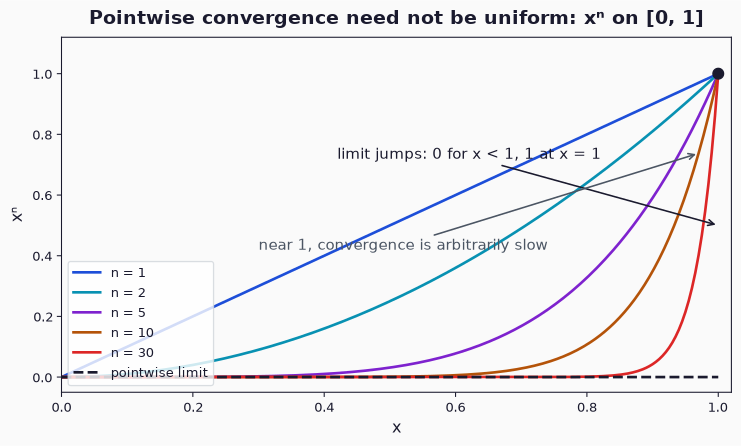
The teaching example: $x^n$ on $[0,1]$ for $n = 1, 2, 5, 10, 30$. Every curve is continuous, but the pointwise limit jumps at $x = 1$. Near 1 the curves stay high longer and longer — convergence at every point, at no uniform speed. The limit function (dashed) is not computed by the plot; it is the pointwise limit.
The repair. If one n works for every x at once (uniform convergence), the jump cannot form: near any point the limit is within ε of a continuous partial sum everywhere, and a continuous function cannot jump by more than 2ε. The condition Cauchy’s 1853 theorem needs is that the remainder be small for all values of x at once; whether his wording states it is the historical question below.
Abel’s series. The classical proof is short, and runs in five steps:
- F1, the finite cosine sum above (kernel-checked).
- Integrate it to get the partial sums of ∑ sin(nt)/n.
- An oscillating integral tends to 0 (integration by parts).
- Hence ∑ sin(nt)/n = (π − t)/2 for 0 < t < 2π, and, putting t = π − x, Abel’s series sums to x/2 on (−π, π). At x = π every term is 0, so the sum is 0. Just below π the sum is near π/2; just above, near −π/2.
- Not uniform near π: each partial sum is continuous and equals 0 at π, while the limit is x/2. For every N, the supremum of |S_N(x) − x/2| over (π − δ, π) is at least π/2. So the convergence is not uniform on any interval (π − δ, π). That is the table above.
The failure is a failure to interchange two limits:
The partial sums show the jump directly: however many terms are taken, the overshoot near $\pi$ does not go away.
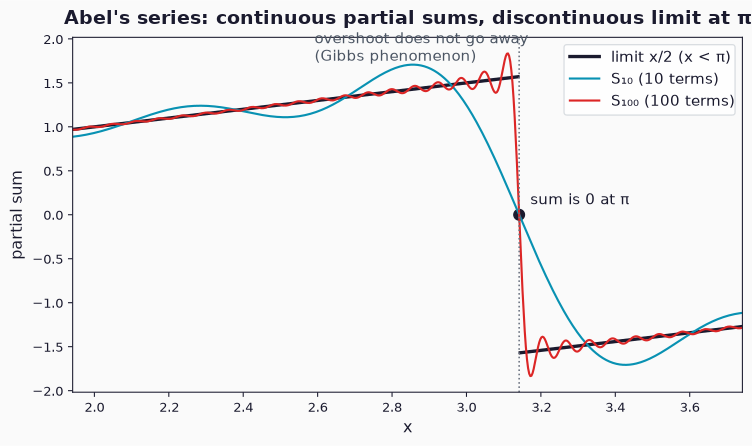
Abel’s partial sums near $\pi$: 10 terms (pale) and 100 terms against the limit $x/2$ below $\pi$ and $0$ at $\pi$. The overshoot near the jump persists — the Gibbs phenomenon. Computed from the series definition; the identity of the limit with $x/2$ is the classical proof, not the plot.
So Abel’s footnote is correct: each term is continuous, the series converges everywhere, and the sum jumps at every odd multiple of π.
What was actually checked
| Claim | Result | |
|---|---|---|
| A | xⁿ: continuous terms, discontinuous limit; the pointwise reading is false | Lean + Mathlib, pinned feasibility probe |
| C | uniform limits of continuous functions are continuous; xⁿ is not uniform on [0, 1] | same probe |
| F1 | the finite cosine sum, step 1 of the proof of B | Lean + Mathlib, pinned run, 5 controls |
| B | Abel’s series sums to x/2, is 0 at π, jumps, and is not uniform near π | classical proof (steps 1–5) and computation; not kernel-checked |
| H | what the 1821, 1826 and 1853 texts say | transcribed from page images; translations ours; 1853 from the 1900 reprint |
Steps 2–5 of Abel’s proof (F2–F5) are argued in the text rather than checked by a kernel. The full series identity therefore rests on the classical proof and the computation, not on a formal proof of the infinite statement.
What this establishes
That a pointwise limit of continuous functions can be discontinuous (A, kernel-checked, through the teaching example); that uniform convergence prevents it (C, kernel-checked); and one finite identity on the way to Abel’s own example (F1, kernel-checked). Abel’s series is shown to behave as he said by a classical proof and by computation.
What remains open
- Abel’s series in a kernel (F2–F5). Until then, B rests on a proof a reader can follow and a computation, not on a proof checker.
- The 1853 original. Our text is the 1900 reprint. The reprint prints 0,6244… for a value that is in fact 0.6247…; whether the slip is in the 1853 printing is unknown until the original is compared.
- Translations and the classical proof are ours; they have not been independently checked.
- Who first isolated uniform convergence. The usual candidates are Seidel (1847), Stokes (1847) and Weierstrass; the priority is disputed, and this chapter does not settle it.
- The historians’ dispute about what Cauchy meant in 1821 stays open.
Try it yourself
- For xⁿ, find for each n the point where xⁿ = ½. Watch it move towards 1.
- Plot the partial sums of Abel’s series near π for N = 10, 100, 1000. The overshoot near the jump does not go away. (It is the Gibbs phenomenon.)
- Substitute t = π − x into Cauchy’s 1853 series and recover Abel’s.
- Read Cauchy’s 1821 argument and his 1853 condition side by side. Which words would you change to make 1821 correct?
Worked answers: Chapter 35 — Appendix A: Solutions to the Exercises (Part IV, Appendix A)#chapter-2-continuous-terms-discontinuous-sum.
Evidence record
| Probe (A, C) | experiments/feasibility/n2-cauchy/CauchyAbelProbe.lean, pinned toolchain, 2026-11-13: passed, no warnings, standard axioms only (feasibility evidence) |
| F1 | N2-ABEL-F1, contract v1 (sha256 7f9de3e5…), run kernel-runs/2026-11-13-pinned: Lean 2/2, controls 5/5; the finite identity is kernel-checked |
| Abel’s series (B) | experiments/feasibility/n2-cauchy/abel_series.py and .out.json (computation); classical proof in N2-CAUCHY-01.md §4 |
| Sources | docs/research/book-proofs/N2-CAUCHY-01.md |
Sources
- A.-L. Cauchy, Cours d’analyse de l’École royale polytechnique. I.re partie: Analyse algébrique (Paris, 1821), ch. VI, §1, pp. 131–132. (transcribed from the Internet Archive scan)
- N. H. Abel, “Untersuchungen über die Reihe 1 + (m/1)x + …”, Journal für die reine und angewandte Mathematik 1 (1826), 311–339; Lehrsatz V, p. 315; footnote, p. 316. (transcribed from the Göttingen scan)
- A.-L. Cauchy, “Note sur les séries convergentes dont les divers termes sont des fonctions continues…”, Comptes rendus 36 (14 March 1853), 454ff. (transcribed from Œuvres complètes, sér. I, t. XII, 1900, pp. 30–35; the 1853 original has not been compared)
Further Reading
For deeper study; not sources for the chapter’s claims.
- Philipp Ludwig Seidel. “Note über eine Eigenschaft der Reihen, welche discontinuirliche Functionen darstellen.” Abhandlungen der Mathematisch-Physikalischen Classe der Königlich Bayerischen Akademie der Wissenschaften 5 (1847), 381–394. link. Why read it: One of the original 1847 papers that identified the need for what became uniform convergence, directly relevant to the chapter’s open question about Seidel, Stokes and Weierstrass.
- Alexandre V. Borovik, Mikhail G. Katz. “Who Gave You the Cauchy–Weierstrass Tale? The Dual History of Rigorous Calculus.” Foundations of Science 17(3) (2012), 245–276. DOI. Why read it: A critical examination of the standard Cauchy–Weierstrass story, helpful for readers who want to pursue the historical dispute the chapter deliberately leaves open.
- Klaus Viertel. “The development of the concept of uniform convergence in Karl Weierstrass’s lectures and publications between 1861 and 1886.” Archive for History of Exact Sciences 75(4) (2021), 455–490. DOI. Why read it: A detailed modern history of uniform convergence in Weierstrass’s lectures and publications, useful for the part of the story that follows Seidel and Stokes.
The mathematics behind this chapter: Chapter 12 — Limits That Do Not Commute (Part II, Chapter 3) (pointwise and uniform convergence, and Abel’s series), with Chapter 10 — Every, Some, None (Part II, Chapter 1) on the order of quantifiers.
Next: Chapter 4, a 2024 claim that special relativity contradicts itself, and two clocks that are not timing the same thing.