What a Theorem Assumes
A theorem is a domain, hypotheses and a conclusion. Delete a hypothesis and watch what breaks; change the domain and the claim changes; reverse the implication and a true theorem becomes Fermat's false one. How a refuted claim is honestly repaired.
Three of Part I’s investigations turn on something a claim did not say. Cauchy’s theorem is true once the word “uniformly” is added, and false without it. Haraux’s contradiction comes, on our reading, not from the three properties his paper names but from two premises its derivation adds along the way. And Fermat’s belief about the numbers 2^(2ⁿ) + 1 is a true theorem read backwards. This chapter is about the parts of a theorem that are easy to overlook: its domain, its hypotheses, and which way its arrow points.
The anatomy of a claim
Almost every theorem has the shape
for all x in domain D, if hypotheses H(x) hold, then conclusion C(x).
Each part does work.
- The domain says what kind of object x is: a natural number, a real, a continuous function on [0, 1], a map in the plane.
- The hypotheses restrict which objects in the domain the claim is about.
- The conclusion is what is asserted about them.
Changing any one of the three gives a different claim. Moving a condition from the hypotheses into the domain (“for all continuous f” instead of “for all f, if f is continuous”) gives the same claim in different clothes. Moving it into the conclusion does not.
It also helps to sort hypotheses by the job they do. The earlier edition of this book used five roles, and they are worth keeping:
| Role | What it does | Example |
|---|---|---|
| domain | says what the variables are | t, x, v, γ are real numbers |
| definition | introduces a name | γ = 1/√(1 − v²) |
| side condition | makes a definition meaningful | |v| < 1 |
| assumption | is simply assumed within this claim | γ²(1 − v²) = 1 |
| derived | was proved elsewhere and is imported | a lemma used as a step |
The same formula can play different roles in different claims. In Chapter 18’s algebraic invariance theorem, γ²(1 − v²) = 1 is an assumption. In the “gamma bridge” it is the conclusion, derived from the definition of γ and the side condition |v| < 1. The role belongs to the claim, not to the symbols.
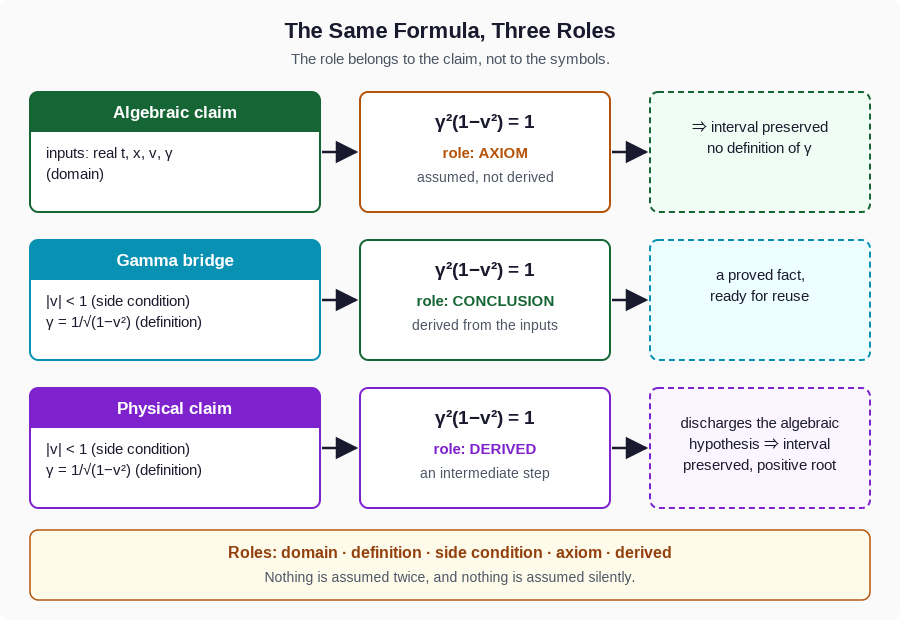
The same formula, three roles. $\gamma^2(1-v^2) = 1$ is assumed in the algebraic claim, proved in the gamma bridge, and used mid-proof in the physical claim. Nothing is assumed twice, and nothing is assumed silently — the figure shows the bookkeeping the table above describes.
The deletion test
The quickest way to see what a hypothesis does is to delete it.
Delete “uniformly” from Cauchy. The claim becomes: a pointwise limit of continuous functions is continuous. xⁿ on [0, 1] refutes it (Chapter 12). The hypothesis was carrying the whole proof.
Delete the right angle from Pythagoras. “For all points A, B, C, d²(B, C) = d²(A, B) + d²(A, C)” is refuted by A = (0, 0), B = (1, 0), C = (1, 1), with residual −2 (Chapter 10). Better, the refutation explains itself. For all points,
$$d^2(B,C) - d^2(A,B) - d^2(A,C) = -2\,(\vec{AB}\cdot\vec{AC}).$$The deleted hypothesis is exactly the condition that makes the right-hand side zero.
Delete |v| < 1 from the gamma bridge. Something subtler happens. In ordinary mathematics, γ = 1/√(1 − v²) is simply undefined at |v| ≥ 1. A proof assistant does not leave it undefined. In Lean, with Mathlib, the square root of a negative number is defined to be 0, and so is division by 0. Both are conventions of the formal library that make the functions total. They are not new facts about the real numbers: no analyst would say √(−3) = 0, and nothing physical is being claimed about speeds above light. So at v = 2, Lean computes
$$\gamma = \frac{1}{\sqrt{1-4}} = \frac{1}{0} = 0, \qquad \gamma^2(1 - v^2) = 0 \ne 1 .$$There is no error message, only a value that makes the conclusion false. The side condition is doing real work, and removing it fails silently. This is the first of several places where a formal statement says something slightly different from its English reading, and Chapter 15 is about them.
A hypothesis that can be deleted without making the claim false is idle. It is not wrong to include one, but it misleads the reader about what the proof needs. Chapter 18 shows a famous example: the algebraic invariance of the interval does not need |v| < 1 at all.
Changing the domain
“x² = 2 has a solution” is false over the rationals and true over the reals. “Every polynomial of degree at least 1 has a root” is false over the reals and true over the complex numbers. The words are the same; the claims are not.
The domain also hides assumptions about operations. “1/x” presupposes x ≠ 0; “√x” over the reals presupposes x ≥ 0. When a claim uses these operations, those conditions are hypotheses whether or not they are written down, and a careful statement writes them down.
Which way the arrow points
A theorem “if H then C” says nothing about “if C then H”, its converse.
Here is a true theorem. If 2ᵐ + 1 is prime, then m is a power of 2. The proof is short. Suppose m has an odd factor k > 1, so m = kj. Then
$$2^m + 1 = (2^j)^k + 1 = (2^j + 1)\bigl((2^j)^{k-1} - (2^j)^{k-2} + \cdots + 1\bigr),$$because a^k + 1 is divisible by a + 1 when k is odd. Since 1 < 2^j + 1 < 2^m + 1, the number is composite. So a prime of this form needs m to have no odd factor, which means m is a power of 2.
Fermat’s belief was the converse. If m is a power of 2, then 2ᵐ + 1 is prime. The theorem is true; its converse is false, and m = 32 refutes it: 2³² + 1 = 641 × 6700417 (Chapter 2 — One Number Against Fermat (Part I, Chapter 1)). Confusing a theorem with its converse is one of the commonest ways to reach a false claim from a true one.
Premises that are used but not stated
The hardest assumptions to see are the ones a derivation uses without listing. They do not appear in the theorem’s statement. They appear in its steps.
Chapter 4 — Two Clocks, Two Questions (Part I, Chapter 3) is a careful example. Haraux’s paper names three properties of special relativity and argues that they are incompatible. On our reading of the derivation, the contradiction comes from two further premises that the derivation uses:
- that αD is the separation of the photon and the body in the body’s frame, without saying at which moment of that frame; and
- that its two elapsed times measure the same interval, when they start from different events.
Our reconstruction shows that the derivation “separation αD, closing speed c, convert with γ” gives D/c for every value of γ. The Lorentz transformation does no work. Take away the two added premises and a single Lorentz model satisfies all three named properties at once. (That reading of the paper is ours; the paper does not settle it.)
The lesson is a method. To find a hidden premise, write the argument as a numbered list of steps and ask, for each step, what it needs that the steps before it did not provide.
Repairing a refuted claim
When a claim is refuted, there are honest ways and dishonest ways to repair it. The triangle claim shows all of them.
- Narrow the hypotheses. Add “AB · AC = 0”. The repaired claim is Pythagoras’ theorem in coordinates. Its new hypothesis must be satisfiable: A = (0, 0), B = (1, 0), C = (0, 1) satisfies it.
- Correct the conclusion. Keep every triangle, and add the cross term: d²(B, C) = d²(A, B) + d²(A, C) − 2 AB · AC. This is true for all points (it is the law of cosines in coordinates).
- Make the hypothesis impossible. “If 0 = 1, then d²(B, C) = d²(A, B) + d²(A, C).” This is a theorem, and a proof assistant will accept it, because from a false hypothesis anything follows. It says nothing. A repair must be checked for vacuity: can its hypotheses be satisfied at all?
- Exclude the known witness. “If AB · AC ≠ 1, then the equality holds.” This rules out the one counterexample we had, since its dot product is 1. A second witness refutes it: A = (0, 0), B = (1, 0), C = (2, 1) has dot product 2 and residual −4. A patch that only removes known witnesses is not a repair.
Repairs 1 and 2 are both honest, and there is no automatic winner between them. They are different theorems, and which is better depends on what the claim was for. The original refuted claim is not deleted. It stays in the record with its counterexample, and the repair is a new claim.
The same pattern scales to genuine research. OpenAI’s 2026 release reports
quantitative counterexamples to the Erdős–Simonovits compactness conjecture
and to two-degenerate extremal conjectures: constructions that defeat
universal asymptotic bounds, where a failed proof search would have shown
nothing. A conjecture refutation and a candidate repair are different objects
with different obligations — the refutation must satisfy the conjecture’s
exact assumptions while violating its conclusion, and no small finite witness
is presented here as settling an asymptotic claim. The book’s dossiers record
the released declarations as source-inspected only
(docs/research/MATH-OAI10-extremal-ehrhart.md).
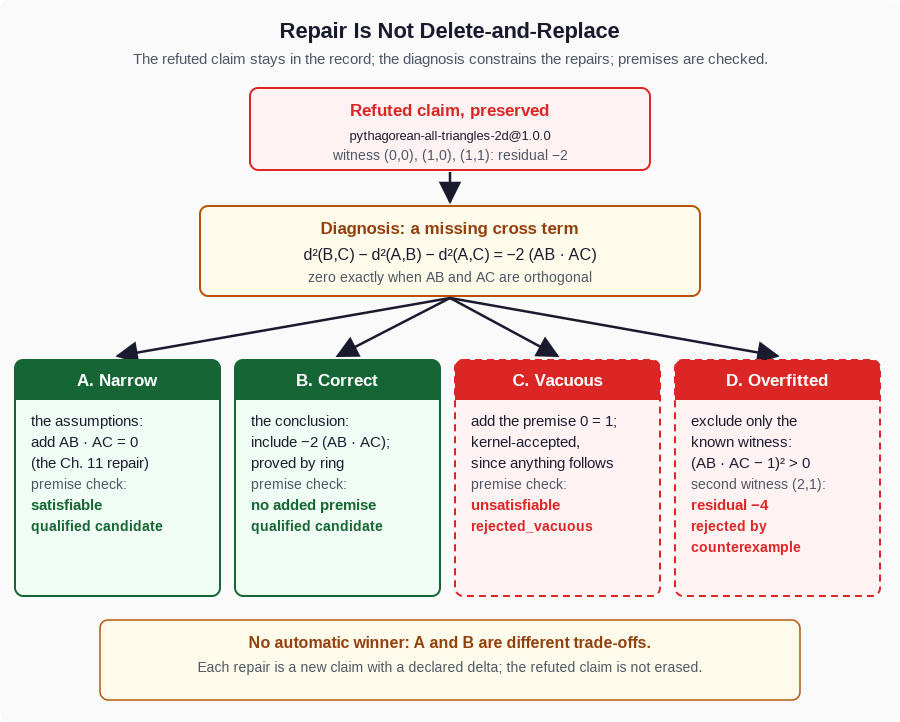
Repair is not delete-and-replace. The refuted triangle claim stays in the record; the missing cross term $-2(\vec{AB}\cdot\vec{AC})$ suggests the honest repairs A and B, while the vacuous C and the overfitted D are rejected — C by a premise-satisfiability check, D by a second witness. The figure follows the four repairs above; the kernel and satisfiability verdicts are the audit’s, not the drawing’s.
Evidence note
The triangle witnesses and both honest repairs are kernel-checked or exactly computed in the MATH01 repair records; the vacuous repair is kernel-accepted and rejected as vacuous by a satisfiability check. Lean’s total square root and division are shown by an illustrative executed file, not a versioned claim. The reading of Haraux’s derivation is ours; the paper does not settle it. The converse theorem about 2ᵐ + 1 is proved in the text, not by machine. Full standing: Part IV, evidence tables.
Exercises
- Show that 2⁶ + 1 is composite using the factorisation in the text, with k = 3 and j = 2.
- State the converse of “if a function is differentiable at a point, it is continuous there”. Give a counterexample to the converse.
- The claim “if a, b > 0 then √(ab) ≤ (a + b)/2” is true. Can the hypothesis be weakened to a, b ≥ 0? Can it be dropped? Try a = b = −1, and remember that ab = 1 there, so the square root is defined.
- A claim reads “for every real x, x/x = 1”. Restore the missing hypothesis. What value does Lean give x/x at x = 0?
- Write Haraux’s second calculation, “separation αD, closing at c, convert with γ”, as three numbered steps, and mark which step uses a premise that the three named properties do not supply.
Worked answers: Chapter 35 — Appendix A: Solutions to the Exercises (Part IV, Appendix A)#chapter-2-what-a-theorem-assumes.
Further Reading
For deeper study; not sources for the chapter’s claims.
- Nicolas Bourbaki. “The Architecture of Mathematics.” The American Mathematical Monthly 57(4) (1950), 221–232. DOI. Why read it: A classic account of how mathematical structures, axioms and domains organise theorems, useful for seeing hypotheses as part of a larger architecture rather than isolated decorations.
- David Hilbert. Grundlagen der Geometrie (Teubner, 1922). DOI. Why read it: The foundational modern treatment of axiom systems and implicit definitions, for readers who want the historical source behind the idea that a theorem’s assumptions must be stated and tested.
Next in Part II: Chapter 12, limits that do not commute, where the missing hypothesis is uniform convergence.