The Lorentz Transformation and the Interval
Where the boost comes from, which assumptions are mathematical and which are physical, why γ²(1 − v²) = 1 is not the same statement as γ = 1/√(1 − v²), what the interval's invariance does and does not say, and when the order of two events can change.
Chapter 17 used the Lorentz transformation as a tool. Chapter 4 — Two Clocks, Two Questions (Part I, Chapter 3) depended on it entirely: every coordinate in the event table came from it, and the argument there turned on what it does to simultaneity. This chapter asks where the transformation comes from, what it preserves, and what follows from that preservation. It keeps one line in view throughout: what the algebra proves, and what has to be assumed about the physical world before the algebra says anything about clocks and rods.
As in Chapter 17, we use units with c = 1. To restore c, replace v by v/c, x by x/c, and so on.
The boost
For a frame S′ moving at velocity v along the x-axis of S, the boost is
$$t' = \gamma\,(t - v x), \qquad x' = \gamma\,(x - v t).$$Two different statements about γ appear in the literature, and they must be kept apart:
$$\text{(R)}\quad \gamma^2(1 - v^2) = 1, \qquad\qquad \text{(D)}\quad \gamma = \frac{1}{\sqrt{1 - v^2}} .$$(D), with |v| < 1, implies (R). (R) does not imply (D). It has two solutions, γ = 1/√(1 − v²) and γ = −1/√(1 − v²), and nothing in (R) chooses between them. The rest of this chapter is careful about which one each result uses.
Light-cone coordinates
The cleanest way to see the boost is through the light-cone coordinates u = t − x and w = t + x. Light moving right has u constant; light moving left has w constant. Two facts follow from adding and subtracting the boost formulas:
$$t^2 - x^2 = u\,w, \qquad u' = \gamma(1 + v)\,u, \qquad w' = \gamma(1 - v)\,w .$$The boost scales each light-cone coordinate separately. Multiply:
$$u'w' = \gamma^2(1 - v^2)\,uw .$$So (R) says exactly that the two scale factors are reciprocals. At v = 3/5 and γ = 5/4 they are 2 and 1/2. The event (t, x) = (5, 3) has (u, w) = (2, 8), which goes to (4, 4), that is, (t′, x′) = (4, 0). Both intervals are 16. That is the clock C′ of Chapter 17.
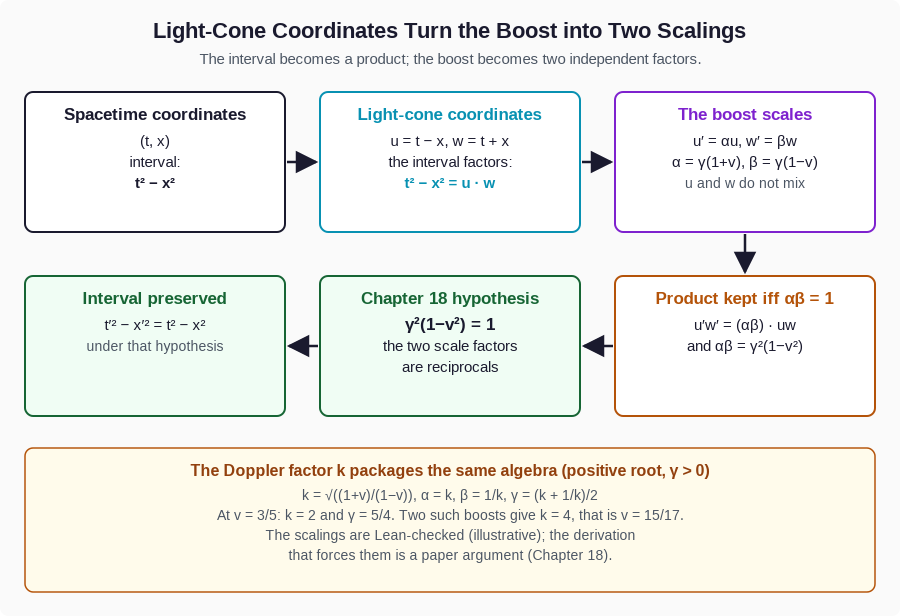
The boost as two independent scalings. In light-cone coordinates the interval is a product and the boost scales each factor; preservation is exactly the reciprocity $\alpha\beta = 1$, which is this chapter’s hypothesis (R) in another form. The Doppler-factor note records the same algebra for the positive root.
Deriving the boost, and what it assumes
The boost is not a postulate. It can be derived, but only from assumptions, and it is worth listing them, because only one of them, the constancy of the speed of light, is famous.
- Linearity. The transformation is linear. This expresses homogeneity: no point or moment is special.
- Light speed is 1 in both frames. Light lines go to light lines.
- The origin of S′ moves at v in S.
- Reciprocity. The inverse transformation is the boost with −v.
- Isotropy. The mirror image of a boost is a boost. Left and right are not special.
- Orientation. The transformation does not swap left and right or reverse the direction of time.
From these, in light-cone coordinates:
- By 1 and 2, the transformation scales u and w separately: u′ = αu, w′ = βw. (Swapping them is excluded by 6.)
- By 3, the worldline x = vt of the S′ origin satisfies u′ = w′, which gives α/β = (1 + v)/(1 − v).
- By 4 and 5, αβ = 1.
- So α = k and β = 1/k with k² = (1 + v)/(1 − v). By 6, k > 0.
- Recovering t′ = (u′ + w′)/2 gives γ = (k + 1/k)/2, and with k = √((1 + v)/(1 − v)) this is 1/√(1 − v²).
The number k is the Doppler factor. At v = 3/5, k = 2 and γ = (2 + 1/2)/2 = 5/4.
The positive sign in (D) comes from assumption 6, nothing else. Take γ = −1/√(1 − v²) instead. At v = 0 it gives t′ = −t and x′ = −x: time runs backwards and space is reflected. In general, the displayed transformation with negative γ is the positive boost followed by reversing both the time direction and the spatial orientation. It satisfies (R), preserves every interval, and is a perfectly good linear map. It is excluded here by the intended choice of orientation (assumption 6): we want frames whose clocks run forward and whose x-axes point the same way. That choice is a convention about which transformations we call boosts, not something the algebra decides.
Assumptions 4, 5 and 6 are physical claims about how frames relate. They are standard, and they are needed. Light-speed invariance alone does not give the boost.
The interval is invariant
Theorem (algebraic invariance). For real t, x, v, γ with γ²(1 − v²) = 1, the boost preserves the interval: t′² − x′² = t² − x².
The proof is the light-cone calculation above, or a direct expansion:
$$t'^2 - x'^2 = \gamma^2\bigl((t - vx)^2 - (x - vt)^2\bigr) = \gamma^2(1 - v^2)(t^2 - x^2).$$Three features of the statement deserve notice.
It does not assume |v| < 1, and it does not need to. If γ is real and γ²(1 − v²) = 1, then γ ≠ 0 and 1 − v² = 1/γ² > 0. The speed bound is a consequence of the hypothesis, not an extra one.
It holds for both signs of γ. Replacing γ by −γ leaves γ² unchanged. So this theorem is about (R), not (D), and it is true of the time-reversing transformation too. Anything that depends on the sign, such as the order of events below, needs more than this theorem.
(R) is needed for invariance at all events together, not at each event separately. Subtract:
$$\bigl(t'^2 - x'^2\bigr) - \bigl(t^2 - x^2\bigr) = \bigl(\gamma^2(1 - v^2) - 1\bigr)(t^2 - x^2).$$To preserve the interval at the event (1, 0), the first factor must be 0, so (R) is forced. But at a light-like event, where t² = x², the second factor is already 0. With v = 0 and γ = 2, the event (1, 1) keeps interval 0, while (1, 0) goes from 1 to 4. Testing only light rays would miss the failure. Chapter 10’s lesson about thin sets, again.
The gamma bridge connects the two statements:
If |v| < 1 and γ = 1/√(1 − v²), then γ²(1 − v²) = 1.
and, in the other direction, if γ²(1 − v²) = 1 and γ > 0, then γ = 1/√(1 − v²). The hypothesis γ > 0 is exactly the sign choice. Without it the converse fails.
Three kinds of separation
Because the interval s² = Δt² − Δx² is the same in every frame, its sign is too, and it sorts pairs of events into three kinds.
- Timelike (s² > 0): some clock can be present at both. Proper time between them is √(s²) along an inertial worldline (Chapter 17).
- Light-like (s² = 0): a light signal can join them.
- Spacelike (s² < 0): no signal slower than light can join them.
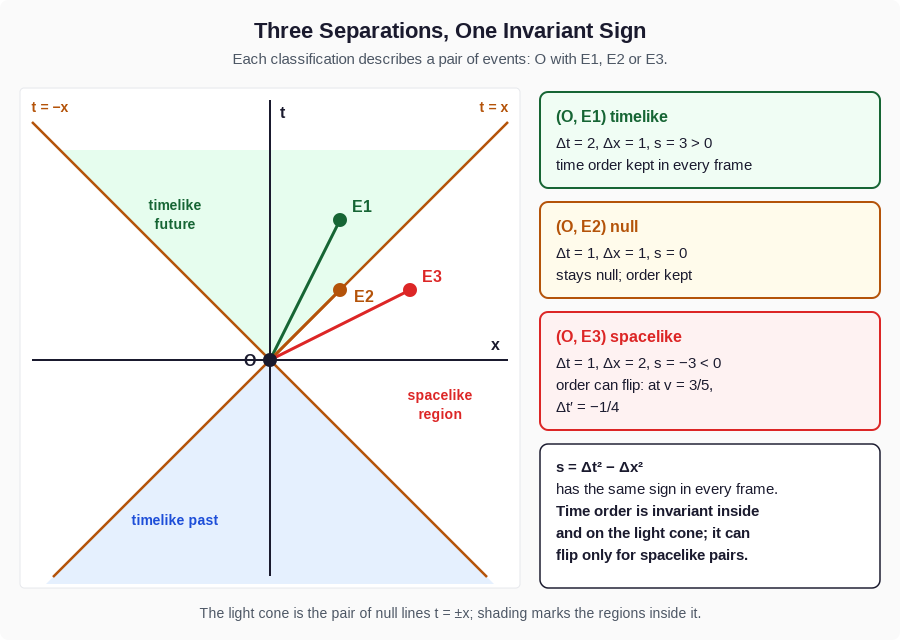
Three separations, one invariant sign. The pairs $(O, E_1)$, $(O, E_2)$ and $(O, E_3)$ are timelike, light-like and spacelike; each pair’s classification is the same in every frame. Time order is invariant inside and on the light cone and can flip only for spacelike pairs — the mechanism behind the relativity of simultaneity used in Chapter 17 and Chapter 4.
When the order of events can change
For two events with Δt > 0, the boost (with the positive sign) gives Δt′ = γ(Δt − vΔx).
- If the separation is timelike, |Δx| < Δt. With |v| < 1, this forces Δt − vΔx > 0, so Δt′ > 0 in every frame. The earlier event stays earlier.
- If the separation is spacelike, the order can change. Take Δt = 1, Δx = 3 and v = 1/2: Δt − vΔx = 1 − 3/2 < 0. In S′ the second event happens first.
Two remarks. First, the timelike result needs γ > 0. With the negative branch the order of every timelike pair reverses: the transformation reverses time orientation, which is why assumption 6 excludes it. Second, the spacelike result is the mathematical form of the relativity of simultaneity: two events that are simultaneous in S (Δt = 0, Δx ≠ 0) are spacelike-separated, and frames disagree about their order. That is the fact Chapter 17 and Chapter 4 — Two Clocks, Two Questions (Part I, Chapter 3) depend on.
The causal reading, “a cause must precede its effect in every frame, so signals cannot be spacelike”, is a physical principle. The theorem only says which orders are frame-independent.
Composing boosts
In light-cone form, boosts compose by multiplying their Doppler factors. Two boosts at v = 3/5, each with k = 2, compose to k = 4, which is v = (k² − 1)/(k² + 1) = 15/17. The velocity-addition formula gives the same:
$$\frac{v_1 + v_2}{1 + v_1 v_2} = \frac{3/5 + 3/5}{1 + 9/25} = \frac{15}{17}.$$Writing k = e^φ turns multiplication into addition. The number φ is the rapidity, and v = tanh φ, γ = cosh φ, γv = sinh φ. Rapidities add; velocities do not. Since tanh φ is always strictly between −1 and 1, composing subluminal boosts can never reach the speed of light.
From algebra to measurement
Everything above is a statement about numbers. It becomes a statement about clocks and rods only with further assumptions:
- that inertial frames exist, and that physical clocks and rods at rest in them realise the coordinates;
- assumptions 1 to 6 above;
- that an ideal clock carried along a worldline measures its proper time (Chapter 17).
These are physical hypotheses, tested by experiment, not proved by algebra. Chapter 4 — Two Clocks, Two Questions (Part I, Chapter 3) never needed them. Its question was whether a derivation shows that the mathematics contradicts itself, and that is a question about the algebra alone. Chapter 19 of this part is about the line between the two.
Evidence note
The algebraic invariance theorem is kernel-checked in Lean and in Rocq (MATH01), and so is the gamma bridge, with |v| < 1 and (D) as hypotheses. The light-cone scalings and the timelike-order result are Lean-checked as illustrations, not versioned claims; the converse of the bridge, the derivation from assumptions 1 to 6 and the rapidity facts are argued here, not machine-checked. The numerical examples are exact computations. The physical hypotheses are not claims of this book. Full standing: Part IV, evidence tables.
Exercises
- Show that (R) has exactly two real solutions for γ when |v| < 1, and none when |v| ≥ 1.
- With γ = −5/4 and v = 3/5, transform the event (5, 3). Check that the interval is preserved, and that the image happens at a negative time.
- Prove the converse of the gamma bridge: if γ²(1 − v²) = 1 and γ > 0, then γ = 1/√(1 − v²).
- Find a v with |v| < 1 that reverses the order of the events (0, 0) and (1, 2). Show that no such v exists for (0, 0) and (2, 1).
- Compose boosts at v = 1/2 and v = 1/3 with the Doppler factors, and check the result against the velocity-addition formula.
Worked answers: Chapter 35 — Appendix A: Solutions to the Exercises (Part IV, Appendix A)#chapter-9-the-lorentz-transformation-and-the-interval.
Further Reading
For deeper study; not sources for the chapter’s claims.
- Jean-Marc Lévy-Leblond. “One more derivation of the Lorentz transformation.” American Journal of Physics 44(3) (1976), 271–277. DOI. Why read it: A careful derivation from explicit physical assumptions, closely paralleling the chapter’s list of linearity, reciprocity, isotropy and orientation.
- Gregory L. Naber. The Geometry of Minkowski Spacetime: An Introduction to the Mathematics of the Special Theory of Relativity (Springer, 2012). DOI. Why read it: A mathematically rigorous treatment of Minkowski space, the Lorentz group and the invariant interval, for readers who want the geometry behind the algebra.
- John L. Synge. Relativity: The Special Theory (North-Holland, 1956). link. Why read it: A classic geometrically minded treatment of special relativity and the Lorentz transformation, with an emphasis on invariant spacetime quantities.
Next in Part II: Chapter 19, mathematics and the world: what a theorem about numbers can and cannot tell us about clocks, rods and paint.