Events, Frames and Simultaneity
Why 'at the same time' depends on who is asking, why that makes time dilation and length contraction statements about particular pairs of events, why each of two clocks can run slow relative to the other without contradiction, and what proper time is: the elapsed time along a specified worldline between specified events.
Chapter 4 turned on one fact. Two events that happen at the same time in one frame need not happen at the same time in another. The emission of the photon and the moving body’s position “at that moment” were simultaneous in the source’s frame, but not in the body’s frame, and the paper’s two collision times quietly started from different events. This chapter develops that fact properly. Almost every apparent paradox of special relativity is a version of it.
We use units in which the speed of light is 1, so distances are measured in light-seconds and speeds are fractions of c. Chapter 4 kept c explicit; setting c = 1 changes nothing but the bookkeeping.
Events and frames
An event is a point in space and time: the photon leaves the source; the photon reaches the body. An event is not a moment and not a place. It is both at once, and it is the thing every observer agrees exists.
A frame is a way of attaching coordinates (t, x) to events: an origin, a direction, a ruler and a set of synchronised clocks at rest in the frame. In an inertial frame, a body that is left alone moves at constant velocity. Two inertial frames describe the same events with different coordinates.
Three things about an event do not depend on the frame: that it happened, which worldlines pass through it, and its relations to other events, such as “this one can send a light signal to that one”. What does depend on the frame is the coordinate pair (t, x) the event receives. In particular, the time difference between two events, and whether that difference is zero, can depend on the frame.
The boost
Let frame S′ move at speed v along the x-axis of S, with the origins agreeing. The Lorentz transformation, or boost, gives the S′ coordinates of an event from its S coordinates:
$$t' = \gamma\,(t - v x), \qquad x' = \gamma\,(x - v t), \qquad \gamma = \frac{1}{\sqrt{1 - v^2}}.$$Chapter 18 of this part derives it and shows what it preserves. For now, look only at the first equation. Two events with the same t but different x get different t′: Δt′ = −γ v Δx when Δt = 0. Simultaneity in S is not simultaneity in S′. The term −γvx is the whole of the relativity of simultaneity.
(In Chapter 4 the body M moved towards the source, so its frame moved at −v, and the signs flip: t′ = γ(t + vx). The argument is the same.)
Two clocks, each slow
Take v = 3/5, so γ = 5/4. A clock C′ rests at the origin of S′. Its reading 4 happens at the event with S′-coordinates (4, 0). By the inverse boost, that event’s S-coordinates are (5, 3). So:
- In S, between the origin event O and this event B, the time is 5, while C′ advances 4. C′ runs slow. Concretely, at B the S-clock standing beside C′ at x = 3, synchronised with C by S’s convention, reads 5 while C′ reads 4.
Now a clock C at rest at the origin of S. Its reading 4 happens at the event B̃ with S-coordinates (4, 0), and S′-coordinates (5, −3). So:
- In S′, between O and B̃, the time is 5, while C advances 4. C runs slow. At B̃ the S′-clock beside C, at x′ = −3 and synchronised by S′’s convention, reads 5 while C reads 4.
Each frame finds the other’s clock slow. If both statements were about the same thing, special relativity would contradict itself. They are not. B and B̃ are different events, and each comparison also leans on a synchronisation convention: “the time in S at B” is read off S’s clocks, synchronised in S; “the time in S′ at B̃” is read off S′’s clocks, synchronised in S′. The event on C’s worldline that S counts as simultaneous with B, namely (5, 0), is not the one S′ counts as simultaneous with B. Each statement compares a clock’s reading with the coordinate time between a particular pair of events, and the two statements use different pairs.
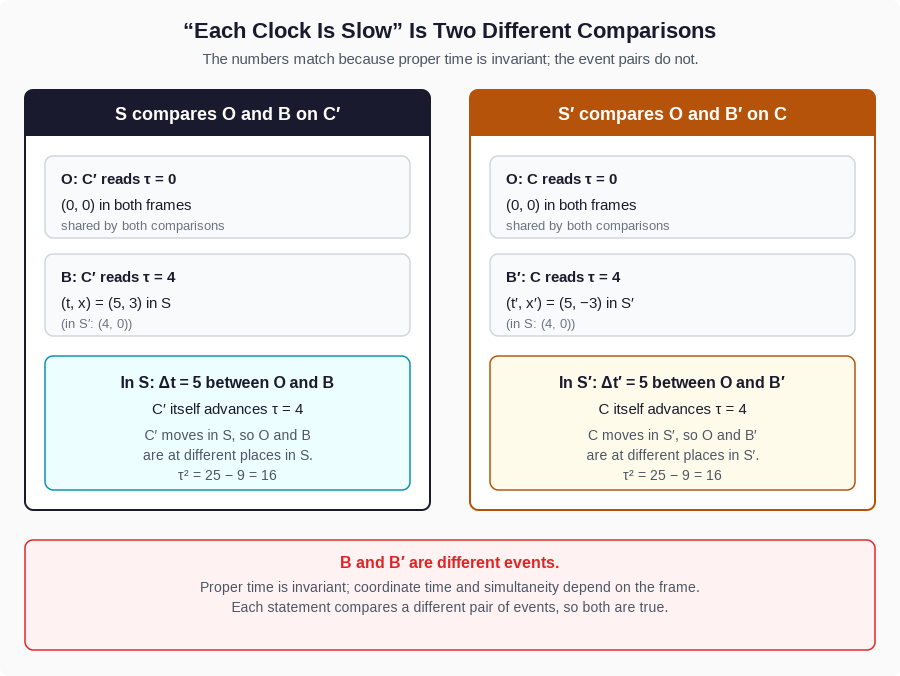
The two-clock comparison: each frame compares a different pair of events, so both statements are true. (Figure from the earlier edition, reused unchanged.)
This is the lesson of Chapter 4 in its simplest form. A comparison of times is meaningful only once you say which two events it runs between.
Where the two formulas come from
Both effects are one-line consequences of the boost, read in the right direction. The inverse boost, from $S'$ coordinates to $S$, is
$$t = \gamma\,(t' + v x'), \qquad x = \gamma\,(x' + v t').$$Time dilation. Take two events at the same place in $S'$, so $\Delta x' = 0$. Then $\Delta t = \gamma\,\Delta t'$. The events are on the worldline of a clock at rest in $S'$, and $\Delta t'$ is that clock’s proper time (defined below). This is the case in which “the moving clock runs slow” compares one clock’s proper time with coordinate time.
Length contraction. A rod at rest in $S'$ has ends separated by $\Delta x' = L_0$. Its length in $S$ is measured by marking both ends at the same $S$-time, so set $\Delta t = 0$ in the forward boost $\Delta x' = \gamma(\Delta x - v\Delta t)$. That gives $\Delta x' = \gamma\Delta x$, hence $\Delta x = L_0/\gamma$. The two end events used for the $S$-measurement are not simultaneous in $S'$; that is why the rod’s rest length is still $L_0$.
Proper time: what every frame agrees on
Proper time is defined for a specified timelike worldline between two specified events on it. In an inertial frame where the worldline has velocity v(t), with |v(t)| < c throughout,
$$\Delta\tau = \int_{t_1}^{t_2} \sqrt{1 - \frac{v(t)^2}{c^2}}\; dt .$$In this chapter’s units c = 1, and the integrand is √(1 − v(t)²). This is the flat-spacetime definition of special relativity; gravity is outside this chapter. It is what an ideal clock carried along that worldline is taken to read, which is a physical postulate, not a theorem.
For an inertial clock, v is constant and the integral collapses to
$$\Delta\tau = \sqrt{\Delta t^2 - \Delta x^2}.$$For C′ from O to B: √(5² − 3²) = 4. For C from O to B̃, computed in S′: the same. Every inertial frame gives the same value of this integral for the same worldline between the same two events. That agreement is the point.
Be precise about what is not agreed:
- Coordinate time differences Δt depend on the frame. They are bookkeeping, not clock readings.
- Different worldlines between the same two events have different proper times. A clock that leaves O, travels out and comes back to meet another at a later event reads less than the clock that stayed put. Both values are frame-independent, but they are different numbers, because they belong to different worldlines.
- Two events not joined by any timelike worldline (a spacelike pair, such as two events simultaneous in some frame) have no proper time between them.
(That Δt² − Δx² has the same value in every inertial frame is the invariance of the interval, Chapter 18.)
In Chapter 4, events A and B were both on the body M’s worldline, so the time between them in M’s frame was M’s proper time: αD/(c+v), with α = 1/γ. The paper’s “time contraction” τ = αt is correct exactly there: along M’s worldline, between events on it. Applied to the photon’s emission, an event nowhere near M, it builds in a simultaneity that the boost denies.
Time dilation, stated properly
Time dilation. If two events happen at the same place in S′ (Δx′ = 0), then their time separation in S is Δt = γ Δt′.
The condition is not decoration. It says the two events are on the worldline of a clock at rest in S′, and that Δt is the difference of their S-times. Drop the condition and the statement is false. For two events simultaneous in S′, Δt′ = 0, but Δt need not be.
Because γ ≥ 1, the frame in which the two events are not at the same place measures the longer time. Nothing has “slowed” in an absolute sense. Each clock ticks at one second per second of its own proper time.
Length contraction, stated properly
A rod’s length in a frame is the distance between its two ends at the same time in that frame. That is a definition, and it brings simultaneity in.
Length contraction. If a rod is at rest in S′ with length L₀ there, then its length in S, measured by marking both ends at the same S-time, is L₀/γ.
The derivation is in Where the two formulas come from. With L₀ = 5 and γ = 5/4, the rod measures 4 in S. The rod itself is unchanged. Its rest length is still 5. What is smaller is a different quantity, the separation of two end events that are simultaneous in S. Those events are not simultaneous in S′.
In Chapter 4, the paper’s “spatial contraction by the same factor α” applied this rule to the distance between an emission event and a moving body. There is no rod there, and no pair of simultaneous end events in the frame the rule needs. On that reading, αD would be the length in S′ of a rod at rest in S from the source to D. The paper never mentions such a rod.
What is not covered
The “twin paradox”, where one twin travels out and back, compares two worldlines that meet twice. The proper-time integral, computed in the stay-at-home twin’s inertial frame, already says which twin’s clock reads less. What this chapter does not do is describe the trip from the traveller’s point of view, which is not one inertial frame. That needs more than the inertial statements here, and it is not checked.
Evidence note
The two-clock numbers are exact computations. Interval invariance under the boost is kernel-checked (MATH01, Lean and Rocq); Chapter 4’s event table is exact computation with kernel-checked claim theorems. The proper-time integral is a definition, and that ideal clocks measure it is a physical postulate, not a theorem of this book. Full standing: Part IV, evidence tables.
Exercises
- With v = 4/5, find the S-coordinates of the event where a clock at rest at the S′ origin reads 3. What is the proper time, and what is Δt?
- Two events have S-coordinates (0, 0) and (0, 2). Find their S′ time difference for v = 3/5. Which one happens first in S′?
- Show that if Δt′ = 0, then Δt = γvΔx′. Explain why this does not contradict time dilation, whose hypothesis is Δx′ = 0.
- In Chapter 4’s notation (c = 1), check that M’s proper time from A to B is αD/(1 + v), using τ² = Δt² − Δx² with A = (0, D) and B = (D/(1+v), D/(1+v)).
Worked answers: Chapter 35 — Appendix A: Solutions to the Exercises (Part IV, Appendix A)#chapter-8-events-frames-and-simultaneity.
Further Reading
For deeper study; not sources for the chapter’s claims.
- Hermann Minkowski. “Raum und Zeit.” Physikalische Zeitschrift 10 (1909), 104–111. link. Why read it: The original four-dimensional formulation of spacetime, which makes proper time and the invariant interval central rather than incidental.
- Alfred A. Robb. A Theory of Time and Space (Cambridge University Press, 1914). link. Why read it: An early axiomatic treatment of time-space relations and simultaneity, offering a different route to the geometry the chapter develops.
- Wolfgang Rindler. Relativity: Special, General, and Cosmological (Oxford University Press, 2006). DOI. Why read it: A rigorous textbook treatment of simultaneity, proper time, time dilation and length contraction, with the physical assumptions stated explicitly.
Next in Part II: Chapter 18, the Lorentz transformation itself: where it comes from, what it preserves, and what that preservation does and does not say about the world.