Two Clocks, Two Questions
A 2024 preprint claims that special relativity contradicts itself: one collision, computed two ways, gives two different times. We reconstruct the argument, find the step where the two calculations stop measuring the same thing, and say carefully what that does and does not show.
The question
In April 2024 Alain Haraux posted the second version of a preprint titled “A Mathematical Contradiction in the Special Theory of Relativity” on the open review platform Qeios. Its claim is strong and simple. Take three properties of special relativity: the speed of light is the same in every inertial frame, moving clocks run slow, and moving lengths contract. Use them to compute when a light signal reaches a moving body, once in one frame and once by way of the body’s own frame. The two answers differ, D/(c + v) and D/c. So, the paper concludes, the three properties are logically incompatible.
A claimed contradiction is the most checkable kind of claim there is. Either the conclusion follows from the stated premises or it does not. This chapter checks, and it has to be precise about what it checks. The question is not whether special relativity is true of the physical world. It is whether this derivation shows that its mathematics contradicts itself.
The short answer is that it does not, and the reason is one of the central ideas of relativity: two calculations of “how long until the collision” can be timing it from two different starting events. The rest of the chapter makes that precise, and keeps three things apart: what follows mathematically, what is our interpretation of the paper, and what the paper leaves ambiguous.
The setup
The source. We use the paper’s version 2 (Qeios, posted 2 April 2024, DOI 10.32388/MFHAG1.2, licensed CC BY), the latest version we could locate as of 12 November 2026. Its mathematical argument is the same as version 1’s; the changes are in presentation. Six published reviews sit beside it. We pinned the paper and every review by hash, and read every sign from the rendered page, because the PDF’s text layer drops minus signs.
What the author has said since. Replying publicly to one review (Minotti, 29 April 2024), the author wrote that several colleagues had told him the same thing, and that in principle he should withdraw the preprint to avoid spreading a wrong interpretation of special relativity, but that withdrawal seemed to be impossible. That is an informal concession in a public comment. It is not a retraction: version 2 is still posted, and its abstract still claims a contradiction. So this chapter examines the published claim as it stands. It is not refuting an author who still holds it.
The scenario. One space dimension, two frames.
- Frame S is the frame of a light source at the origin O. A photon leaves O at time t = 0 and moves right at speed c.
- A body M starts at distance D from O and moves left, towards the photon, at speed v, with 0 < v < c.
- Frame S′ is M’s rest frame.
- Write γ = 1/√(1 − v²/c²) and α = 1/γ = √(1 − v²/c²).
Three events carry the whole argument:
| Event | What happens | In S: (t, x) | In S′: (t′, x′) |
|---|---|---|---|
| E | the photon is emitted at O | (0, 0) | (0, 0) |
| A | M is where it is at S-time 0 | (0, D) | (γvD/c², γD) |
| B | the photon meets M | (D/(c+v), cD/(c+v)) | (γD/c, γD) |
The S′ values come from the Lorentz transformation. Three facts follow from the table, and they are all we need:
- Light still moves at c in S′. The photon goes from (0, 0) to (γD/c, γD).
- E and A happen at the same time in S, but not in S′. In S′, A happens at t′ = γvD/c², later than E. This is the relativity of simultaneity.
- A and B happen at the same place in S′, because both are on M’s worldline. So the S′ time between them is what a clock carried by M measures.
Run it
python experiments/investigations/math-inv-02/reader_events.py --v 3/5
The script works in units with c = 1 and D = 1 and computes everything exactly (SymPy, no decimals). It prints the three events in both frames, the separation between photon and M at three different moments of M’s frame, and the two collision times, each with the event it starts from. It restates results from the full investigation record; it adds nothing new.
In the pinned image, the investigation is math-engine proof haraux, run as
shown in the introduction. It checks that the recorded kernel run of the full
investigation is present and byte-identical to its pinned manifest, reruns the
event ledger exactly at two speeds, and runs a failure control that asserts
the paper’s final step and must be refused. Its status is
historical_verified_…: the kernel evidence is imported, not re-executed.
Re-executing the kernels means the full MATH-INV-02F procedure, a much longer run outside the usual reader commands:
docker run --rm --network none -e UV_OFFLINE=1 -e MATHENV_KEEP_UNTRACKED=1 -e MATHENV_IMAGE_ID=$img `
  -v "${PWD}:/source:ro" -v "${PWD}/out:/out" `
  math-env bash experiments/investigations/math-inv-02/run_02f.sh
The reader script needs only Python and SymPy, so it runs without Docker. The
recorded full run is in
experiments/investigations/math-inv-02/kernel-runs/2026-11-13-02f-run2/.
What happened
At v = 3c/5, so γ = 5/4 and α = 4/5, the reader script gives:
| Value | |
|---|---|
| A in S′ | t′ = 3/4, x′ = 5/4 |
| B in S′ | t′ = 5/4, x′ = 5/4 |
| photon speed in S′ | 1, which is c |
| are E and A simultaneous in S′? | no |
| the paper’s initial separation, αD | 4/5 |
| photon–M separation on the slice t′ = 0 (the moment of emission) | 5/4 |
| photon–M separation on the slice t′ = 3/4 (when M passes A) | 1/2 |
| photon–M separation on the slice t′ = s* = 9/20 | 4/5 |
| T₁, from E to B | 5/8, which is D/(c+v) |
| T₂, from M’s event on slice s* to B | 1, which is D/c |
| how far apart the two start events are, in S-time | 3/8 |
The paper’s two numbers both appear. But they are not two answers to one question.
Why
Step 1: the paper’s two calculations. In frame S nothing is subtle. The gap between photon and M is D at t = 0 and closes at rate c + v, so they meet at T₁ = D/(c+v). (A closing rate of c + v between two objects in one frame is not a violation of anything. Nothing travels at c + v. It is a rate at which a coordinate difference shrinks.)
The paper then computes the meeting time a second way, through M’s frame. It takes the initial separation there to be αD, contracted “by the same factor α”. It notes that in M’s frame the photon approaches at c, so they meet after τ₂ = αD/c of M’s time. It converts back with the factor γ: T₂ = γ·αD/c = D/c. Then it compares: T₁ ≠ T₂, “for the same event in the same frame”.
Step 2: a separation needs a moment. “The initial separation in M’s frame” means the distance between photon and M at some instant of M’s frame, on what we will call a slice: a set of events that are simultaneous in S′. The paper does not say which slice it means. And because of fact 2, the two natural candidates are different instants:
- On the slice t′ = 0, the moment of emission in S′, the photon is at the origin and M is at γD. The separation is γD.
- On the slice t′ = t′_A, the moment M passes A, the photon has already been travelling for a while. The separation is D·√((c−v)/(c+v)).
Neither is αD, for any speed v between 0 and c. Both give the right answer. From either slice, the photon closes the gap at c and reaches M exactly at t′_B. And M’s own clock, run from A to B, reads αD/(c+v), which converts back to S-time as D/(c+v) = T₁. There is no second answer.
Step 3: the one slice where the paper’s numbers hold. Before concluding that the paper’s αD is simply wrong, we looked for the most favourable reading we could find. There is exactly one slice of M’s frame on which the separation is αD. It is t′ = s* = (γ − α)D/c, between the emission and A. From that slice the photon needs αD/c of S′ time to reach M, which is the paper’s τ₂. And the S-time that passes along M, from M’s event on that slice to the collision, is D/c, which is the paper’s T₂.
So on this reading the paper’s arithmetic is right. Its two times now measure:
- T₁: from the emission E to the collision B;
- T₂: from M’s event on slice s* to the collision B.
M’s event on slice s* happens at S-time −vD/(c(c+v)): before the emission, by exactly the amount T₂ exceeds T₁. They are elapsed times between different pairs of events. Of course they differ. Comparing them is like timing a race with one stopwatch started at the gun and another started a little before it, and calling the difference between their readings a paradox.
The spacetime diagram makes the mismatch visible: both times end at the collision B, but they start at different events, 3/8 of S-time apart at v = 3c/5.
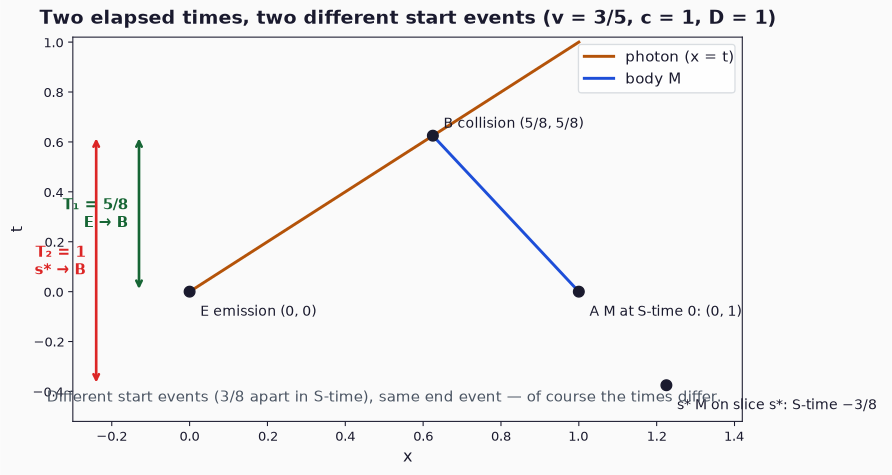
Two elapsed times, two different start events (v = 3/5, c = 1, D = 1). T₁ runs E → B ($5/8$); T₂ runs from M’s event on slice s to B ($1$). The diagram shows S-frame coordinates from the chapter’s event table; it does not show S′ simultaneity, which is the subject of Chapter 17.*
That is the heart of this chapter. Comparing two elapsed times is meaningful only when they run between the same two events. The paper’s final step (H8) treats its two times as times “for the same event”. They share an end event, the collision, but not a start event, and in relativity “the same moment” for the start depends on the frame.
Step 4: where the contradiction really comes from. Two further checks locate it exactly.
- The derivation “separation αD, closing at c, multiply by γ” gives T₂ = D/c for every value of γ. The contraction and the dilation cancel. The contradiction with T₁ does not use the Lorentz transformation at all. It comes from the premises the paper adds: that αD is the separation, and that T₁ and T₂ time the same interval.
- The paper’s own definition of M’s time, τ = αt applied to every event, cannot be squared with the Lorentz transformation for any v > 0. Event A alone shows it, because A has t = 0 but t′ ≠ 0. That rule builds in absolute simultaneity, the one thing relativity gives up.
Step 5: the three properties are compatible. Take each property in its proper scope: light speed c in every frame; the slow-clock relation for a clock carried by M; length contraction for a rod at rest in one frame seen from another. Then a single Lorentz model satisfies all three at once. The incompatibility the paper derives is between its added premises and the Lorentz transformation, not among the three properties.
What was actually checked
Every mathematical statement above was checked in the investigation record, not just argued:
- Computationally. Each was checked by exact SymPy simplification, or by the Z3 solver for statements of the form “for no v in (0, c)”. This covers the event table; the separations on both natural slices; the uniqueness of slice s*; the cancellation in T₂; the inconsistency of τ = αt with the Lorentz map; the joint model of the three properties; and a matrix of three clocks against three starting slices.
- In two proof checkers. The claims are also stated as claim-exact theorems, each with the claim’s own premises as hypotheses, and proved in Lean and in Rocq. On the pinned toolchain, all 84 authorized declarations were accepted under the theorem-identity contract (42 in each kernel), with every attack control rejected. Chapter 5 describes that contract.
- The reviewers’ claims, too. The six published reviews make their own mathematical claims, and those were checked on the same footing. Several reviewers identify the same gap as this chapter: one notes that the slow-clock relation holds only for a clock at rest in M’s frame; another that E and B are not at the same place in either frame. One review’s claim, that writing the distance in S as D − (c+v)t is itself incompatible with the Lorentz transformation, is mistaken: it is an ordinary computation in one frame. The author’s own reply to an earlier review, that c multiplied by any power of γ “will never equal” c + v, is false as stated: at v/c = (√5 − 1)/2, γ² = 1 + v/c exactly.
What this establishes
On the event table that follows from the paper’s own scenario, the paper’s two collision times measure elapsed times between different pairs of events. On the two natural readings of its “initial separation”, the separation is not αD. On the one reading where it is, the times start from different events, so the final comparison does not follow. The contradiction comes from premises the paper adds, not from the Lorentz transformation, and the three properties it names hold together in one model.
That is a statement about a derivation. It says nothing about whether special relativity describes the world. Neither does the paper’s claim: its conclusion is about the theory’s internal consistency, and that is all that is examined here.
What remains open
- What the author meant. The paper does not say which moment of M’s frame its separation αD refers to. The slice s* is a reading this investigation constructed to give the argument its strongest valid form. It is not a reconstruction of the author’s intention. On the paper’s own wording, which justifies αD as a length contraction, αD would be the length in S′ of a rod at rest in S from O to D. The paper mentions no such rod, and its separation runs between an event and a moving body. Our conclusion does not depend on which reading is right, but which reading is right is interpretation, not mathematics.
- Later versions. The chapter reports version 2, the latest found on 12 November 2026. A later version would need its own source check.
- The removed review. One review once listed on the platform now leads to a “Removed Work” page. We make no claim about it.
Try it yourself
- Run the reader script at
--v 1/2and--v 9/10. Confirm that T₂ is always D/c, and find the start event it is measured from. - On the slice t′ = t′_A, the separation is D·√((c−v)/(c+v)), not αD. Show that the photon, closing at c, still meets M exactly at t′_B.
- Show that “separation αD, closing at c, multiply by γ” gives D/c whatever γ is. What does that tell you about where the contradiction comes from?
- Take the race analogy literally. Two stopwatches, one started at the gun and one started early: which differences are paradoxes?
Worked answers: Chapter 35 — Appendix A: Solutions to the Exercises (Part IV, Appendix A)#chapter-3-two-clocks-two-questions.
Evidence record
| Reader demonstration | experiments/investigations/math-inv-02/reader_events.py, test tests/test_haraux_reader_events.py: exact, at any rational v/c |
| Source qualification | docs/research/math-inv-02/MATH-INV-02-SOURCE-QUALIFICATION.md (r1): paper v2 and six reviews pinned by hash |
| Reconstruction | MATH-INV-02-ARGUMENT-RECONSTRUCTION-r2.md (steps H1–H8; readings I-1 to I-3; SEP-SLICE-STAR, labelled as constructed) |
| Results | MATH-INV-02D-MATHEMATICAL-RESULTS.md (r3): D01–D18, D18A |
| Formal | 02F closure theorems, formal/lean/HarauxInv02Closure.lean, formal/rocq/HarauxInv02Closure.v; run 20261113T013549Z-a7525cef: investigation gate passed, 84/84 identity-bound declarations, 168/168 mutation decisions as registered |
| Reader run | math-engine proof haraux, run 20261113T232711Z-ca0a4a56 in math-env (sha256:74006085…), source commit 1f9158e: the 02F record was imported and verified (78 files); the ledger was recomputed at v = 3/5 and 9/10, and the control was refused. Record: experiments/investigations/p03-haraux/runner-runs/2026-11-13-pinned/ |
| What it establishes | The recorded computation and the 02F formal reconstruction support the reading above. The kernel evidence is imported, not rerun, and the physical interpretation is not established. |
Sources
- A. Haraux, “A Mathematical Contradiction in the Special Theory of Relativity”, Qeios, v2, 2 April 2024, doi:10.32388/MFHAG1.2 (CC BY); v1 archived as HAL hal-04529436.
- The six published reviews on the Qeios v2 page (Sauerheber; Gift, on v1; Patrinos; Parthasarathy; Gonder; Minotti), and the author’s replies on the review pages, captured 12 November 2026.
Further Reading
For deeper study; not sources for the chapter’s claims.
- Albert Einstein. “Zur Elektrodynamik bewegter Körper.” Annalen der Physik 322(10) (1905), 891–921. DOI. Why read it: The original paper in which the relativity of simultaneity and the Lorentz transformation are set out, the mathematical background against which the chapter reads Haraux’s claim.
- N. David Mermin. “Relativity without light.” American Journal of Physics 52(2) (1984), 119–124. DOI. Why read it: A compact derivation of the Lorentz transformation from the principle of relativity and homogeneity, useful for seeing exactly which assumptions the chapter’s argument needs.
- Edwin F. Taylor, John Archibald Wheeler. Spacetime Physics: Introduction to Special Relativity (W. H. Freeman, 1992). link. Why read it: A rigorous, exercise-rich treatment of proper time, simultaneity and the interval, freely available from the authors, for readers who want the standard model in full.
The mathematics behind this chapter: Chapter 17 — Events, Frames and Simultaneity (Part II, Chapter 8) (events, simultaneity and proper time) and Chapter 18 — The Lorentz Transformation and the Interval (Part II, Chapter 9) (the Lorentz transformation and the interval); Chapter 11 — What a Theorem Assumes (Part II, Chapter 2) on premises a derivation uses without stating them.
Next: Chapter 5, where our own software credited a correct proof to the wrong theorem.