Eight Investigations
Part I of Adversarial Mathematics: From First Principles — eight short mathematical investigations, each with a question, a runnable check and an honest account of what the check establishes.
This book begins with eight investigations. Each one is a single mathematical question with a definite answer, and each one comes with a check you can run.
Some of the answers are famous: a prime-number conjecture refuted by one multiplication, a proof of the four colour theorem that stood for eleven years before a small map broke it. Some are recent: a 2024 preprint that claims to find a contradiction in special relativity, and an AI-assisted formalization of an olympiad problem whose main theorem turns out to be unproved. And two are about us: a chapter on how our own software credited a proof to the wrong theorem, and a recurring discipline of saying exactly what each check did and did not establish.
The chapters are short and can be read in any order, but they are arranged so that each one adds a single idea to the ones before it.
| Chapter | The question | What it adds | |
|---|---|---|---|
| 1 | One Number Against Fermat | Is every 2^(2^n) + 1 prime? | A counterexample, and what a machine check is worth when you can check by hand |
| 2 | Continuous Terms, Discontinuous Sum | Is a convergent sum of continuous functions continuous? | An unstated hypothesis, and a proof only part of which is machine-checked |
| 3 | Two Clocks, Two Questions | Does special relativity contradict itself? | Comparing like with like; separating mathematics from interpretation |
| 4 | The Wrong Theorem | When a proof checker says yes, what has been proved? | A correct proof of the wrong statement |
| 5 | The AI Proof That Wasn’t Finished | What did the kernel accept in a published AI-assisted proof? | Assumptions hidden inside a successful check |
| 6 | The Proof That Lasted Eleven Years | Where exactly does Kempe’s proof fail? | A failure you can watch, on the original 1890 map |
| 7 | When Every Group Says Yes | Can a treatment win in every group and lose overall? | Exact arithmetic, and reading a source more carefully than its retellers |
| 8 | A Horn You Can Fill but Cannot Paint | Finite volume, infinite surface? | A formal proof whose link to geometry is a stated assumption |
How each chapter works
Every chapter has the same eight parts:
- The question, in plain words.
- The setup: the history, the source, the definitions.
- Run it: the command that reproduces the check.
- What happened: what the recorded run printed.
- Why: the mathematics behind the result.
- What was actually checked, and by what.
- What this establishes, stated as narrowly as the evidence allows.
- What remains open: sources not read, steps not checked, and questions the evidence does not settle.
The last section is not an afterthought. A result whose limits are written down can be trusted for what it is. A result whose limits are hidden cannot be trusted at all.
Those eight parts are one pass round a loop the whole book uses: the question becomes a claim, the claim is challenged and checked, and the conclusion is bounded by the evidence.
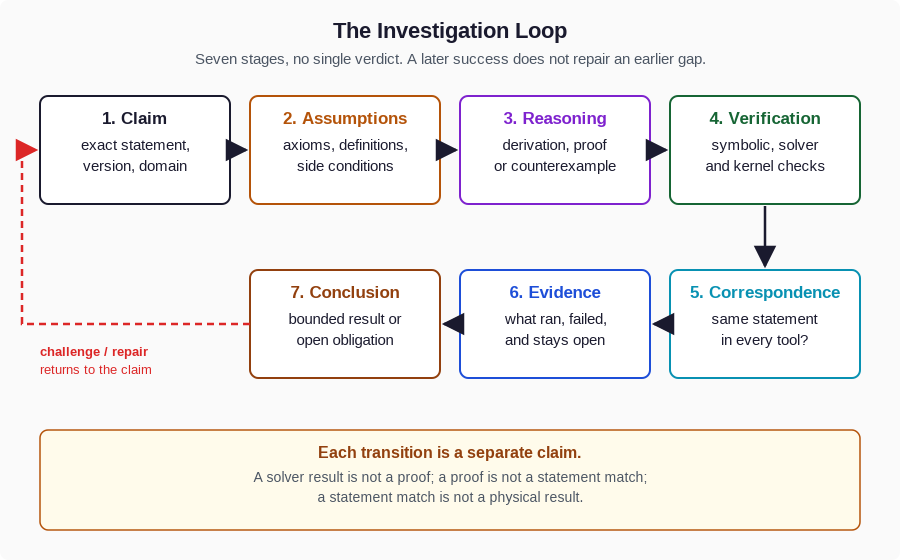
The investigation loop, the same figure as the book index. Each chapter runs it once; each transition is a separate claim, and a later success does not repair an earlier gap.
A few words used throughout
Proof checker, kernel. Lean and Rocq are proof assistants: programs in which a theorem and its proof are written precisely enough for a computer to check every step. The part that does the final checking is small, carefully written and trusted; it is called the kernel. When we say a statement is kernel-checked, we mean a kernel accepted a proof of it. Lean is used with its mathematics library, Mathlib. Rocq was formerly called Coq.
Axioms. Every proof rests on some basic assumptions. Lean reports exactly
which ones a theorem used. Three are standard. A fourth, sorryAx, means “this
step was assumed without proof”; a theorem that depends on it has not been
proved (Chapter 6).
Claim contract. Before anything runs, each investigation writes down the claim it tests: the statement in words, how it is to be read, and the exact formal statements that are supposed to express it. The run checks the contract, not whatever happens to be in the files.
Correspondence. Whether a formal statement says what the claim in words says is a judgement, not a computation. A proof checker cannot make it. The book records that judgement separately from the kernel result, against the exact version of the claim it concerns.
Status. Each run ends with one status line. Its first half says what kind of evidence this execution produced:
kernel_checked: the kernels accepted the formal statements exactly as written in the contract, in this run;computed: an exact computation gave the expected result; no proof kernel is involved (Kempe’s map);historical_verified: kernel evidence recorded by an earlier, separate procedure was imported and found byte-identical to its pinned record, and a fresh computation re-derived the chapter’s results; no kernel was run in this execution (Haraux, the Grasshopper audit).
A separate note records whether the correspondence between the formal
statement and the prose claim has been assessed. A run outside the pinned image
ends checked_unpinned instead: a rehearsal, not evidence. Imported evidence
is never relabelled as a fresh kernel run.
A status line reports what the machines did. It does not say whether the formal statement captures the claim; that judgement is separate.
Failure controls. A check that cannot fail proves nothing. So every run also makes deliberate mistakes: a wrong number, a shifted bound, a proof attached to a different statement. Each must be rejected at the place where it was made. If a mistake slips through, or is caught for the wrong reason, the run fails.
Independent computation. Alongside the proof checkers, each investigation runs an ordinary computation that shares no code with them: exact arithmetic, symbolic algebra or high-precision numerics. Each chapter says which. A computation is evidence, not proof, and is labelled as such.
Running the investigations
There are three ways to follow along, from most to least complete.
-
The full check, in the pinned environment. One container image holds the exact versions of Lean, Mathlib, Rocq and Python that produced the recorded results. The image and how to build it are in Part IV. Each chapter gives a short command such as
math-engine proof fermat; from the book’s repository, run it inside the image like this (PowerShell; in a Unix shell replace the backticks with backslashes):$img = docker image inspect math-env --format '{{.Id}}' docker run --rm --network none -e UV_OFFLINE=1 -e MATHENV_IMAGE_ID=$img ` -v "${PWD}:/source:ro" -v "${PWD}/out:/out" ` math-env uv run --offline math-engine proof fermat --out /out/proof-fermatThe first line looks up the image’s identifier, so that the run can record exactly which image produced it.
That reproduces the run: the kernels, the computation and the failure controls. The result lands in
out/proof-fermat/. All eight investigations run this way;math-engine proof --listnames them and says which kind of evidence each produces. -
The independent computations, with plain Python. Most chapters' computations need nothing but Python and SymPy. After
pip install -e .in the book’s repository, each runs with onepython -m …command, given in the chapter. This reproduces the computation, not the kernel checks. -
The recorded results. Every run in this book left a record: a
result.json, a readablenotebook.md, the logs and a list of their hashes. Each chapter names the folder. Reading the record is the minimum; it is also how you would check our claims about it.
What these chapters do not claim
Several chapters depend on transcriptions of historical sources. Those transcriptions are readings of the cited page images; where a reading is uncertain, the chapter says so. The historical interpretations are reconstructed from the cited sources, and some remain disputed. Each chapter states what the evidence does not settle.
Part II explains the mathematics behind these investigations more deeply. Part III describes the investigation system itself, including the role of AI in building it. Part IV is the reference: every command, environment and source record.
Further Reading
For deeper study; not sources for the chapter’s claims.
- Thomas Tymoczko. “The Four-Color Problem and Its Philosophical Significance.” The Journal of Philosophy 76(2) (1979), 57–83. DOI. Why read it: A classic analysis of what a computer-assisted proof does to mathematical knowledge, and why a checked proof still needs a human account of what it establishes.
- Donald MacKenzie. Mechanizing Proof: Computing, Risk, and Trust (MIT Press, 2001). DOI. Why read it: A historical and sociological study of proof assistants and the trust placed in them, useful background for the book’s separation of kernel results from human judgement.
Next: Chapter 2, a conjecture of Fermat’s and the single multiplication that refutes it.