A Horn You Can Fill but Cannot Paint
Rotate y = 1/x about the x-axis and you get an infinitely long horn. Its volume is exactly π; its surface area is infinite. Lean checks both halves, and a computer algebra system and a numerical integrator check them again.
The question
Take the curve y = 1/x for x ≥ 1 and spin it about the x-axis. You get a horn that starts with a mouth of radius 1 and narrows forever, never closing.
How much does it hold, and how much surface does it have?
Intuition says both are infinite, since the horn is infinitely long. Calculus says otherwise, and the answer splits: the volume is exactly π, and the surface area is infinite. A horn you could fill with a finite amount of paint has a surface no finite amount of paint could cover. That is the claim this chapter checks, and the last sentence is the part to be careful with.
The historical setup
The solid is Evangelista Torricelli’s. In a short work written in 1643, De solido hyperbolico acuto, and printed the next year in his Opera geometrica (Florence, 1644), he showed that the “acute hyperbolic solid”, infinitely long, has the same volume as a certain finite cylinder. Cavalieri, who received the result in a letter in December 1641, called the infinitely long solid equal to a body finite in all three dimensions “endlessly admirable”. The names Torricelli’s trumpet and Gabriel’s horn came much later.
Two things in that history matter for what we check.
- Torricelli’s theorem is about volume. The infinite surface area, the half that makes the horn famous, is the later observation. We attribute only the volume to him.
- His figure is not quite ours. He rotated a branch of a hyperbola about its asymptote, cut it with a plane and compared it, with an added cylinder, against a finite cylinder; he worked with Cavalieri’s indivisibles and also gave an Archimedean proof. We use the modern normalisation y = 1/x from x = 1, whose volume is π. We have not read his Latin; the attribution rests on secondary sources.
Run it
math-engine proof gabriel
in the pinned environment (see “Running the investigations” in the
introduction to Part I). The run compiles the Lean file
formal/lean/GabrielHorn.lean against Mathlib, checks each theorem against
the statement written in the claim contract, lists its axioms, runs an
independent computation, and then tries five deliberately wrong versions,
each of which must fail where the change was made.
Without Docker, the independent computation runs with plain Python:
python -m math_engine.proofs.gabriel_compute. The recorded run is in
experiments/investigations/p08-gabriel/runner-runs/2026-11-13-v2-pinned/;
the earlier v1 run is kept in
experiments/investigations/p08-gabriel/kernel-runs/2026-11-13-v1-pinned/.
What happened
The recorded run (contract v2) printed, as the v1 run had before it:
  Lean + Mathlib   6/6 statements accepted as written in the contract   [passed]
  Python + SymPy (symbolic integration) and mpmath (numerical check): horn_as_claimed   [passed]
  Failure controls 5/5 rejected as expected
All six statements were accepted, each using only Lean’s three standard axioms. SymPy integrated the volume exactly and got π. The numerical check computed the area of the horn cut off at x = b:
| b | area up to b | 2π log b |
|---|---|---|
| 10 | 15.177 | 14.468 |
| 100 | 29.645 | 28.935 |
| 1 000 | 44.113 | 43.403 |
| 10 000 | 58.580 | 57.870 |
| 100 000 | 73.048 | 72.338 |
| 1 000 000 | 87.515 | 86.805 |
Each tenfold lengthening adds the same amount, about 14.47 (2π log 10). The area never levels off. The five wrong versions (a volume of 2π, a wrong formula for the cut-off volume, an area bound of 3π log b, the volume theorem attached to the statement “= 2π”, and the computation told to expect 2π) were all rejected.
Why
The volume adds up discs. At position x the horn’s cross-section is a disc of radius 1/x and area π/x², so
$$V = \int_1^\infty \frac{\pi}{x^2}\,dx = \pi\Big[-\tfrac{1}{x}\Big]_1^\infty = \pi.$$Cut off at x = b, the volume is π(1 − 1/b): always less than π, and closing in on it.
The area adds up thin bands. A band at x has circumference 2π/x and a slant width √(1 + f′(x)²) dx, where f′(x) = −1/x² is the slope of the curve. So
$$A = \int_1^\infty \frac{2\pi}{x}\sqrt{1 + \frac{1}{x^4}}\,dx \;\ge\; \int_1^\infty \frac{2\pi}{x}\,dx = \infty.$$The difference between the two integrals is the difference between 1/x² and 1/x. The cross-sections shrink like 1/x², fast enough that their total is finite. The circumferences shrink only like 1/x, and ∫ dx/x is log x, which grows without bound, slowly but forever. Cut off at b, the area is at least 2π log b, which is the column in the table.
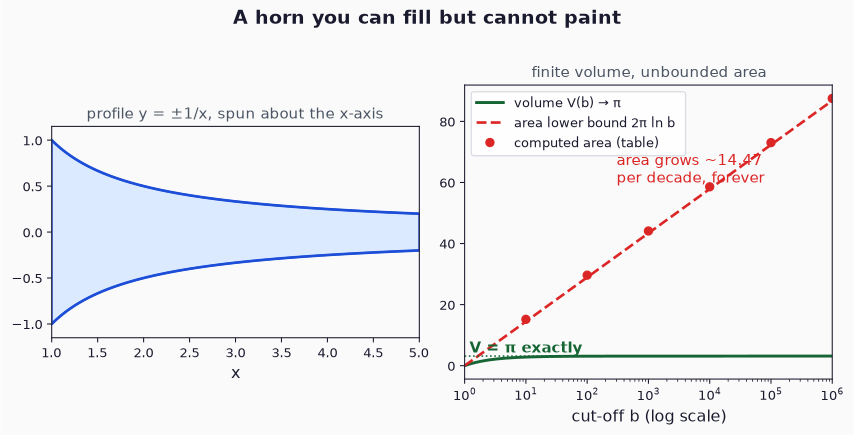
A horn you can fill but cannot paint. Left: the profile $y = \pm 1/x$ spun about the $x$-axis — the mouth has radius 1 and the tube narrows forever. Right: the cut-off volume closes in on $\pi$ while the area grows at least like $2\pi \log b$, with the computed areas from the table. The volume curve is the exact formula; the area dots are the numerical check and the dashed line its proven lower bound.
The paint. Can you fill the horn with π units of paint but never paint its inside? The mathematics says only what the two integrals say. Real paint has a thickness: a coat of fixed thickness cannot go down a tube narrower than the coat, and the horn’s radius tends to zero. And “filling” the horn already paints its inside surface, in an ever-thinner layer. The paradox is a collision between two pictures of paint, not between two pieces of mathematics. Nothing about paint was checked here.
What was actually checked
Six statements, in Lean with Mathlib:
| Statement | In plain words | |
|---|---|---|
| P01 | ∫ x in Ioi 1, π · (x⁻¹)² = π |
the volume integral is π |
| P02 | π · (x⁻¹)² is integrable on (1, ∞) |
the volume integral converges |
| P03 | for b ≥ 1, ∫ x in 1..b, π · (x⁻¹)² = π (1 − b⁻¹) |
the cut-off volume |
| P04 | for b ≥ 1, 2π log b ≤ ∫ x in 1..b, 2π x⁻¹ √(1 + ((x⁻¹)²)²) |
the cut-off area is at least 2π log b |
| P05 | that area integral tends to ∞ as b → ∞ | the area diverges |
| P06 | the slope of 1/x, squared, is ((x⁻¹)²)² | the term under the root is right |
What Lean did not check is the step from “integral” to “volume” and “area”. That the volume of a solid of revolution is ∫ π f² and its area is ∫ 2π f √(1 + f′²) is the classical formula. Mathlib has no theory of surface area for solids of revolution, so the contract states the formula as a bridge (P08-B01) rather than proving it. P06 narrows the gap by checking that the area integrand really is the formula applied to f(x) = 1/x.
There is one kernel only. The Rocq standard library has no convenient theory of improper integrals, and a weaker stand-in statement would not be a second check of the same theorem, so none is claimed.
The proofs were written before they were ever compiled. Several Mathlib lemmas have changed names over the years, so where a step depends on one, the proof tries the known names in turn. It compiled on its first run.
What this establishes
For f(x) = 1/x on [1, ∞): the volume integral ∫ π f² converges and equals π, and the area integral ∫ 2π f √(1 + f′²) diverges. Both are kernel-checked in Lean with Mathlib using only the standard axioms. The volume is confirmed by exact symbolic integration, and the area’s unbounded growth numerically.
What remains open
- The bridge. That these integrals are the solid’s volume and area is the classical formula (P08-B01), assumed, not derived.
- Torricelli’s text. Until the Opera geometrica is transcribed, the attribution rests on secondary sources, and what we say about his figure and proof is reported, not checked.
- A second kernel. No second kernel has been used.
Try it yourself
- Change the curve to y = 1/√x. What happens to the volume integral? For which exponents p does y = x^(−p) give finite volume but infinite area? (Answer: 1/2 < p ≤ 1.)
- Run the computation with
--volume 2*piand read why it refuses. - The cut-off area grows by about 14.47 per tenfold lengthening. Why exactly 2π log 10, and why does the difference from 2π log b settle down?
- Read Torricelli’s claim as Cavalieri reports it: equal to a body finite in all three dimensions. Which cylinder?
Worked answers: Chapter 35 — Appendix A: Solutions to the Exercises (Part IV, Appendix A)#chapter-8-a-horn-you-can-fill-but-cannot-paint.
Evidence record
| Investigation | P08-GABRIEL-01, claim contract v2 (sha256 9732bda4…); v1 8817fd37… |
| Run | v2: 20261113T233641Z-bf73f1ee, pinned math-env image (sha256:74006085…, Lean 4.35.0 + Mathlib), source commit 1f9158e: 6/6 statements accepted, 5/5 controls rejected. v1 (historical): 20261113T183654Z-8979732c |
| Result | v2: experiments/investigations/p08-gabriel/runner-runs/2026-11-13-v2-pinned/; v1: experiments/investigations/p08-gabriel/kernel-runs/2026-11-13-v1-pinned/ |
| What it establishes | Lean accepted the six formal statements; SymPy and the numerical check confirm the volume and the divergence. The bridge from those integrals to the solid’s volume and area is assumed. |
Sources
- E. Torricelli, De solido hyperbolico acuto (1643), in Opera geometrica (Florence, 1644). (located; Latin text not transcribed here)
- B. Cavalieri, letter to Torricelli, 17 December 1641, as quoted in secondary sources.
- J. J. O’Connor and E. F. Robertson, “Evangelista Torricelli”, MacTutor History of Mathematics archive.
- P. Mancosu, Philosophy of Mathematics and Mathematical Practice in the Seventeenth Century (Oxford, 1996), which translates the passage. (cited via secondary sources)
- Repository:
experiments/investigations/p08-gabriel/investigation.json,formal/lean/GabrielHorn.lean,src/math_engine/proofs/gabriel_compute.py.
Further Reading
For deeper study; not sources for the chapter’s claims.
- Paolo Mancosu, Ezio Vailati. “Torricelli’s Infinitely Long Solid and Its Philosophical Reception in the Seventeenth Century.” Isis 82(1) (1991), 50–70. DOI. Why read it: The authoritative historical study of Torricelli’s solid and its reception, supporting the chapter’s care in attributing the volume result rather than the infinite area to Torricelli.
- Chanakya Wijeratne, Rina Zazkis. “On Painter’s Paradox: Contextual and Mathematical Approaches to Infinity.” International Journal of Research in Undergraduate Mathematics Education 1(2) (2015), 163–186. DOI. Why read it: Examines the paint paradox and the difference between the mathematical integrals and the physical picture, exactly the line the chapter draws at the end.
The mathematics behind this chapter: Chapter 12 — Limits That Do Not Commute (Part II, Chapter 3) (improper integrals as limits) and Chapter 19 — Mathematics and the World (Part II, Chapter 10) (the paint paradox).
Next: Part II, which takes the ideas these eight investigations rely on (counterexamples, hypotheses, formal statements, correspondence) and develops them properly.