Mathematics and the World
When does a mathematical result tell us something about the world? Three separate questions: is it true under its assumptions, does it describe what we meant it to describe, and what evidence says that the description fits. Formal proof answers the first. The eight investigations show what the other two need.
Gabriel’s horn has finite volume and infinite surface area. So, the story goes, you can fill it with paint but never paint it. Both halves of the mathematics are kernel-checked in Part I. The paradox is not in the mathematics. It is in the word “paint”, which carries the result out of the real numbers and into a pot on a workbench. This last chapter of Part II is about that move, and about when it is justified.
The question is: when does a mathematical result tell us something about the world? It has three parts, and they must be answered separately.
- Is the result true under its stated assumptions? This is a question about mathematics alone.
- Does the mathematics describe what we meant it to describe? This is the question of correspondence: between a formula and a physical system, a formal statement and an English claim, a transcription and a historical page.
- What evidence supports that correspondence? For a physical model the evidence is experiment and measurement. For a historical claim it is the documents. For a statistical claim it is how the data were collected.
| Question | What answers it | What would count as evidence |
|---|---|---|
| 1. Is it true under its assumptions? | mathematics, including a kernel check | a proof of the stated proposition from stated assumptions |
| 2. Does it describe what we meant? | a person reading the formal statement against the claim, source or model | the reading and its stated reasons |
| 3. What evidence supports the correspondence? | experiment, documents, study design | measurements, page images, collection records |
The questions are distinct, but they are not independent in practice: the evidence in question 3 supports the correspondence in question 2, and question 2 is what connects question 1 to the world. A theorem can be true and still be about the wrong object; a correspondence can be well supported while the theorem beneath it is unproved.
Formal verification makes the answer to the first question very secure. It does not, by itself, answer the second or the third. Every investigation in Part I separates them, and the rest of this chapter shows how.
1. True under its assumptions
A theorem says: under these hypotheses, this conclusion holds. Chapters 10, 11, 15 and 16 are about reading that sentence exactly. When a kernel accepts a proof of the pinned statement, from the standard axioms, the first question is settled as firmly as mathematics settles anything.
What the eight investigations establish at this level is precise and limited:
- F₅ = 641 × 6700417, so “every Fermat number is prime” is false.
- A pointwise limit of continuous functions need not be continuous; a uniform one must be.
- In the Lorentz model of Chapter 4 — Two Clocks, Two Questions (Part I, Chapter 3), the two elapsed times start from different events, and the model satisfies all three properties the paper names.
- A system that attaches proofs by name can credit a proof to the wrong claim.
- In the grasshopper file, four lemmas rest only on the standard axioms, and
the main theorem rests on
sorryAx. - On the graph of our transcription of Heawood’s figure, Kempe’s double swap produces a clash.
- In the two published tables, as transcribed, the comparisons hold exactly as stated.
- The integral π∫₁^∞ x⁻² dx equals π, and 2π∫₁^b x⁻¹√(1 + x⁻⁴) dx grows without bound.
Notice how each sentence is phrased. “In the model”, “in our transcription”, “as transcribed”, “the integral”. Each is true of a mathematical object. None yet says anything about a clock, a map in an 1890 journal, a hospital or a horn.
2. Does the mathematics describe what we meant?
Between every one of those mathematical facts and the thing we care about there is a correspondence, and each is of a different kind.
A formula and a physical quantity. That π∫ f² is the volume of a solid of revolution, and 2π∫ f√(1 + f′²) its surface area, is standard calculus. It is a correspondence between an integral and a geometric quantity. The Gabriel investigation assumes it and does not prove it. Beyond that lies a second correspondence, between the geometric horn and anything made of material.
A formal statement and a mathematical claim. Chapter 15 was about this one. The wrong-theorem investigation is entirely about it: the kernel was right, and the claim it was credited to was not the claim it proved. Every kernel-checked result in Part I is tied to the exact formal statement it proves. The kernel does not establish that the statement captures the prose claim; that requires reading the two side by side.
A model and a theory. In Chapter 4 — Two Clocks, Two Questions (Part I, Chapter 3), the mathematics is a model of events and frames: real coordinates, the boost, the interval. Whether that model is special relativity’s model is settled by its definitions. Whether Haraux’s paper is reasoning about that model is a question of reading his derivation, and our reading is ours; the paper does not settle it.
One sentence, three claims: “Lorentz boosts preserve the interval” is an algebraic theorem with $\gamma$ free, a theorem about the real-number model with $\gamma$ defined, and an empirical claim about the world that no theorem settles.
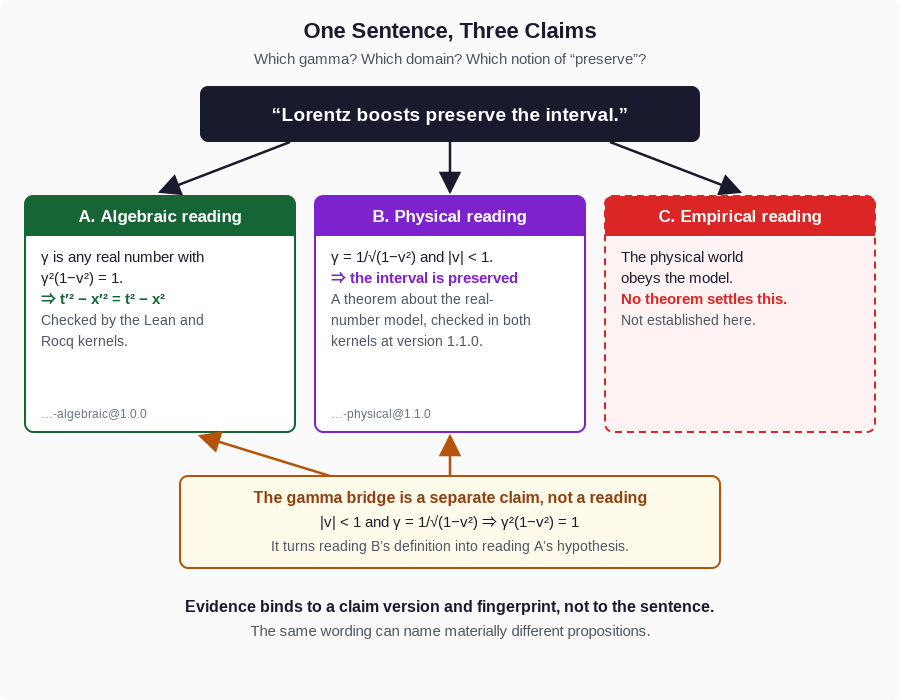
Which “preserve the interval”? The algebraic reading is kernel-checked; the physical reading adds the positive-root definition; the empirical reading is not established here. The gamma bridge is a separate claim, not a reading. Evidence binds to a claim version, not to the sentence.
A transcription and a source. Heawood’s Fig. 18 became a list of 25 regions and 69 boundaries. The investigation shows that one boundary decides the outcome: drop it, and Kempe’s step succeeds. The mathematics of the graph is checked. That the graph is Heawood’s figure depends on reading a scan correctly. The same is true of the kidney-stone counts and Simpson’s 1951 table.
A historical text and its modern reading. Cauchy’s 1821 sentence, Abel’s 1826 footnote and Cauchy’s 1853 note are in French and German, in the vocabulary of their time. Whether Cauchy’s 1821 “convergent” meant pointwise convergence, and whether his 1853 condition is uniform convergence, are questions about texts. The book gives its translations and marks them as its own.
An artifact and the claims made about it. The grasshopper investigation reports what the kernel certified about a file. What the AI system actually contributed to that file, and what the paper says about it, are separate questions, and the book does not assess them.
None of these correspondences is checked by a proof assistant, because one side of each is not a formal object. Each needs a person who reads both sides.
3. What evidence supports the correspondence?
Once the correspondence is stated, evidence decides whether it holds. The kind of evidence depends on the kind of subject.
Physical models are supported by experiment. Special relativity’s description of clocks and rods is among the best-tested ideas in physics. But that support comes from measurement: particle lifetimes, clocks flown in aircraft, the timing of signals. It does not come from the algebra in Chapter 18, and it could not. The interval theorem would be true even if nature were Galilean. A proof that the model is consistent shows only that the model can be right, not that it is.
That is why this book never says it has verified relativity, and why Part I, Chapter 4’s conclusion is exactly as large as its evidence: the paper’s derivation does not show that the mathematics contradicts itself. Whether the world is relativistic was never the question.
Historical claims are supported by documents. That Euler found 641 in 1732 rests on his paper, dated and read. That Fermat believed every such number prime rests on his letter to Frénicle, whose wording the book has not transcribed. That Landry factored F₆ in 1880 rests, for now, on two careful secondary sources. Arithmetic cannot settle any of these. The book cites them at the strength it has.
Statistical conclusions are supported by how the data arose. The arithmetic of Simpson’s paradox is exact and complete (Chapter 13). Whether open surgery or percutaneous treatment is better is a different kind of question, and the numbers in Charig’s tables cannot answer it. The study was not randomised, and the open-surgery arm pools three operations. A causal conclusion would need a design that makes the groups comparable, or a defensible model of why they are not. The book draws none.
Software claims are supported by tests that can fail. That the statement gate refuses substitution was shown by building the attacks and watching them be refused. That it refuses every possible attack is not shown. Failure controls are evidence about a checker in the same way experiments are evidence about a model: they could have come out the other way.
The paint, again
Return to the horn. The volume theorem says an integral equals π. The area theorem says another integral diverges. “You can fill it but not paint it” makes three further claims.
- That the integrals are the horn’s volume and area: the solid-of-revolution correspondence, which is sound geometry, assumed here.
- That filling with a volume π of paint is possible. Mathematically, the filling paint occupies a tube whose radius 1/x shrinks below any positive thickness.
- That painting needs infinite paint. That is true for a coat of any fixed thickness, since its volume is at least the thickness times an infinite area.
Put the second and third side by side and the paradox dissolves. Filling the horn does coat its inside, but with a coat that becomes arbitrarily thin far down the horn. Mathematical paint can do that. Real paint cannot: it is made of molecules, and it could neither fill the horn beyond the point where the tube is narrower than a molecule, nor coat it more thinly than one. With real paint, both halves of the slogan fail together. With mathematical paint, both halves hold, and there is no conflict, because a coat of shrinking thickness over an infinite area can have finite volume.
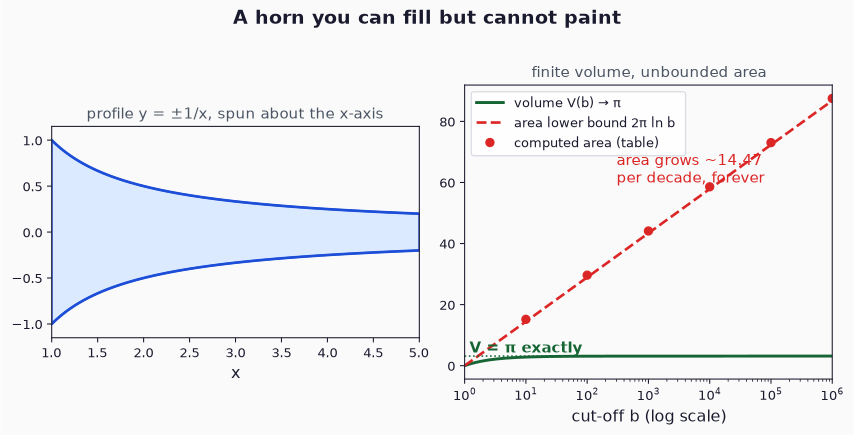
The same figure as Chapter 9, read physically. The volume curve is why a shrinking coat has finite volume; the diverging area is why a fixed-thickness coat needs infinite paint. The mathematics holds on both sides — the slogan fails at the correspondence between a geometric coat and physical paint.
The mathematics was never paradoxical. The slogan mixed one correspondence that holds (integral to geometric volume and area) with one that does not (geometric coat to physical paint).
What formal verification adds, and what it does not
A proof assistant makes the first question’s answer more reliable than any human referee can: every step checked, every axiom listed, the statement pinned. That is a large gain, and it is why this book uses one.
It adds nothing, by itself, to the second and third questions. A kernel-checked theorem about the wrong statement, the wrong model, the wrong transcription or the wrong data is still a theorem, and still about the wrong thing. That is why every investigation in this book records three things separately: what the kernel accepted, what correspondence between the formal statement and the prose claim has been established, and what sources or evidence that correspondence rests on.
Evidence note
This chapter introduces no new results. The mathematical facts it lists are established in Part I at the standing recorded there; the correspondences it discusses are examined there. The empirical support for special relativity and the causal-inference points are cited, not checked. Full standing: Part IV, evidence tables.
Exercises
- For each of the three questions in this chapter, give one example from Part I where the answer is settled and one where it is still open.
- The interval theorem would remain true if nature were Galilean. Explain why, and say what observation could tell the two apart.
- Kempe’s step fails on our transcription of Heawood’s figure. List the assumptions needed to conclude that it fails on Heawood’s figure itself.
- In Simpson’s 1951 table, which of the three questions does “the treatment helps” depend on?
- Paint the outside of the horn with a layer of radial thickness ε > 0, so that at distance x the paint fills the ring between radius 1/x and 1/x + ε. Show that the paint needed from x = 1 to x = b is at least 2πε ln b, so it grows without bound. Then fill the inside: a coat whose thickness at x equals the radius 1/x. What volume is that, and why is it no surprise?
Worked answers: Chapter 35 — Appendix A: Solutions to the Exercises (Part IV, Appendix A)#chapter-10-mathematics-and-the-world.
Further Reading
For deeper study; not sources for the chapter’s claims.
- Eugene P. Wigner. “The unreasonable effectiveness of mathematics in the natural sciences.” Communications on Pure and Applied Mathematics 13(1) (1960), 1–14. DOI. Why read it: The classic statement of the puzzle of mathematical applicability, the question the chapter turns into a discipline of separate correspondences.
- R. W. Hamming. “The Unreasonable Effectiveness of Mathematics.” The American Mathematical Monthly 87(2) (1980), 81–90. DOI. Why read it: A sharp response to Wigner that distinguishes mathematical representation from physical explanation, useful for the chapter’s three-question framework.
- Mark Steiner. The Applicability of Mathematics as a Philosophical Problem (Harvard University Press, 1998). DOI. Why read it: A book-length philosophical analysis of how mathematical models relate to the world, for readers who want to pursue the correspondence question beyond the chapter.
End of Part II. Part III turns from the mathematics to the laboratory: how the investigations are run, recorded, challenged and reproduced.