The Proof That Lasted Eleven Years
In 1879 Kempe published a proof that four colours suffice for any map. In 1890 Heawood printed a map on which one step of it fails. We transcribe Heawood's map, run Kempe's step on it, and watch the two colour swaps collide.
The question
In 1879 Alfred Bray Kempe, a London barrister and amateur mathematician, published a proof that any map can be coloured with four colours so that neighbouring countries always differ. It appeared in the American Journal of Mathematics, and it was accepted.
Eleven years later Percy Heawood, a lecturer at Durham, printed a small map with one region left blank. On that map, he showed, one step of Kempe’s argument does not do what Kempe said it does. The proof was gone. The theorem was not: four colours do suffice, but that was not established until Appel and Haken’s computer-assisted proof of 1976–77.
This chapter takes Heawood’s map from the page, turns it into data, and runs Kempe’s step on it. The failure turns out to be visible: two chains of regions that Kempe treats as separate are in fact touching.
Colour the regions of a map so that any two regions sharing a boundary line get different colours. (Meeting at a single point does not count.) How many colours are ever needed?
Four are sometimes necessary: four regions that all touch each other need four colours. The four colour theorem says four are always enough. Kempe thought he had proved it.
The setup
Kempe’s argument, as Heawood states it
Kempe’s paper has not been transcribed here, so the argument below is the one Heawood sets out on pp. 337–338 of his 1890 paper, which is the form in which Heawood refuted it.
Reduce the map. Every map has a region with at most five neighbours (a consequence of Euler’s formula). Remove it, colour what is left (by induction, the smaller map can be coloured), then put it back. If its neighbours use at most three colours, the fourth is free for it.
Kempe’s device. If the neighbours use all four, change the colouring. Take two colours, say red and blue, and a region coloured one of them. Follow every chain of red and blue regions out from it, to get a connected red-blue region of the map. Swap red and blue throughout it. The map stays properly coloured: inside the chain the two colours trade places, and the chain’s boundary touches no other red or blue region, or it would have been part of the chain.
Four neighbours. For a removed region with four neighbours this always frees a colour, and that part of Kempe’s proof is sound.
Five neighbours. Number them 1 to 5 round the removed region. With four colours among five neighbours one colour appears twice; Heawood takes 1 and 3 red, 2 blue, 4 green, 5 yellow.
- If 2 and 5 are in different blue-yellow regions, swap one: blue (or yellow) disappears from round the centre. Similarly for 2 and 4 with blue-green.
- If both fail, a blue-yellow chain joins 2 to 5 and a blue-green chain joins 2 to 4. These chains wall 1 off from 4 and 3 off from 5. So 1’s red-green region does not contain 4, and 3’s red-yellow region does not contain 5.
- Kempe then swaps both: red-green in 1’s region, removing 1’s red; red-yellow in 3’s region, removing 3’s red. Red is now free for the centre.
Heawood’s objection is exact: “though either transposition would remove a red, both may not remove both reds.”
Heawood’s map

Heawood (1890), plate, Fig. 18 (Göttingen digitisation). The letters are the colours: red, blue, yellow, green.
Heawood writes that Fig. 18 “is an actual exemplification of this possibility, where either transposition prevents the other from being of any avail”. He did not spell out how. The rest of this chapter does.
We transcribed the figure: 25 regions (counting the three rings round the outside), each with its printed letter, and 69 shared boundaries. The unlettered region, X, touches exactly five others. In order round it they are red, blue, red, green, yellow: Heawood’s 1 to 5.
Run it
The whole experiment runs with plain Python, so it needs no Docker. From the
book’s repository, after pip install -e .:
python -m math_engine.proofs.kempe_compute
python -m math_engine.proofs.kempe_compute --drop B3-Gout
In the pinned image, math-engine proof kempe runs both as one investigation
and also checks that the transcription and the program are byte-identical to
their pins. There is no proof kernel here, and the status says so:
computed_…, not kernel_checked_….
The first command runs Kempe’s step on the transcription of Heawood’s map. The
second removes the one boundary that was hardest to read, to show how much
the result depends on it. The figure in this chapter is generated from the
same data by experiments/investigations/p06-kempe/draw_chains.py.
What happened
Every step of Kempe’s argument, applied to Heawood’s map, is a finite question about a 25-region map, so a computer can answer it exhaustively. The experiment loads the transcription, runs Kempe’s step on Heawood’s own colouring, and makes eleven checks (listed below, under what was checked). All eleven come out as Heawood says. The output ends:
"both_swaps_clash": [["Gout", "Yout"]]
"both_swaps_free": ["r"]
"verdict": "kempe_step_fails_as_heawood_says"
(lightly reformatted: the program prints indented JSON). With --drop B3-Gout
the verdict is not_as_heawood_says: without that boundary, regions 2 and 4
are no longer joined by a blue-green chain, and Heawood’s premise fails.
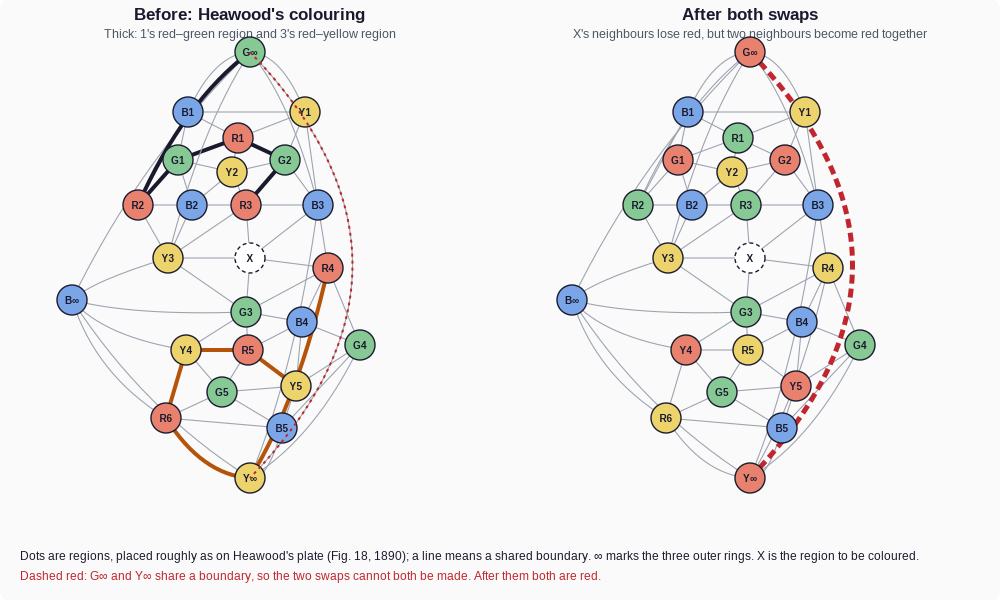
Heawood’s map as a graph: a dot for each region, placed roughly as on the 1890
plate, and a line wherever two regions share a boundary. Generated from the
transcription by draw_chains.py; it is a schematic, not a copy of the plate.
Run Kempe’s argument on Heawood’s colouring and every premise holds:
- 2 and 5 lie in one blue-yellow region, and 2 and 4 in one blue-green region, so neither of the first swaps helps.
- 1’s red-green region is R3, R1, R2, G1, G2 and the outer green ring. It does not contain 4.
- 3’s red-yellow region is R4, R5, R6, Y4, Y5 and the outer yellow ring. It does not contain 5.
So far, exactly as Kempe says. Now look at the two regions together. Neither contains a neighbour it must avoid, but they touch each other: the outer green ring and the outer yellow ring share a boundary on the right of the map.
That is the whole failure. Make both swaps at once and the outer green ring turns red (red-green swap) while the outer yellow ring turns red too (red-yellow swap). Two neighbouring regions are now both red. The centre has a free colour, but the map is no longer properly coloured.
Make the swaps one after the other instead, recomputing the second region after the first, and it is worse. After the red-green swap the outer ring is red, and 3’s red-yellow region now runs from the outer yellow ring into it, and from it to Y3, which is 5 (twelve regions in all). Swapping it turns 5 red, and no colour is freed. Either transposition, as Heawood said, “prevents the other from being of any avail”.
Why
Kempe’s argument assumed that two regions which each avoid a given neighbour also avoid each other. Nothing in his reasoning guarantees that, and Heawood’s map is a case where they do not.
Kempe was wrong; the theorem was not
The same map can be four-coloured: a direct search finds a colouring in which X is green. Fig. 18 is not a counterexample to the four colour theorem. It is a counterexample to one step of one proof.
Heawood saw what survives. In the same paper he showed that Kempe’s method, run with five colours instead of four, does work: with five colours there is always room. Five colours suffice, by an argument that fits on a page. Four colours suffice too, but no proof of that has fit on a page since.
What was actually checked
Eleven statements about the transcribed map, each computed exhaustively: the printed colouring is proper; X has five neighbours coloured red, blue, red, green, yellow; the four chain premises; that each swap alone frees nothing; that both swaps together give an improper colouring; that the recomputed second swap frees nothing; and that the whole map has some four-colouring.
This is a computation, not a kernel-checked proof. The statements are decidable; a formal proof would check the same eleven facts, not new ones.
What the computation checks is the transcription. That the transcription is Heawood’s map rests on reading the 1890 plate, which brings us to what remains open.
What this establishes
On the transcription of Heawood’s Fig. 18, Kempe’s five-neighbour step fails exactly as Heawood says: the red-green region of 1 and the red-yellow region of 3 each avoid the neighbour they must, but they touch each other along the boundary of the outer green and outer yellow rings, so the two swaps cannot both be made. The map itself is four-colourable.
What remains open
Misreading the map. Everything rests on the transcription, and a printed
1890 figure can be misread. One boundary was hard to read: between region 2
(B3) and the outer green ring, at a notch in the right-hand margin. A close
crop shows a boundary of real length, and two consistency checks support it:
69 boundaries is the most a planar map of 25 regions can have, so the map is
a full triangulation; and without that boundary, Heawood’s own premise fails.
The experiment makes the dependence explicit: drop that one boundary and the
verdict flips to not_as_heawood_says. The transcription has not been
independently checked region by region.
Inventing a counterexample. Modern books often show Kempe’s failure on later, tidier maps (Errera’s, Kittell’s). Those are useful, but they are not what Heawood printed, and attributing them to him would be wrong. This chapter uses only his Fig. 18.
Arguing with a paraphrase. Kempe’s own wording has not been checked against Heawood’s summary. If it states the step differently, the conclusion about the historical argument would need qualification.
Not kernel-checked. The eleven statements are decidable, but no Lean or Rocq proof is used here; the result is an exhaustive computation on the transcription.
Try it yourself
- Run the experiment and read its JSON: which regions are in each chain, and where do they touch?
- Run it again with
--drop B3-Gout. Which premise fails, and why does one boundary matter? - Colour the map by hand from the printed letters, remove X, and try every pair of colours at 1 to 5. Can any single Kempe swap free a colour?
- Find a four-colouring of the whole map with X coloured. (The experiment finds one with X green.) What had to change, and is it reachable by Kempe swaps at all?
- Replace red with a fifth colour for one of the swaps. Why does Kempe’s method work with five colours?
Worked answers: Chapter 35 — Appendix A: Solutions to the Exercises (Part IV, Appendix A)#chapter-6-the-proof-that-lasted-eleven-years.
Evidence record
| Contract | experiments/investigations/p06-kempe/contract.json: lightweight contract (frozen transcription, operations, conclusions); principal obligation: source correspondence with Fig. 18 |
| Transcription | experiments/investigations/p06-kempe/heawood-fig18.json: 25 regions, 69 boundaries, transcribed from the plate; not independently checked region by region |
| Experiment | src/math_engine/proofs/kempe_compute.py → kempe_step_fails_as_heawood_says; control --drop B3-Gout → not_as_heawood_says |
| Reader run | math-engine proof kempe, run 20261113T233009Z-4b4a1765 in math-env (sha256:74006085…), source commit 1f9158e: the computation passed; B3–Gout control as expected. Record: experiments/investigations/p06-kempe/runner-runs/2026-11-13-pinned/ |
| Diagram | static/images/books/math/diagrams/kempe-heawood-chains.svg, generated by experiments/investigations/p06-kempe/draw_chains.py from the same data |
| Kernel checks | None; the result is an exhaustive computation on the transcription |
Sources
- P. J. Heawood, “Map-colour theorem”, Quarterly Journal of Pure and Applied
Mathematics 24 (1890), 332–338, and plate (Fig. 18); argument on
pp. 337–338. Göttingen digitisation
PPN600494829_0024. (read; Fig. 18 transcribed) - A. B. Kempe, “On the geographical problem of the four colours”, American Journal of Mathematics 2 (1879), 193–200. (cited by Heawood; not transcribed here)
- K. Appel and W. Haken, “Every planar map is four colorable. Part I: Discharging”, Illinois Journal of Mathematics 21 (1977), 429–490; K. Appel, W. Haken and J. Koch, “Part II: Reducibility”, ibid., 491–567.
- E. W. Weisstein, “Heawood Four-Color Map”, MathWorld (used to locate the figure; not relied on).
Further Reading
For deeper study; not sources for the chapter’s claims.
- Neil Robertson, Daniel Sanders, Paul Seymour, Robin Thomas. “The Four-Colour Theorem.” Journal of Combinatorial Theory, Series B 70(1) (1997), 2–44. DOI. Why read it: The standard modern proof and simplification of the Appel–Haken theorem, showing what replaced Kempe’s argument and how the computer case analysis was reduced.
- Robin Thomas. “An Update on the Four-Color Theorem.” Notices of the American Mathematical Society 45(7) (1998), 848–859. link. Why read it: An accessible authoritative survey of the history, the new proof and the parts of the subject that remain incomplete.
- Rudolf Fritsch, Gerda Fritsch. The Four-Color Theorem: History, Topological Foundations, and Idea of Proof (Springer, 1998). DOI. Why read it: A book-length historical and mathematical treatment that sets Kempe’s and Heawood’s arguments in the longer story of the theorem.
The mathematics behind this chapter: Chapter 14 — Maps, Graphs and Colourings (Part II, Chapter 5) (planar graphs, Kempe chains and Heawood’s five-colour proof).
Next: Chapter 8, where every group of patients says yes, the total says no, and the arithmetic is exactly right.