Every, Some, None
How 'for every' and 'there exists' work, why a single witness refutes a universal claim and a thousand passing cases do not prove one, and why a counterexample to a proof step is not a counterexample to its theorem.
Part I kept meeting sentences that begin “for every”. Fermat believed that every number of the form 2^(2ⁿ) + 1 is prime. Cauchy claimed that every convergent series of continuous functions has a continuous sum. Kempe claimed that every map can be coloured with four colours, and his proof claimed that a certain recolouring step always works. Euler answered Fermat with one number, Abel answered Cauchy with one series, and Heawood answered Kempe with one map. This chapter is about why one example can be enough, and about what exactly it is enough for.
Two quantifiers
Mathematical claims are built from two quantifiers.
- For every x, P(x), written ∀x, P(x). It is true when P holds for each x in the domain, without exception.
- There exists an x with P(x), written ∃x, P(x). It is true when at least one x in the domain has P.
The domain is part of the claim. “For every real x, x² ≥ 0” is true; “for every complex x, x² ≥ 0” does not even make sense, since complex numbers are not ordered. Chapter 11 of this part is about the hypotheses that hide inside a domain.
“None” is a universal claim: “no x has P” means “for every x, not P(x)”. “There is no largest prime” is of this form. So is “no Fermat number has a proper divisor”, which is Fermat’s claim restated.
Negation swaps the quantifier
The negation of “every x has P” is “some x does not have P”:
$$\neg\,\forall x\, P(x) \iff \exists x\, \neg P(x).$$Likewise, the negation of “some x has P” is “every x fails P”. This one rule explains the asymmetry that runs through Part I:
- To refute a universal claim, exhibit one x for which P fails. That x is a counterexample, or witness.
- To prove a universal claim, you must say something about every x at once. Checking cases cannot do it unless there are finitely many of them and you check them all.
Fermat had five cases. F₀ to F₄ are 3, 5, 17, 257 and 65537, and all five are prime. Five passing cases out of infinitely many proved nothing, and the sixth, F₅ = 4294967297 = 641 × 6700417, refuted the claim. Euler’s one division by 641 settled what five confirmations could not.
Passing tests are weak evidence
Take the shear t′ = t, x′ = x + vt and the claim that it preserves t² − x². Try a few inputs. At t = 0 it holds, since x′ = x. At v = 0 it holds. At x = −vt/2 it holds too, because x′ = vt/2 and x′² = x². Someone who tests convenient inputs may conclude the claim is true. The residual, the difference between the two sides, shows why it only seems to be:
$$\bigl(t^2 - (x+vt)^2\bigr) - \bigl(t^2 - x^2\bigr) = -vt\,(2x + vt).$$It vanishes only when v = 0, t = 0 or 2x + vt = 0, a thin set. Everywhere else the claim fails. At t = 1, x = 0, v = 1/2 the residual is −1/4, and that single point refutes the claim.
The lesson generalises. The cases that pass are often the cases where something degenerates, such as a zero, a symmetry or a boundary. A good witness avoids them.
What makes a witness valid
A counterexample is only as good as its check. It must satisfy two conditions:
- it lies in the claim’s domain and satisfies the claim’s hypotheses; and
- it violates the conclusion, as shown by evaluating both sides exactly.
The first condition is where counterexamples most often go wrong. A “witness” outside the hypotheses refutes nothing. Abel’s series is a fair witness against the pointwise reading of Cauchy because each term sin(nx)/n is continuous and the series converges at every x. Chapter 12 develops both facts, and Chapter 3 records the evidence and its limits.
A second false claim shows the same pattern. “For all points A, B, C in the plane, d²(B, C) = d²(A, B) + d²(A, C)” is Pythagoras with the right angle removed. Take A = (0, 0), B = (1, 0), C = (1, 1). Then d²(B, C) = 1, while d²(A, B) + d²(A, C) = 1 + 2 = 3. The residual is −2. The repair is to restore the hypothesis “the angle at A is a right angle”, which is the subject of Chapter 11.
What a counterexample refutes
A witness refutes exactly the claim it violates, and nothing more.
- The shear witness refutes “this shear preserves the interval”. It says nothing about whether some other transformation does. Chapter 18 shows that the Lorentz boost does.
- Abel’s series refutes the pointwise reading of Cauchy’s theorem. It does not refute the uniform version, which is true and is checked in Part I.
- Heawood’s map refutes one step of Kempe’s proof: that making two Kempe-chain swaps together frees a colour without spoiling the colouring. It does not refute the four-colour theorem, which was later proved by other means.
The last case is the subtlest. A proof is a chain of claims, and each step is a claim of its own. “Every map satisfies step 4” can be false while “every map can be four-coloured” is true. A counterexample to a step shows that the proof is broken. Whether the theorem survives is a separate question.
The order of quantifiers
When a claim uses both quantifiers, their order matters. Compare:
- ∀x ∃y, y > x: “for every number there is a bigger one”. True of the reals.
- ∃y ∀x, y > x: “there is a number bigger than every number”. False.
The same letters in a different order give a different claim. In the first, y may depend on x. In the second, one y must serve every x.
This distinction is the difference between pointwise and uniform convergence, which is what Cauchy’s theorem needed. Pointwise convergence says: for every x and every ε > 0, there is an N, which may depend on x. Uniform convergence says: for every ε > 0, there is one N that works for every x. Chapter 12 shows what goes wrong when one is read as the other.
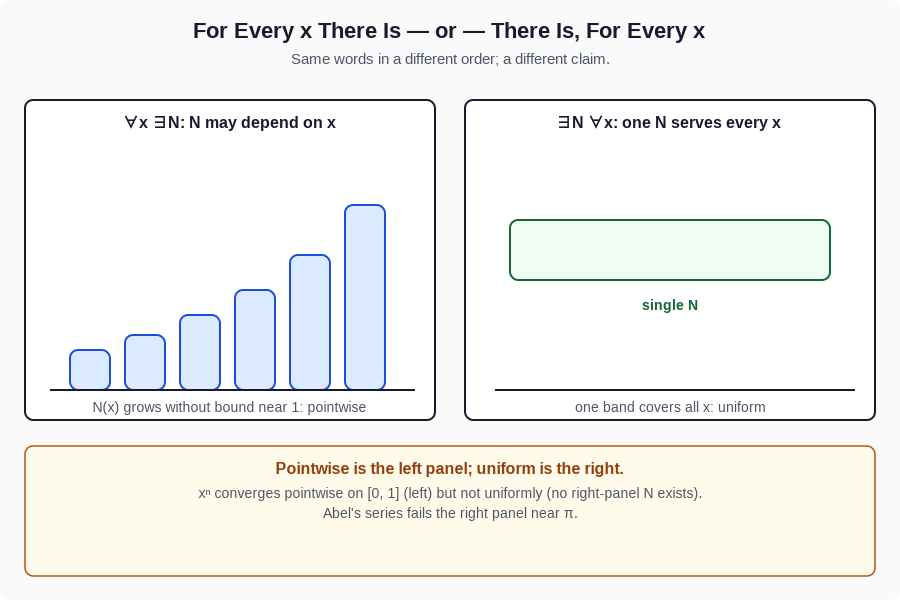
The order of quantifiers, drawn. Left ($\forall x\, \exists N$): the witness may depend on $x$, and near $1$ it grows without bound — that is pointwise convergence. Right ($\exists N\, \forall x$): one band serves every $x$ — that is uniform convergence, the hypothesis the repair needs. The bars are schematic, not computed values.
Evidence note
The two refuting witnesses (the shear, the triangle) are exact computations recorded in the MATH01 claims. F₅ = 641 × 6700417 and the xⁿ counterexample are kernel-checked in Part I. Heawood’s map is computed on our transcription, whose reading has not been independently checked. The four-colour theorem is cited, not checked. Full standing: Part IV, evidence tables.
Exercises
- Write the negation of “every even number greater than 2 is a sum of two primes”. What would a counterexample have to be?
- Find all real (t, x) with v = 1 for which the shear preserves t² − x².
- The claim “n² + n + 41 is prime for every natural number n” holds for n = 0, 1, …, 39. Find a counterexample. Which degeneracy makes it easy to guess?
- Explain why “∀ε > 0 ∃δ > 0 ∀x, |x| < δ → |f(x)| < ε” and “∃δ > 0 ∀ε > 0 ∀x, |x| < δ → |f(x)| < ε” say different things about f. Give an f satisfying the first but not the second.
Worked answers: Chapter 35 — Appendix A: Solutions to the Exercises (Part IV, Appendix A)#chapter-1-every-some-none.
Further Reading
For deeper study; not sources for the chapter’s claims.
- Imre Lakatos. Proofs and Refutations: The Logic of Mathematical Discovery (Cambridge University Press, 1976). DOI. Why read it: The classic study of counterexamples, failed proof steps and the repair of mathematical claims, a natural sequel to the chapter’s distinction between refuting a step and refuting a theorem.
- Bernard R. Gelbaum, John M. H. Olmsted. Counterexamples in Analysis (Holden-Day, 1964; Dover reprint, 2003). link. Why read it: A large curated collection of counterexamples, including uniform convergence and interchange failures, for readers who want to practise the chapter’s habits on real analysis.
Next in Part II: Chapter 11, what a theorem assumes, and how a false claim is repaired by finding the hypothesis it left out.