ALIVE — Living Technology
Building software that can help maintain and improve itself — the vision, what ALIVE has actually demonstrated, and what it has not.
Someone builds a useful application. They test it, release it, and it works. Traditionally, much of what happens next is organised around the software rather than within it: a user reports a problem, a developer investigates, a fix is written, a new version is released. The application may keep running for years, yet remain largely dependent on people outside it to improve it. It sits there and waits.
I have come to think that assumption is worth challenging. Why should an application not know when one of its operations has failed? Why should it not notice that it has become slower, or that users keep correcting the same mistake? Why should it not investigate a reported defect, try out a newly available technique, or propose a better version of itself?
Software has had monitoring, automated tests, recovery and continuous deployment for a long time. AI invented none of them. What increasingly capable AI offers is a way to connect those mechanisms with research, investigation and experimentation in a continuing process. Earlier chapters put those capabilities in the hands of the person building the software. What happens when we build some of them into the software itself?
I call the idea Living Technology: software designed not only to be built with intelligence, but to use intelligence in its continuing operation, maintenance and development. Living describes a way of developing software, not consciousness or biology. ALIVE, the project I am building towards that vision, investigates one part of it: whether retained experience can improve future work.
Give the product a pulse
The first capability is the simplest: the software should be able to tell how it is doing.
That means watching meaningful signals. How often do operations fail? How long do responses take? Which workflows break? Do users keep correcting the same output? Are there tasks the system repeatedly fails to complete? Is quality declining? The system needs to collect these observations, interpret them and show the evidence behind its conclusions.
Too often, monitoring becomes a priority only after something goes badly wrong. I would rather it were there from the start — a pulse you can take at any time.
A machine that can investigate itself
Once software can tell that something is wrong, the next step is for it to help find out why.
When an operation fails, an intelligent component can examine the logs, attempt to reproduce the failure, identify a likely cause and propose a repair. In a bounded environment, a tested, reversible, low-risk correction could be applied automatically under an agreed policy. More consequential changes would require explicit approval. Diagnosing a defect need not begin with a human programmer opening the source — Chapter 15’s argument applied to maintenance.
The same machinery can look beyond faults. A feature may work but be slow. An answer may be right but cost more than it should. A workflow may have been overtaken by a better tool. Users may keep struggling at one point in the interface. A system that can notice those things can propose experiments to address them without waiting for a bug report.
And it can look outward. The AI Frontier Scout proposed in Chapter 17 watches developments for a person. Built into an application, a similar mechanism could discover methods, libraries or models relevant to its purpose and propose trials against what it already uses. The same permissions apply: a discovery never becomes a licence to install or deploy.
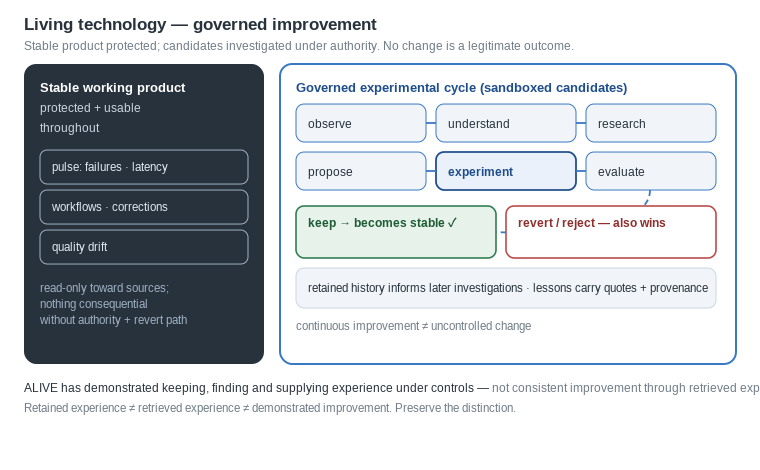
The cycle is familiar: observe, understand, research, propose, experiment, evaluate. Accept a demonstrated improvement, reject an unsuccessful candidate, or revert a change that proves harmful. It is the book’s loop again, with more of the work initiated by the product itself.
Building ALIVE
ALIVE — Adaptive Living Intelligence — is my attempt to build towards this. Its repository opens with the question that drives it: what if an AI could use the results of yesterday’s work to make better decisions tomorrow?
I wanted it because so much AI work evaporates. A conversation ends, and the decisions, failures, evaluations and useful corrections become hard to find, let alone reuse. Even a good result may leave no reliable record of what the model saw, what it did or whether it helped. ALIVE is a persistent, local-first environment that brings live model calls, approved project sources, repeatable workflows, human decisions and retained history together.
ALIVE’s documentation distinguishes capabilities by the evidence supporting them. Persistent workspaces have survived sessions and restarts in live use. Conversational research over approved project material has been demonstrated with real model calls and retained receipts. Live and pinned project sources are implemented and tested. Chapter and documentation workflows have run live, retaining proposed changes and independent assessments. Versioned runbooks have been exercised end to end on a real journey.
The limits matter too. Model-assisted capability selection is not yet qualified. A newer grouped code-review path has passed tests but not live acceptance. Indexing project history is implemented and tested offline, but has not been confirmed on real project data.
In these workflows, ALIVE has read-only access to the project’s files. It prepares and retains proposed changes rather than applying them. ALIVE is not yet self-repairing software and does not monitor and rewrite its own code. It investigates a narrower question underlying Living Technology: can experience make the next piece of work better?
What the product learns from yesterday
The distinction between retaining experience and benefiting from it is central to the project.
ALIVE retains work results and their evaluations. It has demonstrated retrieving relevant past experience and supplying it to later tasks through real model calls. But retaining a result is not learning, retrieving it is not improvement, and supplying it to a later model call does not by itself prove that the next result is better.
The evidence is mixed. In one demonstration, a second document-improvement proposal received the earlier findings explicitly and scored twenty-six out of thirty, compared with twenty for the first, under the evaluator’s rubric. That demonstrates feedback-assisted revision in this case, not automatic improvement through retrieved experience: the findings were supplied by hand. In a later controlled comparison, experience was retrieved automatically and supplied to a live request. The measured outcome was a tie. No quality advantage was demonstrated.
The LEARN-01 work addresses a more difficult question: when should a past lesson be applied at all? Its policy requires exact quotations from current, approved evidence to support a lesson. Selecting no lesson is normal, and contrary evidence can lower a lesson’s standing: a measured loss can move it from unproven to rejected. These transitions have been tested offline, and the mechanism has made one authorised live call. The controlled trial needed to assess whether this policy improves results remains unrun in the evidence reported here.
ALIVE has demonstrated that experience can be retained, retrieved and supplied under controlled conditions. It has not demonstrated consistent improvement from that experience. We have established part of the machinery; we have yet to establish its benefit. The ambition remains, and the next experiment matters precisely because the answer is not known.
Living does not mean unstable
The strongest objection to Living Technology is that continual change could undermine reliability. A system can introduce regressions, optimise the wrong measure, mistake an apparent improvement for a real one or change something users wanted left alone. It can become more expensive or expose information to services that should never have seen it.
The answer is a distinction: continuous improvement does not require continuous uncontrolled change.
A living product keeps a stable working version while it investigates alternatives. Candidates are evaluated against that version. Unsuccessful experiments are rejected, accepted changes are monitored, and reversibility is established before changes are made. The history records what was tried, what worked and why. Different changes require different permissions — a cosmetic adjustment is not a data migration. Above all, the system must be able to examine every proposal and decide to change nothing. ALIVE’s lesson policy embodies that principle in the narrower context of selecting past lessons.
These safeguards cannot guarantee indefinite improvement or eliminate every regression. They are how we pursue improvement while protecting the usefulness the product already has. Motion is not the goal. Demonstrated improvement is.
Why wouldn’t you build this?
Here is the argument I find hardest to resist.
Imagine an application with no way to notice that it is getting slower. If measuring its performance is affordable, why leave it blind? Imagine one that records failures but cannot help investigate them. Why not let it analyse its own evidence? Imagine one that keeps making the same mistake. Why not test whether a past correction can prevent its recurrence? And when a better model becomes available, why not give the application a way to investigate and test it?
Not every application needs this. A small, stable tool may already do everything it should. In safety-critical systems, changes may need to be rare, tightly controlled and independently validated. But as the cost of building these capabilities falls, more applications may benefit from them. If we can build technology that helps maintain and improve itself, that capability deserves to be considered from the beginning — not added after everything has started breaking.
Try Machine Coding — Give Your Application a Pulse
Start with your arcade game from Chapter 13, your scout from Chapter 17 or another application you have built. Give it a modest capacity to observe its own operation and retain useful evidence. This is a proposed exercise, not a report of an executed demonstration.
Understand its health.
I want this application to help me understand whether it’s working properly. Identify a few meaningful signs of its health — failed operations, responsiveness, the behaviour users actually depend on — and suggest a simple way to watch them.
Record problems.
Add a simple way to record failures and recurring problems, with enough detail to investigate them later. Collect only what is needed, exclude secrets and unnecessary personal data, and keep diagnostic records private. Show me where the records are stored and how I can inspect them.
Investigate.
Pick a known problem, or create a safe simulated failure in an isolated version. Use the application’s own diagnostic records to investigate it, distinguish observed facts from likely causes, and propose a fix. Don’t change the published version.
Test the repair.
Make a candidate fix separately from the working version. Reproduce the original failure, test whether the candidate resolves it and check for regressions. Compare the results with the working version. Tell me what the evidence establishes and what it doesn’t. Leave acceptance to me.
Look beyond faults.
Now look at the application and suggest one worthwhile improvement that isn’t a bug fix. Explain why it might help, and propose a small experiment that would show whether it does.
Keep the history.
Record the problem, the proposed fix, the experiment, the outcome and my decision. Keep the working version safe. Make the record available to a fresh maintenance session so future work can use it.
The exercise succeeds when the application records a meaningful failure, that record helps an investigation, a candidate repair is evaluated without disturbing the working version, and a fresh session can recover the evidence and decision. Rejecting the repair is a valid outcome. This is not autonomous self-improvement; it is the beginning of building maintenance capabilities into the product.
The technology grows with you
I want to build software that does not simply sit there waiting for me. Software that knows when something has gone wrong, investigates it, proposes a fix, notices when it is getting worse, finds technology that could make it better, tries those possibilities out, keeps what works and lets go of what does not — and remembers enough of all that to make tomorrow’s work better than yesterday’s.
It will still need direction, judgement, standards and an understanding of what it is for. But more of the work of sustaining and improving it can become part of the machinery itself. That changes what I aspire to build: software that can grow as its tools grow and develop as our understanding develops.
The software is no longer merely something we have built. It is something we can keep building with.
That is my ambition, and ALIVE is how I am pursuing it. It need not be yours. The last chapter is about that.