Configuring Your Coding Machine
The model is only part of the system; configure the whole machine that turns assignments into software.
Chapter 06 established how to give a machine meaningful work. Chapter 03 established how to allocate intelligence. Here I turn to the machinery that makes that intelligence useful: what must surround the model before it can turn an assignment into software? My central claim is simple:
The model is not the coding machine.
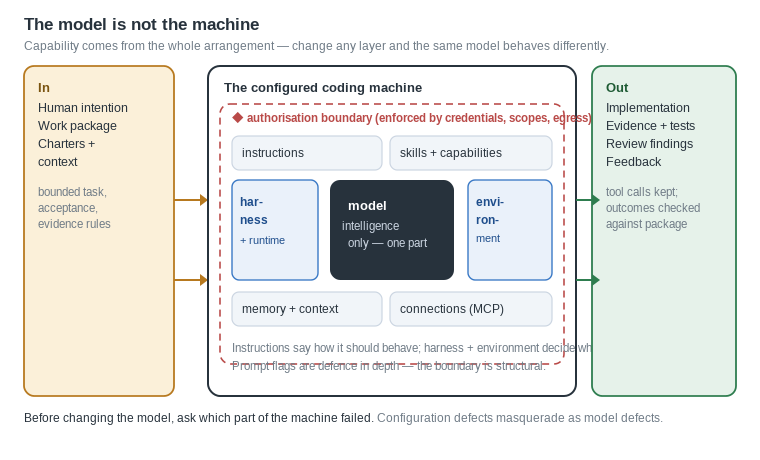
A coding machine is the model plus everything around it: instructions, accessible knowledge, installed skills and tools, external connections, the agent runtime and its execution environment, permissions, and feedback. Two agents using the same model can perform very differently on the same work package. Choosing the model is only one part of configuring intelligence; arranging the conditions under which it works can be just as consequential.
The model is not the machine
Consider what happens when I hand a work package to a coding agent. It needs project conventions, relevant context, tools to read and change files, a way to execute commands, and feedback about what happened. Remove repository access and the agent becomes an adviser. Remove test execution and its claims about passing tests become unsupported by executed tests. Remove the conventions and it may produce code that does not belong in the system.
Human intention enters as a work package. Implementation and evidence emerge from the configured machine. A well-written assignment can fail because the machine was never equipped to perform it. Before blaming the intelligence, I need to examine the conditions I gave it.
Instructions: teach the machine how this project works
Every serious coding setup needs a place where the project tells the machine
how work is done: conventions, architectural invariants, approved patterns,
test commands, code ownership, and scope. AGENTS.md is one convention for
recording this guidance — a README for agents. Supporting tools may discover
it automatically and use nested files to provide directory-specific
instructions. Discovery and precedence depend on the tool.
ALIVE’s own AGENTS.md shows what good looks like in practice, and it
does not begin with commands. It begins with direction: what the
product is for, which document governs, what to reuse before building,
what counts as evidence. Only then do the tiers of verification follow —
fast targeted checks for ordinary edits, integration checks as a
separate tier, full-suite qualification as an explicit decision, never
the default. The file even forbids its own misuse: no slow suites on a
whim, no editing the test policy to dodge it. That is instruction as
design, not instruction as accumulation.
Precedence matters as much as content. I establish how my chosen agent resolves standing repository guidance, directory-specific instructions, and explicit task directions rather than assuming every tool follows the same hierarchy. None of these instructions grants authority denied by higher-priority rules or enforced permissions. When standing instructions conflict, I resolve the conflict in the files themselves rather than hoping the machine chooses wisely.
Nor do I pour the project’s entire history into its instruction file. A repository manual loaded for every typo fix is not guidance but a tax on work that never needed it.
Instructions accumulate. A rule that helped an older, weaker model — read
three architecture documents before every edit — may become overhead once a
newer model can locate the relevant material itself. I revisit standing
prompts, skills, and AGENTS.md files as models change. Each instruction
that applies to every edit must earn its place.
I keep instructions concise, actionable, current, and grounded in the repository. I review them as carefully as code, because bad instructions can fail silently: producing slightly worse work everywhere instead of an obvious error anywhere.
Skills and reusable capabilities
Instructions guide behaviour; tools make actions possible. A reusable instruction is guidance the model follows. A tool exposes an action with inputs, outputs, and failure modes. A workflow combines actions toward a result. A governed capability exposes functionality through a defined interface with permissions attached. These distinctions matter: a machine that has read how to perform an operation does not necessarily have the means or authority to perform it.
Portable skill formats package reusable knowledge in a SKILL.md file, with
metadata, instructions, and optional scripts and references. Progressive
loading lets an agent discover the catalogue without immediately loading
every procedure. This reduces duplicated guidance and can make skills
reusable across tools. Portability, however, depends on the receiving agent:
can it discover and select the skill, load the necessary context, and
execute its scripts in the available environment? Has the procedure actually
been tested?
ALIVE’s skill_forge illustrates a governed approach: the host owns the
handlers, the model cannot register capabilities or grant itself power,
execution requires an explicit owner request, and results are bounded.
Installed is not invoked; invoked is not effective. I want evidence that a capability was selected for the right reason, used correctly, and improved the outcome. That evidence comes from retained tool calls, their inputs and results, and independent checks of what changed — not from the model’s account of its own performance. A capability without such evidence remains an unverified promise.
Connections: what the machine may touch
Connections extend what a coding machine can accomplish, but also what it can disclose or change. The Model Context Protocol (MCP) provides a standardised way to connect AI applications to tools, resources, and reusable prompts. Its details evolve, but the engineering questions endure: what is exposed, which operations are authorised, what information crosses the connection, how failures are handled, and what evidence survives the exchange.
The important distinction is authority, not plumbing. Reading an API specification is a different grant from changing production data. A failed read may leave the machine without information it needs; a failed write may have partially changed the system. Before retrying either, the machine must understand the consequences and establish what happened.
As Chapter 05 argued, credentials, scopes, and approval mechanisms enforce the boundary. Within it, I give the machine the connections its assignment requires and verify what it actually accessed. Every external dependency adds an obligation to manage, not simply another capability to celebrate.
Memory: continuity without confusion
A machine-coding project lives across sessions, and something must carry knowledge between them. Yet memory is several different things wearing one name: the current context window, retrieved documents, retained conversations, persistent memories, and authoritative repository documentation. Configuring continuity begins by distinguishing them.
The tests I apply are practical. Can a future session recover the right knowledge? Does it know where that knowledge came from — a verified decision, a model’s suggestion, an observation nobody confirmed? Can it detect that the repository has changed since the knowledge was recorded? A remembered claim is not a verified description of the current codebase; provenance, freshness, and relevance decide whether a memory is an asset or a trap. Stale knowledge, confidently applied, damages more than ignorance, which at least asks questions.
Chapter 06’s application map and package records provide continuity through provenance and updates tied to accepted changes. Even these records must be checked against the repository when freshness matters. When retained claims disagree, I return to the authoritative source rather than trusting whichever memory is newest or most confidently expressed. I record the resolution, including any uncertainty, so the next session inherits the finding rather than the argument.
The runtime: the machinery around the model
The agent harness is the machinery through which the model operates: file access, command execution, tool results, context management, branches and working directories, delegation where supported, and recovery from failure. The execution environment underneath provides resources and constrains what those operations can touch.
This is where the distinction between model capability and effective capability becomes concrete. A stronger model in a poor harness — no test execution, clumsy context handling, no recovery — can easily lose to a weaker model whose environment lets it try, check, and correct. When I evaluate an agent setup, I ask which behaviours belong to the model, which to the harness, and which to the operating environment, because each has a different remedy when it fails.
ALIVE’s Pi runner illustrates the distinction. Its source treats Pi as an untrusted child. Launch settings disable tools, extensions, skills, prompt templates, context files, sessions, MCP, and automatic approval, and request offline operation. These settings are described as defence in depth, not the security boundary.
The provider-access boundary is structural: Pi receives a run-scoped token for ALIVE’s egress rather than the real provider credential. ALIVE controls which requests it forwards. Four layers therefore perform different jobs: model instructions guide behaviour; harness restrictions limit available features; the execution environment constrains processes; and host-enforced authorisation governs provider access. The launch flags alone do not establish the guarantee.
The same scrutiny applies to less dramatic choices: which directory and branch the agent starts in, what survives a crash, and how an interrupted change is recovered or rolled back. A capable model cannot compensate for every failure of the machinery around it. Instructions describe what the machine should do; enforcement determines what it is permitted to do.
Configure for the work, not once for everything
Different tasks deserve different machines. An exploration agent benefits from broad, authorised research access and room to consider alternatives. An implementation agent needs the smallest practical scope containing the task, an executable test environment, and network access only where justified. An independent reviewer needs fresh context, original intent, the actual changes, and tools for adversarial checking, without authority to silently repair the work it is meant to judge. The same underlying model can serve all three roles, but the configured machines are quite different.
I keep two levels. The stable baseline — repository conventions, standard capabilities, the execution environment, permissions — changes slowly and deliberately. The task-specific configuration — relevant context, enabled tools, the workflow for this package, its scope, and its verification requirements — is assembled per assignment and discarded or retained on merit. The rule that holds both together: task-specific configuration must never silently weaken established safety boundaries. Convenience for this task is not a reason to widen what the machine may touch; if the task genuinely needs more authority, that is a human decision, recorded in the charter, not a flag flipped for the afternoon.
When configuration makes things worse
More configuration is not better configuration. Long instruction files bury the rules that matter. Conflicting guidance survives from earlier architectures. Irrelevant skill descriptions and unused connections consume context. Stale memories and excessive retrieval obscure the relevant facts. Permissions expand beyond the needs of the work. Each addition once seemed helpful; together they can make the machine slower, more expensive, less reliable, and less safe.
Removing configuration is an engineering improvement when the evidence supports it. When a worker ignores relevant guidance, chooses the wrong tool, or burns tokens wandering, I diagnose the failure before adding another rule. Was the assignment flawed? Was context missing? Was the wrong capability selected? Did the runtime fail, or did the model genuinely lack the necessary reasoning? A missing test runner is not a model defect; a badly designed package is not cured by installing another skill. The remedy belongs at the layer that failed.
Suppose I assign the arcade game’s restart transition to an agent in a fresh checkout. It returns a plausible diff but reports that the test command is unavailable. Before upgrading the model, I inspect the machine. The repository has a test script and the dependencies are installed, but the agent started in a parent directory where its configured test command cannot find them.
I correct the working directory within the existing permissions and rerun the assignment. Now the tests execute, and one exposes an implementation defect in the transition’s edge handling. The configuration repair has not made the code correct; it has made the defect observable. Had I changed models first, I might simply have paid more to reproduce the same environmental failure.
Before changing the model, understand which part of the coding machine failed.
Test the coding machine
Configuration becomes engineering when I compare environments on the same work. Consider the arcade-game restart task from Chapter 06. Keep the model, assignment, initial repository revision, test runner, permissions, and safety restrictions fixed. Configuration A is a minimal functioning agent with repository access and a test runner. Configuration B adds selected repository instructions, relevant skill guidance, and curated context, without granting additional tools or permissions. It may also guide or automate use of the existing runner.
Evaluate both against the same independent acceptance criteria: correctness, preserved invariants, integration success, correction effort, elapsed time, and resource use where measurable.
This is a proposed experiment, not a reported result. Repeat the comparison from clean, equivalent starting states to reduce the influence of chance. A bundle comparison can establish whether the added configuration improves outcomes on the tasks examined, but not which addition deserves the credit. Follow-up comparisons can vary one element at a time, keeping independent evaluation consistent. The first comparison tells me whether to retain the bundle; the second helps me decide what to change next. Without this distinction, a useful setting can become an excuse to keep a dozen useless ones.
A coding machine that evolves
Every coding machine changes. Models improve, yesterday’s scaffolding becomes overhead, runtimes evolve, protocols are revised, connections break, and memories go stale. Configuration is not an installation task completed once. It is an ongoing engineering responsibility.
I keep that attention cheap with two habits. First, a lightweight Coding Machine Configuration Record: the model and provider, the agent runtime and version, applicable instruction sources, available capabilities, authorised connections, relevant memory and context sources, execution boundaries, and how the setup is verified. Enough to reproduce the working machine, never a place for credentials or secrets. Second, a cycle I run whenever anything important changes — configure, test, observe, adjust, retest — against representative work packages, keeping a known-good baseline and changing one important dimension at a time where practical. A new capability is adopted because it improved a measured outcome on my work, not because it exists.
What I am maintaining is not a settings file but a correspondence between the machine I think I have and the machine revealed by its tool calls, retrieved context, and verified results. Keeping those two machines aligned is itself a modern programming skill. As the underlying intelligence evolves, so must the way I organise it.
The foundations are settled, intelligence allocated, intention discovered, the system understood, work packaged, and the coding machine equipped. Before turning to judgement and control, the next chapter steps back to consider the significance of this new relationship with technology. That is the subject of A New Approach to Technology.