Intent Before Implementation
Discover what is worth building through exploration with the machine, before specifying it.
The first three chapters established the method, its foundations, and the allocation of intelligence. But before I can put any of that to work, I face a more creative question: what do I actually want to build?
My starting position is deliberately strong:
If you can get it into words, the AI can build it.
That is my practical conviction after sustained machine coding, not a guarantee of feasibility or correctness. Words cannot overcome physical limits, missing information, permissions, cost, or the limits of the machine itself. But translating an idea into source code is no longer the obstacle it once was. I can explore a concept with the same kind of intelligence that will help me implement it. Increasingly, the difficulty I encounter is not writing the code but discovering what I want to say.
That changes the creative process. I no longer need to know exactly how to implement something before beginning to explore whether it should exist.
Start with the gap
My starting point is rarely a specification. It is usually a perceived gap: a repeated frustration, a missing tool, two capabilities that ought to be combined, or a problem that has become solvable in a way that was not practical before.
Knowing that something ought to exist is different from knowing what form it should take. The first is enough to begin a conversation; discovering the second is the creative work.
Intent is personal
That starting thought comes from my own experience, imagination and interests. It might be a technical irritation, a business opportunity, an artistic idea or simple curiosity. Turning it into a product specification too early risks closing off the very possibilities I want to explore.
The machine can suggest problems as readily as solutions, but it cannot decide on my behalf which ones matter to me. The purpose of exploration is not to surrender that choice to the AI. It is to enlarge the range of possibilities from which I can choose. My relationship with the problem is the compass; the machine helps me survey the terrain.
The AI’s tendency to converge
I encounter a recurring pattern when exploring an idea with an assistant. I offer an incomplete thought and receive a proposed solution, an architecture, a project plan, a suggested stack — and an offer to begin coding.
All of that may be useful later. But if I have not yet understood the problem, a plausible solution can become an anchor around which the rest of the conversation revolves. In my experience, assistants too often express helpfulness through completion, precisely when I need them to keep the question open.
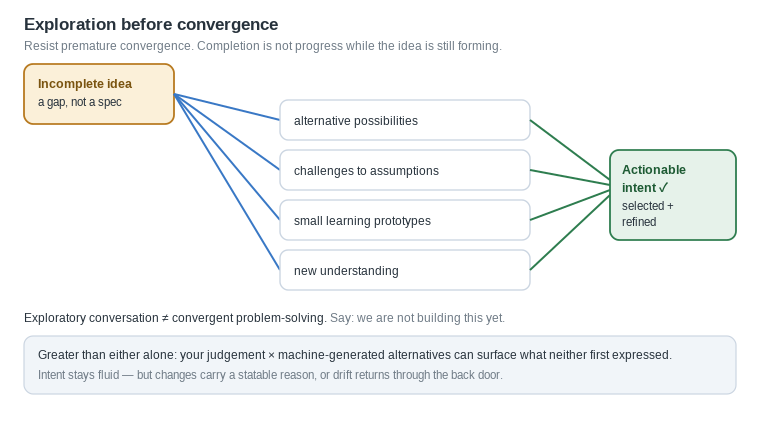
The skill is distinguishing exploratory conversation from convergent problem-solving, and knowing which one I am in. In exploration I need to be able to say: we are not building this yet; we are trying to understand what it could become. Progress means discovering possibilities, not closing them down. Premature convergence is its quietest enemy.
Explore widely before narrowing
I begin with the idea and give the machine the context that makes it meaningful: the surrounding problem, existing solutions, relevant experiences and constraints. Then I ask it to go beyond my description rather than merely execute it.
The questions I find most productive challenge the boundaries of the idea. What have I overlooked? Is this the real problem or a symptom? What could become possible if the original limitations were removed? How would a different user approach it? Is there a simpler solution? What might invalidate the entire concept?
Sometimes the machine should challenge the idea rather than extend it. The measure of a good exploratory session is how much my understanding has changed, not how much text has been produced.
The greater of the two
In a good session, I bring intent, judgement, experience and a sense of what matters. The machine generates alternatives, connects ideas and explores possibilities I had not considered. My original concept may be incomplete and the machine’s first proposal unsuitable. Through conversation, a third possibility emerges that neither of us initially expressed.
That is the outcome I seek: something greater than my original idea and greater than the machine’s original suggestion. I still decide what survives. The machine should neither amplify my idea uncritically nor substitute its direction for mine. I think of this as dreaming something into being — a conversation in which the idea itself becomes better before we attempt to build it.
Context is the raw material
Exploration depends on what the machine knows about the problem. My motivation, existing software and workflows, previous failures, technical constraints, examples, relevant research and rejected ideas all help it see possibilities that a bare request would conceal.
More text is not the same as better context. I have watched sessions degrade as irrelevant material accumulated. I curate what the machine receives and preserve what the conversation discovers: decisions, rejected alternatives and open questions. Exploration produces knowledge worth keeping. Without that continuity, the next conversation may spend its intelligence rediscovering what the last one established.
Throw something against the wall
Eventually exploration needs contact with reality. I ask the machine to produce something small and concrete: an interface sketch, a sample interaction, a simple data model, a simulation or a deliberately limited proof of concept.
The purpose is often to discover what I want, not to begin final implementation. A prototype may reveal that the original idea is less useful than expected, or that an overlooked corner of it is the valuable part. I distinguish building to learn from building to finish. A discarded prototype can be a successful experiment if it changes my understanding.
But experimentation needs a question and a decision. When I have learned enough to choose a direction, I choose.
Intent is not fixed
Requirements are often established before development and then managed as changes arise. In machine coding, I find that intent itself can continue to develop as I see what the machine can build. A feature may suggest an entirely different product. An architectural limitation may prompt a better design. A disappointing prototype may expose a false assumption.
Changing intent is not automatically a failure of planning. It can be evidence that the human and the machine are discovering a better product together.
There is a difference between learning and scope drift. I change direction when new understanding justifies it, not simply because the machine suggests another feature. I record why the intention changed as well as what changed. Otherwise discarded ideas have a habit of returning in different words.
ALIVE — a changing intention
ALIVE offers a documented example of an intention developing through the work itself.
The earliest commits, from 26 October 2026, show a persistent runtime, dashboard and browser integrations, an identity and event log, and a cognitive loop with attention handling and model-driven investigation. The First Contact qualification and frozen comparisons with spending governors reflect the early emphasis: bounded autonomous cognition and the question of whether experience could improve subsequent work. The README retains an important distinction: experience retrieval has been demonstrated; consistent quality improvement has not.
Development exposed problems the early design had not resolved. Independent audits required corrections to credential handling and invocation lifecycle. An adaptation comparison returned negative results. Evaluation limits were recorded. These discoveries redirected effort, but not every correction represented a change of purpose.
The charter of 3 November records a more fundamental shift. ALIVE was no longer framed primarily around what its models could accomplish. It was framed around a persistent intelligence environment in which work and accumulated understanding survive conversations, models and restarts. Work became primary, chat secondary. Continuity itself became the product.
I cannot identify the precise moment that understanding changed, or attribute it to any single discovery. What the dated records establish is the direction of travel: from what the models can do towards what the work retains.
Two other developments illustrate different kinds of change. On 30 October, the production runtime was separated from the research harness: one system for real work, another for experiments, each with its own rules. That architectural decision is consistent with the emerging purpose, although the records do not establish that the later charter caused it.
On 4 November, version 2 of the DEMO-01 protocol narrowed the demonstration’s claim. The implemented route produced review items, not a recoverable revised document, so the claim of producing an improved document was withdrawn. That was a correction to what the evidence supported, not a change in the product’s purpose.
These distinctions matter. A project can change what it is for, how it is built, or what it can legitimately claim to have achieved. The first is a change of intent; the others may be responses to engineering or evidence. ALIVE has a runtime, dashboard, workflows and independent review, but its full charter and the demonstration of consistent learning improvement remain ambitions. Adding functionality is not the same as discovering a new purpose.
A practical exploration session
Consider a reconstructed, simplified exploration session. It is not a transcript; its purpose is to show how an ordinary conversation can change the idea being explored.
I begin with a gap: reviewing long documents, I keep losing track of which claims I have already checked and what changed since. “I waste time re-verifying passages in revised reports. I want something that remembers what was checked.”
A machine rushing towards implementation might propose an architecture. In an exploratory conversation I want questions instead. What does “checked” mean — read, verified against a source, or approved? Where do the documents live? Is the unit a passage, a claim or a figure? Do I need the evidence itself or can I trust a verdict? What have I tried before, and why did it fail?
Suppose I answer: I need the evidence, not the verdict. The documents are versioned reports, the unit is the claim, and a previous spreadsheet failed because nobody maintained it. The machine proposes a status ledger: every claim marked checked, pending or failed. I push back. A status without supporting evidence recreates the problem I had with the spreadsheet. A green badge I cannot audit is worse than no badge at all.
The machine reconsiders: what if the system shows the evidence or its absence rather than simply marking a claim as checked? It offers three possibilities: a claim ledger tied to document revisions, a recheck driven by differences between versions, and a review queue that assigns verification as work. It also challenges the assumption that every claim deserves equal scrutiny.
The idea that survives is narrower and more valuable than my opening sentence: retain the evidence against pinned sources, recheck claims when either the claim or its supporting evidence changes, and say plainly when evidence is missing. Neither my initial idea nor the machine’s first proposal contained that design. The machine supplied alternatives and objections; I decided which failure mattered. The conversation changed what I chose to build.
The exploration-to-implementation boundary
Exploration may end with a better idea, a narrower problem, an informed rejection, a decision to defer, or an experiment that reveals what to investigate next. Any of these can be worth more than a hasty implementation. The distinction is between accumulating conversation and acquiring understanding.
When I know enough to choose a direction, I record the gap, why it matters, who benefits, the desired behaviour, the alternatives considered, the constraints and the questions still open. This is not yet an implementation specification, but it gives the designers something more valuable than a vague request: a purpose and the reasoning behind it.
The handoff matters in both directions. The designers and implementers who follow should not silently replace my purpose; they work from the recorded intent, and the acceptance criteria trace back to it. Conversely, when implementation reveals new possibilities — and it will — those return to the intent conversation rather than entering the product as unapproved changes. The boundary is permeable to learning and closed to drift.
The Intent Record
I keep this lightweight: a short Markdown document, a thinking aid rather than a bureaucratic gate, cheap enough to revise when I change my mind.
The gap: what problem or opportunity started this?
Why it matters: why do I want to solve it?
Current intention: what is the product expected to become?
Explored possibilities: which alternatives were considered?
Decisions: what was chosen, and why?
Open questions: what remains uncertain?
Changes in intent: what changed, when, and why?
Next exploration: what should be investigated before implementation?
If maintaining it becomes a burden, simplify it; a stale record that nobody trusts is worse than a brief one that stays current.
When exploration goes wrong
Exploration goes wrong in two opposing ways: we choose too early, or we never choose at all. The machine flatters instead of challenging; I fall in love with the first workable prototype; conversations multiply while decisions remain open. Other failures compound these: irrelevant context buries the problem, suggestions are mistaken for facts, scope expands without regard to cost, and discarded ideas are repeatedly reconsidered.
I return to the original gap and ask whether the current direction still addresses it. The Intent Record helps me reconstruct why I chose this path, challenge those reasons where necessary, and decide whether to continue or change direction.
Intent keeps moving
This process is not confined to the project’s beginning. A project cycles through exploration, design, implementation, review, and operation — then returns to exploration when new information appears. I have spent weeks discovering better formulations of an original idea long after implementation started, and that is not a defect in the method.
This is why the Foundation Charter and the Intent Record complement each other. The foundations provide stability while the purpose develops. I can reconsider what the product should become without reopening every decision about the database or deployment. If a new intention genuinely requires different foundations, I revise them deliberately.
Communication becomes creation
Describing something to a sufficiently capable machine is becoming part of creating it. I bring an intention into language; the machine helps me explore, challenge and enlarge it; experiments change my understanding. Eventually the idea takes the form of a design that the machine can help turn into software.
That is an extraordinary opportunity for people with ideas who do not wish to devote their lives to implementing every detail. The ability to imagine, communicate, judge and verify increasingly determines what they can create.
If you can get it into words, you have already begun building it.
The next chapter takes that discovered intent into the world where it must become software: the system the machine needs to understand, the contracts it must honour, and the evidence it must produce.