A New Approach to Technology
From operating technology to directing it: amplification, compression, and machine coding.
The previous chapters built a method: foundations, configured intelligence, discovered intent, an understood world, bounded work packages, an equipped machine. Now I want to step back from the method and consider what it means. I believe we are seeing a change in humanity’s relationship with technology itself, and machine coding is one early instance of it.
The purpose of machine coding is not to make the programmer perform more operations. It is to make more of those operations unnecessary.
The Mountain of Clay
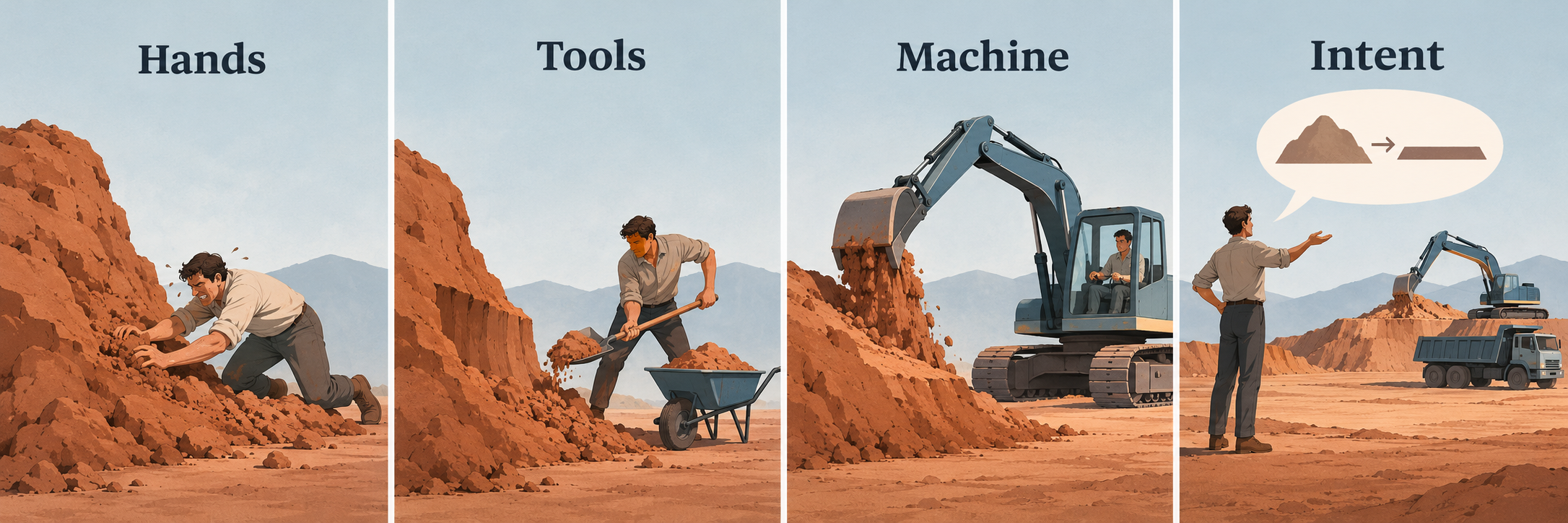
Imagine a mountain of clay that must be moved. One person works with bare hands: honest effort, strictly limited capacity. A second brings a shovel and a wheelbarrow — the same human strength amplified by levers and wheels. A third operates an excavator, moving in an afternoon what might otherwise take weeks.
The goal never changed. What changed was the technology between the intention and the result — and with it, the human’s role. The first person does the work directly. The second uses tools to multiply physical effort. The third operates machinery whose power dwarfs their own, through controls they had to learn and ground conditions they had to understand.
Now imagine a fourth possibility. The person describes the desired excavation, where the clay should go and what must be preserved. The machine works out much of the operation itself, asks for clarification where necessary, and reports what it did. The human directs the work without operating every control.
The years spent mastering the excavator represent genuine skill. Some of that skill, particularly the knowledge of what makes an excavation safe and sound, remains valuable. But mastery of the controls is no longer the same prerequisite in this imagined fourth stage. What gains importance is knowing what the finished work should look like, communicating it and recognising whether it has been achieved.
This is a metaphor, not a prediction about autonomous excavators. The transition I want to describe is from doing, to operating, to directing — each step taking the human further from the mechanism and closer to the intention.
What We Call Artificial Intelligence
AI is not one algorithm or one kind of intelligence. I use the term for a broad family of methods — including statistical learning, neural networks, search, optimisation, generation and planning — that support work we associate with intelligence: recognising, predicting, generating, deciding and adapting.
Behind a single conversational interface may sit a retrieval index, a ranking model, a generator, a verifier and an orchestrator. Each is a distinct mechanism with its own failure modes. When I configure a coding machine, I am assembling such mechanisms; when something fails, I need to discover which one failed.
What interests me here is that increasingly diverse machinery can be reached through an interface shaped around human intention. Speech, text, visual interaction and demonstrations can all become ways of expressing a desired outcome rather than specifying every operation. Conversation is a prominent example today, not necessarily the final form.
The achievement is that one interface can give us access to so many different mechanisms. The danger is mistaking the interface for the machinery. Nothing in this argument depends on whether machines are conscious.
Technology on Its Own Terms
Throughout technological history, new capabilities have often arrived with new controls to master. Computers, databases, industrial machines and networks each brought their own interfaces, procedures and languages. To use the technology, people had to learn to work on its terms.
Software development is the clearest example I know, because it was my apprenticeship. Programmers learned languages, compilers, libraries, frameworks, build systems and deployment procedures — an entire stack of translation between what was wanted and what the computer would do. These were genuine achievements, and they remain useful. But much of the translation still had to be performed by the programmer. Fluency in the mechanism was part of the price of admission to the outcome. I think of that price as the fluency tax.
For the programmer, part of that tax was operational knowledge: syntax, tooling and procedure. AI is beginning to absorb much of that work. But programming also requires knowledge of systems, algorithms and failure, just as flying or surgery requires judgement beyond mastery of the controls. Reducing the fluency tax does not abolish expertise or responsibility.
It does, however, change who can participate. Someone with an idea but without the necessary operational fluency might once have depended on finding a specialist to realise it. Technology that lowers that barrier does more than speed up existing practitioners: it admits new ones, bringing with them problems that might otherwise never have been addressed.
When Technology Understands the Request
AI introduces a different arrangement: the human expresses what they want, and the machine increasingly handles the translation itself — interpreting the request, choosing or coordinating the appropriate tools, using information systems, and returning a result.
Consider research. Much of the work once involved manually searching, browsing, comparing, extracting and synthesising material from dozens of sources. AI can increasingly perform or coordinate those operations. The browser and source documents remain essential, especially when claims need verifying. But some of the time once spent gathering information can now be spent judging it. The person is not removed; the person is moved.
Software follows the same pattern. A person describes an application, the machine generates an implementation, and conversation directs successive improvements. Working starting points are already possible. Turning them into software worth trusting still requires the context, tools, constraints and supervision described in the preceding chapters.
Imagine describing an application aloud, trying what the machine produces, and continuing by voice: “make the restart obvious”, “that broke the permissions, put them back”. The example is hypothetical, but it illustrates the direction of the interface: towards the intention and away from the mechanism.
Compression Before Expansion
I call the first effect interface compression: AI reduces the number of specialised interactions a person must perform directly. Fewer consoles, fewer query languages, fewer manual translations between intention and execution. That alone would be a significant productivity gain.
The greater effect is amplification. With fewer interfaces to master personally, a person can direct more capabilities, combine technologies they could never have learned in equal depth, and attempt projects previously beyond their available time, skills or resources. A developer can direct database design, interface construction, document processing and deployment in one sustained effort, drawing on specialist expertise and verification where necessary rather than personally operating every mechanism.
Compression, then amplification, then an expansion of possibility. The underlying technologies have not necessarily become simpler; much of their complexity has moved behind the interface, where it still matters and still fails. What has fallen is the cost of reaching through that complexity.
The earlier chapters describe how I manage what has moved out of sight: stable foundations, a configured machine, clear intent, understood constraints and bounded assignments. The chapters ahead address how I judge the results. Without those disciplines, easier access to powerful machinery can become abdication rather than amplification.
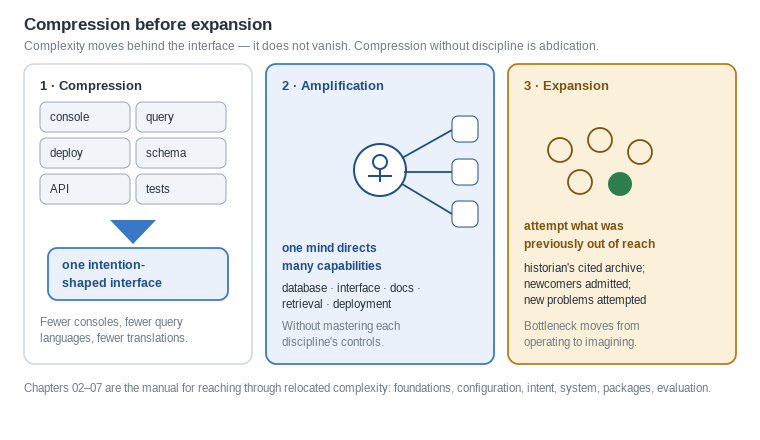
Imagine a local historian with a lifetime of parish records, photographs and taped interviews, but no database training or web development experience. They direct the creation of a searchable archive in which scholars can trace claims back to original sources. Storage, retrieval, interface design and preservation all contribute to the result. Specialist help may still be needed, but the historian can shape the application directly around a purpose they understand better than most programmers ever could.
None of the constituent technologies needs to be new. The opportunity lies in their combination by someone who might previously have been unable to bring them together. That is why the expansion of possibility matters more than the compression that enables it.
Drive the Steamroller
There is a metaphor I keep returning to: get out of the way of the steamroller — and start driving it. Capable machines are absorbing many of the manual operations software developers historically performed. Defending every one of those operations as indispensable is not a strategy. Learning to direct the machinery is.
This is not an abandonment of responsibility but a change in its level. I increasingly judge my contribution by what I choose to build, the conditions under which it is built and the quality of the result, rather than by the lines I write myself.
My working day is changing: less time translating requirements into syntax, more time expressing what the software should do; less time debugging my own code, more time evaluating the machine’s output; less time memorising APIs, more time organising work so that many machine efforts accumulate into one application.
Even that organisation is not a permanent human duty. As machines become more capable, maintaining charters, arranging packages and keeping records current may themselves become machine work. The objective was never to exchange a programming workload for an administrative one. It was to achieve greater amplification with fewer operations performed by me.
What I must preserve is control over the direction: what I want to achieve, what matters to me and whether the result is worth pursuing. Responsibility stays with me; the labour may not. Traditional expertise remains valuable because the judgement earned through years of practice helps me direct the machinery. What I need to relinquish is the reflex that every problem must be solved by hand.
The Advantage Changes
Newcomers and experienced developers arrive at this transition with different advantages.
Newcomers may take naturally to conversational creation. With fewer established implementation habits, they can concentrate on outcomes rather than mechanisms. But freedom from habits is not the same as judgement. Without experience of failure, poor designs and incomplete results can look every bit as convincing as good ones. Scepticism grows through encounters with failure: the bug that escaped, the green test suite that missed the problem, the design that worked until it met real users. Will machine coding help newcomers acquire that judgement faster through supervised experimentation, or slower by insulating them from the consequences? I do not yet know.
Experienced developers bring technical judgement, architectural knowledge and a catalogue of failures that teaches them what to distrust. Their danger is the instinct to seize the keyboard. I recognise it from my own work: watching a machine fumble something I could have typed in a minute and having to remember that the minute was never the point. The discipline is to hold back the hands without holding back the judgement.
Over time, machines may acquire or surpass some of the very abilities that make experienced developers effective directors today. I have no interest in preserving every manual review activity as permanently human territory. My responsibility is to understand what constitutes a satisfactory outcome and to decide when to trust, question, redirect or demand more evidence. The judgement that matters most is knowing where judgement itself is still required.
The opportunity belongs to neither group exclusively. It belongs to whoever combines freedom from unnecessary implementation habits with the ability to recognise good and bad results. That ability brings us to the larger question of quality — taste, individuality and the recognition of the genuinely good — which deserves a chapter of its own.
From Coding to Machine Direction
The method itself is subject to the transition it describes. Selecting tools, arranging work packages, configuring runtimes, retrieving context, testing, correcting and integrating may increasingly become operations that machines perform on our behalf. Some of this is already visible in agents that select search strategies, runtimes that recover from failures and automated test loops.
The important point is that machine coding need not stop at delegating implementation. The machinery that organises implementation can itself become something we direct. Progress will be uneven, but the direction I see is from implementation towards intention.
I sometimes call my current practice machine direction, because guiding machinery describes my working day better than writing code. I keep the name Machine Coding because the discipline grew out of programming and its product is software. The name honours where we came from; the practice points at where we are going. The engineering described in Chapters 02 through 07 is how I exercise that direction today, rather than an argument that every part of it must remain manual tomorrow.
We Are Only Beginning
I believe we are in the early stages of this transition, and I expect substantial further change over the coming five years. That is a forecast, not a measured trajectory. It rests on the improvements I have seen in the machinery and on the possibility of delegating the very operations that currently make delegation possible.
What would change my mind? If machines became ever more fluent at implementation but made little progress in handling context, coordinating work or evaluating results, the method described in this book might remain necessary in much its present form. I do not expect that plateau, but it is a possibility.
The next chapters return to the practical problems of reading the machine, retaining its history, and recognising quality. Amplification is valuable only if what we produce is worth producing.
Return once more to the clay. The opportunity was never to become the most skilled person at moving clay with a shovel. It is to learn to direct machinery capable of moving the mountain — and then to decide which mountains are worth moving.