The New Programming
From telling the computer how to work to organising machines that develop software.
The Introduction argued that the routine production of code is becoming a machine task. That raises a more interesting question: if the machine writes the code, what is the human’s job? This chapter begins with that change in the division of labour.
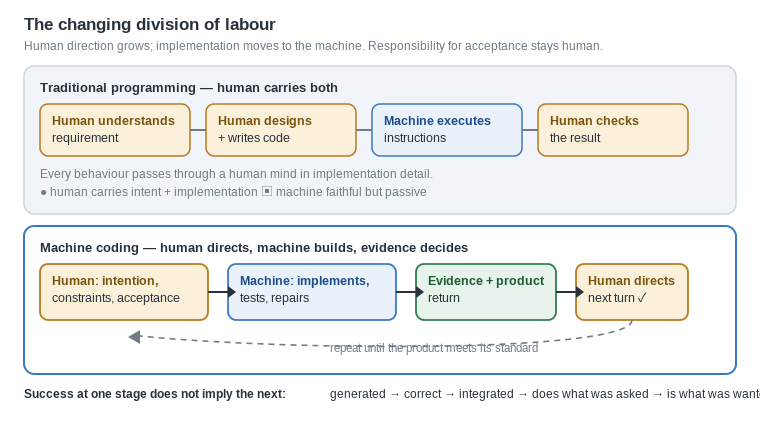
Traditional programming is about a human telling a machine how to perform a task. Machine coding is about a human organising machines to develop software.
The difference sounds small. It changes where the work happens, what skill looks like, and who must judge the result.
What programming assumed
For most of the history of software, the division of labour was fixed. The human understood the requirement, chose the algorithm and data structures, wrote the instructions in a programming language, and checked the result. The computer executed those instructions faithfully and quickly, but it did not decide what they should be.
Skill followed that boundary. A good programmer knew syntax, libraries, idioms, performance characteristics, and failure modes. Much of professional pride came from writing precise instructions with few defects.
The limitation was also clear. Much of a system’s behaviour still had to be translated into implementation detail by people. When a requirement was vague, the programmer often resolved the ambiguity while writing code, without making the decision explicit. And as systems grew, teams divided the work among people who could see only parts of the whole.
Tools improved this process without changing it. Better languages, better editors, better compilers, better tests, and better version control all helped humans produce instructions more reliably. The human remained the programmer.
A new participant
That boundary has now moved. A machine can read an existing repository, propose a change across several files, run the tests, examine the failure, revise the change, and present the outcome for review. It can do this at a scale and speed no human typist can match.
This is not a faster way of typing. It is a new participant in development.
A machine that can change a system has not thereby taken responsibility for it. It can produce a convincing implementation without establishing that the change serves the user or fits the product. Plausible code has become cheaper to produce. Deciding which change is worth making, finding out whether it works in context, and accepting its consequences remain harder tasks.
Central idea: the machine increasingly writes the instructions. The human increasingly defines the behaviour, organises the work, and judges the result.
Generating code is not developing software
It is easy to confuse a correct-looking change with a completed piece of engineering. Consider a small request: “reject expired credentials at login.”
A machine can produce the check in seconds. It may add a comparison in the login handler, write a test for an expired token, and report success when the test passes. All of that can be correct at the level of the edited lines and still be wrong as engineering.
An expired credential might still be accepted by a refresh route, or a remembered session might bypass the new check. The change could contradict the documented policy. A unit test might prove that the comparison works without showing that a real user is prevented from logging in. None of those failures is visible in the edited lines alone.
Generating code is not the same as developing software. The intended behaviour must be clear. Tests must challenge that behaviour, not merely confirm that the new branch runs. The change must work in the existing system, and there must be a defensible reason to accept it. Later chapters turn these demands into a method. None follows automatically from the appearance of code.
Success at one stage does not imply success at the next. Code can be generated without being correct, pass its tests without being integrated, be integrated without solving the user’s problem, and meet the literal request without satisfying the real need. Each transition needs its own evidence.
A different division of labour
Machine coding therefore reorganises the work rather than removing it.
In traditional programming, the human carried both intention and implementation. In machine coding, machines increasingly search the repository, draft changes, run checks, and attempt repairs. The human’s work shifts towards framing the problem, giving the machine the context it needs, setting boundaries, deciding what counts as evidence, and accepting or rejecting the outcome. The work moves; responsibility does not.
This is not abdication. Delegating implementation is not the same as delegating authority. A machine may prepare consequential actions — changing stored data, granting access, publishing a release, deleting history — but its authority to carry them out must be explicitly bounded. Reversible changes need a credible way back. Irreversible actions need a higher bar before they happen. We return to these boundaries in the chapters on authority and evidence.
Nor does this remove the need for engineers to read code. It changes why and where they read it. Instead of treating line-by-line inspection as the only route to confidence, an engineer examines the areas of greatest risk, probes the behaviour, and looks for independent evidence elsewhere. The aim is not to reproduce the machine’s implementation work. It is to judge whether that work deserves to be trusted.
Why this needs its own name
Autocomplete, pair programming, and agentic coding describe ways of producing code. They do not, by themselves, tell us how a change becomes trustworthy. A convincing answer in a chat is one thing; a reliable change to a living repository is another. That change must preserve the behaviour that matters, survive integration, and leave evidence another engineer — human or machine — can inspect later.
Machine coding, as used in this book, is the method around that change. Work is bounded and given enough system context to make sense. A plan can be challenged before execution. Tests and independent review question the result. Integration is verified in the real system, not assumed from local success. What was learned and why the change was accepted become part of the record for next time.
The difference is practical. A prompt can remain in a chat history, but it is not, on its own, a dependable record of what was intended, attempted, tested, and accepted. Work packages, decisions, review findings, and acceptance records give later work something to build on. They make it possible to trace a mistake instead of rediscovering it.
This is a working method, not a finished doctrine. Building a real system this way forced us to revise the approach several times; later chapters show where it failed. The claim is specific: when machines can produce code, the harder engineering questions increasingly concern how work is organised, how results are evaluated, and how experience carries forward. That discipline deserves a name.
The loop, and where the evidence comes from
Machine coding is not a single prompt. It is a loop: decide what you want, communicate it, let machines attempt the work, examine what happened, and use that evidence to decide what comes next. Sometimes the next move is a correction. Sometimes it is a better idea. Sometimes it is to stop. The loop ends not when the machine announces success, but when the result meets the standard you set.
Most of this book is about making that loop dependable. The early chapters prepare it: the foundations to build on, the intelligence to allocate, the intention to discover, the world the software must work within, the packages of work, and the machine that carries them out. Later chapters turn to judging the machine, keeping its history, and keeping control of what it produces.
The evidence in this book comes mainly from one system: ALIVE, a persistent environment for doing real work with AI. Built with Python and PostgreSQL, it carries work and what has been learned across conversations, models, and restarts. Its repository, reviews, and records show where our method worked, where it broke, and what we changed. ALIVE is evidence for the method, not the subject of the book. A small arcade game provides a second, more approachable example for individual turns of the loop.
What comes next
If machines are going to write the code, what must the human decide before they begin? The next chapter, The Foundation Charter, starts there. You cannot supervise foundations you do not understand.