Make the Machine Yours
From a general AI to your own working intelligence: context, memory, instructions, roles and tuning — and how to tell whether it worked.
A general-purpose AI can write, code, research, argue and build. Many systems can also retain information across conversations, organise work into projects, read your files and connect to other accounts.
None of it means the machine knows how you work.
The default system is designed to serve millions of different purposes. It may know something about your interests but not the decision you made last month, the research that changes today’s answer, or the standard you expect this particular piece of work to meet. It can be a capable assistant without being a particularly useful assistant to you.
The model provides general capability. The context, memory, instructions, tools and feedback around it make that capability useful for your particular purposes. You do not need to retrain the model or turn it into a copy of yourself. You need to bring more of your knowledge, intentions, standards and working methods into the machinery through which you work.
Memory is not context
Memory is what remains available from previous work: research findings, earlier discussions, decisions, preferences, rejected approaches, records of experiments, unfinished tasks. Context is what the machine actually has in front of it while doing the current task: this question, these documents, these instructions, these earlier decisions, these constraints.
The two fail differently. The right information may be stored somewhere but never reach the current task. Equally, giving the machine everything at once can bury the one detail it needs. Chapter 07 made this point about coding agents; it applies just as readily to research, writing and other work.
Good memory is retaining what matters. Good context is bringing the right part of it into the work when it is needed. When the machine misses an important decision, find out whether it was never recorded, whether it was not retrieved, or whether the machine received it and failed to apply it. Each failure needs a different repair.
The underlying mechanisms — embeddings, indexes and context windows — are covered in my more technical books. Here I am interested in what you can observe and change.
A project you can leave and return to
You get interested in an idea — a scientific question, a technology, a possible application. You discuss it with an AI, read several papers, explore what it might be used for, find something promising, and hit a difficulty. Then life intervenes. Other work, other interests. Weeks pass.
When you come back, what were you trying to find out? Which papers mattered and which turned out to be irrelevant? Which ideas had you already rejected, and why? What did your small experiments actually establish? What was the next thing you meant to try?
Without durable records, you reconstruct the investigation from fragments — or quietly give up. With a well-kept workspace, the machine can recover the notes, sources, decisions and experimental results you left behind. It should distinguish what it found from what it inferred, and leave genuinely missing information unresolved.
A project can stop without disappearing. That changes what an individual can sustain. Many of us have a graveyard of half-explored ideas, abandoned not because they were bad but because resuming them was too expensive. When resuming is cheap, the graveyard becomes a library. A capability that did not exist when you stopped may be exactly what makes an old idea worth revisiting now.
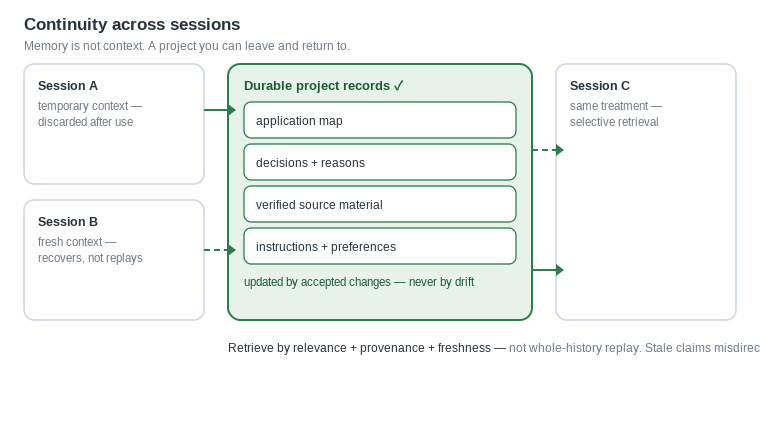
This book is itself an example. It has been written across many sessions with several AI systems, without relying on any one of them to remember the work. What carries it is a set of plain files in the repository: a living editorial index recording the purpose and status of each chapter, evidence notes distinguishing verified claims from unverified ones, and an instruction file explaining how work is done here. The method is deliberately simple: each new session is meant to begin from those records. Continuity belongs to the project, not to any particular model.
Give it something to work with
The machine cannot use information it cannot reach. Make relevant material available: notes, papers, repository history, selected conversations, work logs, saved findings and your own explanations of what you are trying to accomplish.
The important word is relevant. The aim is not to connect your whole digital life. Connecting everything is not personalisation; it is noise, and often risk. A small, deliberately chosen collection of the right material is usually worth more than unrestricted access to all of it, and it is far easier to keep accurate.
Know which accounts you have connected, what access you granted, how the provider handles the information and how to revoke access. Treat correspondence, workplace records and sensitive personal information with particular care: much of it is not yours alone to share. Keep credentials out of instruction files and repositories, and private material out of public ones. A document retrieved for reference is not automatically an authority over the machine: instructions found inside it must not override your approved guidance or permissions.
Tell it how you work
Memory is not instruction either. Knowing what you did last week does not tell the machine how you want this week’s work approached.
Many AI systems provide standing guidance through custom instructions or project-level settings. You can also maintain a document and supply it at the start of each assignment. Coding agents often use a repository file for this purpose; AGENTS.md is a common convention, though its interpretation varies by tool. The practice described in Chapter 07 extends well beyond coding.
Good instructions explain what the project is for, which records govern it, how to handle uncertainty, what evidence is required before reporting success, which actions require permission and what unnecessary work to avoid. Keep them concise enough to use repeatedly. A long, contradictory instruction file that nobody maintains is another source of error.
Instructions are part of your working environment, and like the rest of it they go stale. Review them when the work changes, and remove what no longer earns its place.
One machine, several roles
Chapter 09 compared learning to direct different models to learning to ride different horses. The comparison extends further: the same horse responds differently on different ground and under different demands. The same model behaves differently with different context, instructions and responsibilities.
You can use that deliberately. One familiar machine can work as a researcher — finding material, explaining concepts, separating evidence from speculation, preserving sources. As a creative collaborator — exploring unfamiliar ideas and proposing alternatives. As an engineer — working out what an idea needs and building it. As a reviewer — challenging conclusions, finding weak evidence, saying what would need to be established before a claim is accepted. As an organiser — keeping track of projects, priorities and unfinished work.
These roles need not require five different models. They can be different configurations of the same model working on the same project. A creative collaborator may benefit from broad context; a reviewer needs the original evidence, clear criteria and enough independence to challenge the work. For consequential reviews, use a fresh context and stronger independent checks where needed. A role changes the assignment, not the permissions: calling a machine a reviewer does not grant it authority to alter the work it judges.
When a result disappoints, distinguish the model’s capability from the task, the available information, the standing instructions and your own direction. These are different levers, and changing the wrong one can make the machine worse.
Learn to tune the machine
Making the machine yours is not a setup step. It is a continuing practice of diagnosis, adjustment and evaluation.
Suppose the answers are consistently too long. Check whether your instructions specify the depth you want. Suppose the machine forgets a decision. Find out whether it was recorded, retrieved and applied before adding another reminder. If it keeps drawing on the wrong research, inspect which sources it received. If it keeps proposing unwanted features, revisit the purpose and scope of its assignment.
The common mistake is to make the same repair every time: add another instruction. The cause may instead be stale records, missing context, conflicting guidance, an unsuitable role or a genuine limitation of the model. Change the part most likely to be responsible, then test the result.
This book’s repository supplied a useful example. Its instruction file had been carried over from another book of mine about retrieval systems and still described that subject. A sentence about retrieval pipelines appeared in the opening chapter of Machine Coding. The stale guidance was a plausible explanation, though the incident alone does not establish the exact cause. The appropriate repair was to correct the inherited instructions rather than add another layer on top of them.
If you do not know which information, instructions and tools are shaping the machine’s behaviour, you cannot improve it deliberately. The tuning described here changes what the machine receives and how it works, rather than retraining its model. Judge a change by whether it produces better behaviour on comparable work, not by whether the new configuration looks more sophisticated.
How do you know it worked?
It is easy to feel that a machine knows you better. The useful question is whether it applies the right knowledge and guidance to produce better work.
Can it resume an old investigation accurately — the question, sources, decisions and remaining uncertainties? Does it follow current guidance and expose conflicting instructions? Does it retrieve relevant material rather than everything available? Can it remain a critical reviewer when asked to challenge the work? Does a corrected preference or fact take effect in a fresh session? Can it identify the source of an important remembered claim? Above all, does it acknowledge a missing record rather than invent a plausible history?
That last one matters more than it looks. A machine that confidently reconstructs a past you never had is worse than one with no memory at all, because you may believe it.
One impressive session proves little. Start with a small before-and-after comparison: use the same resumption request in fresh sessions, against the same underlying project records, changing only the configuration you intend to test where practical. Compare accuracy, omissions, unsupported claims and the effort needed to resume. Repeat on other tasks before treating the improvement as dependable.
ALIVE, the system behind much of this book’s evidence, illustrates an important distinction. Its records show that past experience has been retrieved into new work. They do not establish that this consistently improves subsequent results. Remembering is one achievement; improving because of what is remembered is another. The first is a capability. The second is the benefit we are trying to obtain from it.
Personalisation is not surveillance
You choose what is shared and why. Information gathered for one project should not automatically flow into another. An inference about you should not silently become a permanent fact, nor a temporary request a standing preference. Choose systems that let you inspect and correct the information shaping their behaviour, separate projects, restrict access and revoke it. Check retention and deletion arrangements too: withdrawing access to a source need not erase information already retained from it. Do not share confidential or sensitive records unless you have the authority to do so and understand how they will be handled.
The strongest personalisation is not accumulation. It is control over how appropriate information is used in service of your purposes.
Try Machine Coding — Build a Machine That Remembers Your Work
This exercise requires no database, programming or paid API. Choose a research topic you genuinely care about and use a workspace your assistant can access in fresh sessions. The exercise is proposed, not a reported demonstration; its value lies in testing continuity for yourself.
Create a workspace you can leave.
I want a research workspace I can leave for several weeks and come back to without starting again. Help me set it up around a topic I’m interested in. Keep the important questions, sources, decisions and next steps somewhere durable that I can inspect myself.
A private repository, a project with files, or a single maintained document can all work. Make sure both you and the assistant can access the records in a fresh session. If the assistant cannot save them directly, save its proposed updates yourself and provide the document again when needed.
Write the instructions.
I want you to research carefully in this workspace. Write short instructions telling you to separate facts from suggestions, keep the sources for important claims, challenge unsupported conclusions, and tell me when you don’t know something. Store them where you’ll read them again next time.
Read what it wrote. Cut anything you would not want followed routinely, and confirm where the approved instructions will be kept.
Do some real work.
Help me explore this subject. Find a few good starting sources, explain the key ideas, and identify some questions worth investigating. Record what we established, what’s still uncertain, and what we might do next.
Do at least one genuine session. Check an important claim against its source, record one decision and its reason, and leave a specific next step. Save the actual record before closing the session.
Stop. Then come back.
Close the conversation. Come back in a fresh session — tomorrow, or next week.
I want to return to my earlier research. Recover what I was investigating, which sources we used, the decisions we made and the next step we planned. Show me where each part came from, and tell me what you can’t recover.
Check the answer against the saved record, not just your recollection. Did it recover the question, sources, decision and reason? Can you trace its claims to the original material? Note omissions and inventions as well as successes; this is your baseline for tuning.
Change its job.
For this session, act as a critical reviewer rather than a collaborator. Challenge our current conclusions, point out weak evidence, and say what we’d need to establish before accepting the strongest claims. Don’t change the research record.
Tune, then test the tuning.
Review how well you recovered my earlier work and followed my instructions. What context was missing, what assumptions were wrong, what was irrelevant? Suggest improvements to the workspace or the instructions, but don’t make them until I approve. Then help me check whether the next session is actually better.
Approve one useful adjustment, then repeat the resumption request in another fresh session and compare it with your baseline. Success means recovering specific facts and decisions accurately, tracing important claims to their sources, switching roles without rewriting the research record, and knowing where the authoritative information lives. Establish whether your adjustment actually helped; if it did not, record that too. You should remain in control of what the machine can see and change throughout.
Get more of yourself into the work
I am not describing a machine that merely knows your name or remembers that you like short answers. I want a working environment that knows where to find my research, recovers the decisions that matter, follows my standards and lets me move between exploration, criticism and implementation without losing the thread. I want to be able to leave a project and return to it.
That takes practice. Explain what you are doing, provide the information that matters, correct mistakes, and observe whether each adjustment improves the work. Over time, the environment should carry more of that burden rather than demanding the same explanations from you again and again.
The deeper engineering of language, context, memory, roles and persistent AI systems is the subject of my other books. You need not master it to begin here. A workspace, honest records, a few clear instructions and the habit of checking are enough to start.
Many people now have access to broadly similar underlying capability. What you build around that capability is where your own contribution increasingly lies. That is what it means to make the machine yours.
What comes next
A machine configured for your work is more useful than a generic assistant, but no single configuration suits every assignment. Some work needs strong reasoning, some economical execution, some a specialist tool and some no model at all. The next chapter, Different Tools for Different Jobs, is about making that choice within the constraints of the work.