The Work Package
Decompose intention into bounded assignments machines can complete and applications can absorb.
The foundations are settled, the intelligence allocated, the intention discovered, and the system understood. Now comes the daily practice of machine coding: what, exactly, do I give the machine to do?
The answer I have arrived at, through enough failed attempts to respect the question, is the work package: a bounded engineering assignment that a machine can complete and an application can absorb. The skill is to divide an intention into such assignments without losing sight of the whole.
That skill is, I believe, the new programming. Not writing instructions for a computer — organising machines that write them, and ensuring the thousands of things they produce become one thing that works.
The new programming problem
In my own machine-coding practice, producing code is rarely the bottleneck. A capable model can fill a screen with plausible implementation in seconds, and for some tasks that is genuinely the hard part done. But changing a living system is different. The difficulty lies in choosing what should happen next, communicating it clearly, verifying the result, and ensuring it belongs to the same application as everything that came before.
I have watched this failure from the inside. A session produces an impressive volume of code — new endpoints, tables, components — and the application is no further forward. Each piece works in isolation; together they disagree about names, duplicate responsibilities, bypass established patterns, and leave integration until some unspecified later date. The machine did what it was asked. I had not asked for what the application needed.
This is the distinction on which the chapter turns. Local success means a package satisfies its specified contract. Application success means the work integrates with the existing system, preserves its constraints, and advances the user’s actual goal. A package may pass every test while the application remains broken. I need evidence at both levels.
Start with goals, not tasks
I begin not with artefacts — twelve endpoints, three tables, a component — but with what the application must accomplish. I work downward from the intention and then verify the result in the application:
Product intention → Goal → Capability → Component → Work package → Integrated behaviour.
A goal describes an outcome in user terms: a developer can change files in an approved project without repeatedly losing access or weakening security. Capabilities are what the system must provide to achieve that goal — stable authorisation and live revision resolution, for example. Components deliver those capabilities, and work packages are the bounded assignments through which components are built or changed. Integrated behaviour is where the user experiences the result.
This is a thinking tool, not a taxonomy to enforce. Small efforts may collapse levels; large ones may need all of them. Its purpose is traceability: I should be able to follow any piece of machine-written code upward to the user outcome it serves, and follow any goal downward to the packages that implement it. Work that cannot be traced in either direction is work I should question before commissioning.
Before decomposing a goal, I ask whether it is worth pursuing at all. Does it serve the product intention? Does its value justify the integration and review it will consume? Does an existing capability already provide it? Machines make it cheap to start things; that is precisely why choosing what to start deserves more thought, not less. I ask what outcome a candidate goal changes and what other work I would defer to pursue it. If I cannot answer, the idea needs further exploration, not a work package.
Build on what you already know
One of the costliest avoidable mistakes in machine coding is asking the machine to create what already exists. Before any package is designed, I establish what the repository already offers: architecture, prior decisions, accepted components, reusable services, interfaces, tests, and implementations the machine can read and follow.
ALIVE has taught me this twice in documented form. The WF-01 reuse investigation found that the existing workflow runner could invoke capabilities under grants, pass stage outputs into later inputs, and persist runs, stages, and artefacts. The design therefore called for narrow adapters rather than another orchestration system.
WF-03 mapped existing workflows, persistence, source authority, and evaluation before specifying only the missing behaviour: a character-span planner over exact corpus text and a whole-chapter context mechanism. Both assignments shrank because discovery preceded design.
WF-03 also exposed two failing revocation regressions in the experimental stack. The work was paused and retained on a separate branch rather than merged or treated as established capability. Unfinished work remained visible without becoming a foundation for subsequent packages.
Reuse must be demonstrated, not assumed. Two components with similar names may have different authority or lifecycle requirements. Following the wrong precedent can produce code that looks idiomatic while violating the constraints that matter. Every accepted component can make future packages easier to define and review, provided its suitability is established and the reference is precise.
A work package is not merely a prompt
A prompt is a message I send to a model. A work package is a durable engineering assignment that survives the model that receives it. Another intelligence — human or machine, tomorrow or next month — should be able to pick it up and understand what is being asked without reconstructing the entire conversation that produced it.
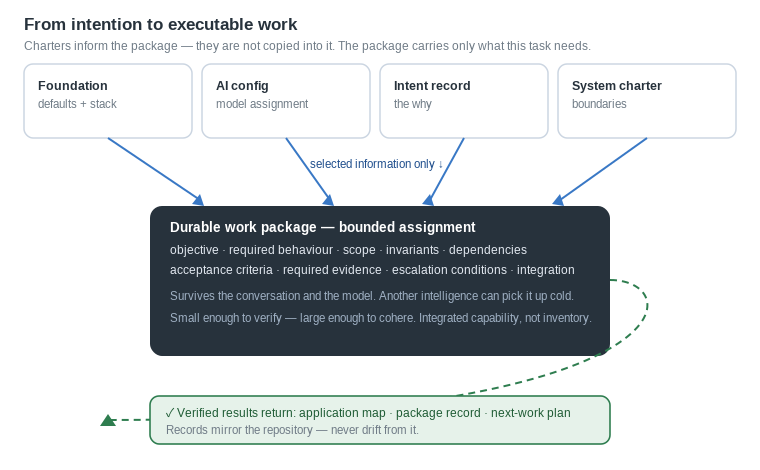
My standard package contains ten elements. Each earns its place by answering a question the implementer would otherwise answer by guessing:
- Goal: why does this change exist, and which capability does it serve?
- Existing reference: what code, capability, contract, or precedent must be reused or followed?
- Required behaviour: what must change, and what outcome is expected?
- Scope: what may the worker modify — and what is out of bounds?
- Invariants: what behaviour, constraint, or security property must remain true throughout?
- Dependencies: what must already exist or be completed first?
- Acceptance criteria: what would establish that the task works?
- Required evidence: what tests, outputs, inspection records, and observations must be retained?
- Escalation conditions: when must the worker stop, ask, or return the package to design rather than improvise?
- Integration: how does the result become part of the application — where it is wired in, what verifies the wiring, and who accepts it?
The earlier charters inform the package without needing to be reproduced in full. The Foundation Charter supplies the defaults; the AI Configuration Charter supplies the model assignment; the Intent Record explains why; the System Charter defines the boundaries. The package carries the information this task needs, with references to the rest. Thoroughness means supplying the right context, not the most context.
Consider an illustrative assignment based on the live-source binding from Chapter 05. Revocation blocks the central workspace path; the goal is to establish the same guarantee for legacy callers without changing authorisation semantics.
I cannot yet specify the implementation, because I have not verified which callers bypass the live-aware path. The report explicitly leaves direct legacy callers using old approval references unaudited. The known path (_source_for_runtime in alive/workspace_api.py, resolving through source_live.resolve_current unless the EXACT_CAPTURE opt-out applies) does not establish what happens elsewhere. The first assignment is therefore discovery, not implementation:
Goal: Identify which source-consuming paths resolve the binding and which retain exact-revision behaviour.
Existing reference: The central _source_for_runtime path and the report’s limitations.
Required behaviour and evidence: Enumerate approval_ref consumers and trace their call paths. Classify each as binding-aware, legacy, or unresolved, citing file and function names and the code supporting each conclusion.
Scope and invariants: Read-only inspection; no refactoring or permission changes.
Acceptance: Account for the discovered consumers, describe how they were located, and identify any remaining coverage gaps. Escalate paths whose behaviour cannot be established without execution.
Integration: The resulting map informs the implementation packages. Unresolved paths remain discovery work, not assumed coverage.
Only then can I specify an implementation package for a named caller, with verified current behaviour and tests that can fail for the right reason. “Harden revocation everywhere” is a goal. “Identify and classify the approval_ref consumers” is an executable assignment. Jumping straight to implementation risks a convincing result that leaves unaudited paths untouched.
Notice what this discovery package does not ask the worker to do: invent an architecture, reinterpret permissions, or settle open design decisions. Findings that require such decisions return to design.
How large should a package be?
Sizing is one of the hardest judgements in machine coding. Make a package too large and requirements blur, unrelated systems change, and assumptions hide in the volume of code. Make it too small and I spend my scarcest resource — attention — issuing instructions, coordinating dependencies, and reviewing trivialities.
My principle: small enough to understand and verify; large enough to deliver a coherent change. Sometimes that is one function. Sometimes it is a component across several files. Sometimes a cross-cutting security change is too interdependent to divide safely, and the honest response is a larger package with stronger review rather than a false decomposition.
Size depends on the machine, the system, and the evidence available. A capable model with well-chosen context and a well-mapped subsystem can handle more. Fast, reliable tests with clear expected outcomes can support larger packages. Unfamiliar territory calls for smaller probes whose failures teach cheaply. Tightly coupled changes may need either a narrower boundary or a coordinated package, depending on whether the change can safely be divided.
Parallelism follows the same logic. Independent packages with stable interfaces can proceed together; packages sharing interfaces or data models that are still changing need coordination or sequencing. I do not prescribe numbers of files, functions, or tokens. I ask two questions: can I verify this as one thing, and does it deliver something coherent?
Hand work to the appropriate intelligence
This chapter assumes Chapter 03’s allocation and applies it. The designing intelligence — the one that produced the package above — does the architectural thinking: understanding the system, discovering references, settling contracts, anticipating integration risks. The implementing intelligence executes within those decisions. Independent review then examines the result against the package and the actual system, in a separate context.
The warning signs are familiar: the worker questions settled contracts, invents abstractions, or asks for decisions the package should have contained. Sometimes it has found a genuine flaw in the design; sometimes the context is incomplete or the assignment exceeds its capability. I diagnose the cause before retrying. Improve the context, redraw the boundary, return to design, supply specialist tools, or assign a more capable model. Asking the same worker to try harder is not a diagnosis.
Keep the whole application moving
A sequence of locally successful packages can leave an application inconsistent, incomplete, or unusable. Dependencies must be honoured, established interfaces preserved, duplicate components avoided, and parallel changes kept compatible. Accepted work should be integrated promptly. I want the application to remain demonstrable at meaningful checkpoints: if it works only after everything lands, I may discover too late that I have been building the wrong thing.
Discoveries must travel to the right destination. A finding about the architecture returns to design; a finding about the purpose returns to intent. What must not happen is silent absorption: the implementer noticing a better structure and rebuilding toward it without authorisation, so that the application drifts one unreviewed improvement at a time.
The moment after a package reports completion is when I choose what happens next. In the arcade-game example later in this chapter, a new transition allows the player to restart without reloading. Its narrow contract is satisfied, but extended play reveals that scores from the previous run survive the restart.
The transition package can remain accepted against its stated contract, provided the new finding does not invalidate its evidence. Reliable restart, however, remains unfinished. I record the omitted score-reset requirement and commission a correction package with its own tests. The attractive next feature — a persistent leaderboard, perhaps — can wait.
That is how I choose the next package: examine the delivered behaviour, reassess the goal, resolve what blocks or completes the capability, and only then reach for something new. Precise acceptance makes unfinished work visible rather than hiding it inside a vague approval.
The unit of progress is the integrated capability, not the completed package. I work towards moments when I can demonstrate something the application can now do that it could not do before — a vertical slice of real behaviour, however thin. Completed but unintegrated work is inventory, not evidence of application progress. And inventory rots.
ALIVE’s PI-03C delivery illustrates the discipline: substantial deterministic work was delivered as a draft, with milestone acceptance blocked on named gates and an explicit instruction not to merge on author tests or green CI alone. Implemented is not accepted, and the record says so. Completion of a package is not completion of a capability; completion of a capability is not necessarily completion of the goal. Package acceptance requires evidence, review, and verification of its agreed integration.
Evaluate and correct continuously
Every package enters the loop at the heart of this book: communicate, build, evaluate, improve. The first implementation is an attempt, not a verdict. Tests examine behaviour; review examines the requirement, boundaries, and system effects. Wherever I can judge the behaviour directly, I use the application myself.
I send each failure back to the level that caused it. An implementation defect calls for a bounded correction. A scope defect calls for a revised package. An architectural defect returns to design, missing system knowledge to discovery and the System Charter, and a mistaken intention to exploration. Blind repetition of the same request is not persistence; it is a refusal to diagnose that can turn a small defect into a large token bill.
Preserve the application between sessions
A machine-coding application will be built by many models across many conversations, branches, sessions, and days. It must not depend on any one of them remembering anything. I keep three lightweight durable records, in plain Markdown, aligned with the repository they describe:
Application map: what exists, how components fit together, which interfaces and patterns are authoritative, which architectural decisions stand. This is the newcomer’s orientation and the reviewer’s baseline.
Package record: for each package, what was requested, which sources were referenced, what the scope was, what actually changed, what tests were run, what the review found, and what acceptance evidence closed it.
Next-work plan: what still needs doing, what is blocked and on what, which dependencies determine the next useful package, and where the next integration milestone lies.
These records must remain aligned with the repository and its evidence. I watch for maps describing vanished components, package records misrepresenting historical or current test coverage, and plans pointing at abandoned milestones. Accepted changes trigger updates to the records they affect; periodic checks catch discrepancies that escaped earlier attention.
A map nobody maintains becomes folklore; a plan nobody reads becomes ritual. Small, current records that people and machines actually consult beat comprehensive ones nobody trusts. When the next worker can start from these pages rather than reconstructing the world, I have achieved continuity across models, sessions, and days.
The real measure of speed
There is a temptation, sharpened by how fast machines produce code, to measure activity: lines written, calls made, tickets closed, packages completed. All of it can rise while the application stands still. I have seen the shape of it — a week of impressive throughput and nothing new the application can actually do — and the lesson survives every new model: the objective is not maximum machine activity but sustained progress toward a functioning application.
I measure progress as an owner would: what accepted, integrated behaviour now works, and how long did it take to get there? Correction cycles, unintegrated backlog, regressions, and the severity of review findings help explain the answer. A prototype may emphasise time to demonstration; a regulated system may emphasise traceability and serious defects. There is no universal metric, but the outcome measures must relate to the application. Package-level measures are diagnostic, not substitutes for progress. As Chapter 03 established, fewer review findings alone prove nothing unless the effectiveness of review is also considered.
A package that produces a working improvement
To make the relationship concrete, here is the chapter’s method applied end to end — an illustrative walkthrough of the recurring arcade-game demonstration, not a report of work executed. Assume a small playable space-shooter already exists, created by a coding AI. It runs, but restarting after the player loses is poor: the game freezes on the final frame and the only recovery is reloading the application.
Goal: A player can restart a completed game without reloading, beginning a fresh run while retaining the high-score table.
Existing knowledge and design: Reuse the input handler, game-state object, scoring mechanism, and rendering loop. The restart capability requires a transition from the game-over screen to a playable initial state, with current-run state reset and existing input mappings preserved.
First package: Suppose I scope the assignment too narrowly: implement the game-over transition and its wiring, modifying only the state-transition module and its tests. The explicit checks cover entering a playable state, existing input mappings, and high-score preservation. They do not cover resetting the current-run score. Preserve the approved high-score write path, and stop if the transition requires broader refactoring.
Implementation and evaluation: In this hypothetical run, the machine implements the transition and its tests. Independent review checks the narrow contract, and play-testing confirms the transition works across repeated attempts, including game-over animation edge cases. The package is accepted against those checks, not as proof of the complete restart capability.
Improvement: Extended play reveals the omitted requirement: points from the abandoned run leak into the new one. Commission a score-state correction with tests that start from a non-zero score, restart, verify a zero current-run score, and confirm the high-score table is preserved. If the finding contradicts any previously accepted evidence, reopen that acceptance too.
Integration: Accept the restart capability only after the correction is integrated, the combined behaviour passes review and tests, and play-testing demonstrates a genuinely fresh run. Update the package records and application map to distinguish what was accepted earlier from what has now been completed.
One improvement, fully worked, leaves the game better and the records more accurate. Repeat that across goals that matter, and the application grows through demonstrable improvements rather than accumulated promises.
Directing machines, building applications
A machine can complete an assignment. The developer remains responsible for ensuring that the assignments collectively become the intended product. That is the new programming problem: directing intelligence towards work that can be verified, integrated, and carried forward.
The charters establish what to build, with what, and under which constraints. The work package establishes what happens next and how we will know it worked. The measure of my skill is not how much code the machines produce, but what their work becomes.
The chapters ahead turn to the machinery of trust: establishing, independently and repeatedly, that machine-made software deserves its place in the application.