Configuring Your AI
Spend strong intelligence on design and review; use economical intelligence for bounded implementation.
The Foundation Charter settled what I am building and the ground I intend to build on. This chapter settles a different question: how I distribute intelligence across the work.
The objective is not to use the cheapest AI. It is to build the best software I can with the intelligence and tokens available to me.
The best place to spend intelligence may not be on writing code at all. It may be on deciding what should be built and judging whether the machine has built it.
Not all AI work is equal
Suppose I have access to two models. One reasons well over large systems but is expensive to run. The other is inexpensive, perhaps even free, but less reliable on complex tasks.
Should I use the strong model for everything? Or the cheap model for everything?
My answer is neither. Software development contains different kinds of work, and the cost of a wrong decision is not evenly distributed across them.
Deciding how a new behaviour fits into an existing system, what contracts it must honour, and what could break elsewhere demands architectural understanding and foresight. Writing a data object from an agreed schema, once those decisions exist, is a far more bounded exercise. Reviewing the result for security omissions and broken assumptions is again a different kind of thinking — sceptical, integrative, and consequential.
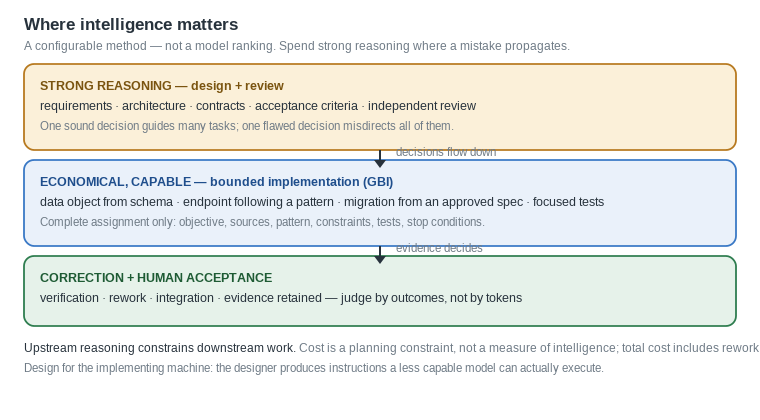
I configure AI by responsibility, not by habit. My default is simple: strong intelligence where mistakes propagate, economical intelligence where the important decisions have already been made.
Price is a constraint, not a measure of intelligence. I choose models for their ability to do the assigned work, not for their position on a price list.
There is no universally correct configuration
The available intelligence differs from developer to developer. Budgets, subscriptions, rate limits and local hardware determine what I can afford to run. Privacy determines what information I can send and where. The project’s language, repository size, context requirements and the consequences of failure determine which of those available models I can reasonably trust with the work.
I make these choices deliberately, and I expect them to differ between projects. A solo developer on a limited budget can still organise a useful hierarchy: careful thinking invested once in design and review, economical execution applied many times within those bounds. A larger organisation may use expensive models more freely. Neither automatically has the better development process. The purpose of configuration is to use whatever capabilities are available where they change the outcome most.
Spend intelligence on design
I put my strongest available reasoning where a mistake affects everything downstream: understanding the system, resolving complexity, designing the solution, and establishing contracts.
A designer may need to read across a large repository, trace dependencies and distinguish the real problem from its most obvious symptom. It must compare solutions, anticipate security and migration risks, and establish the contracts and acceptance criteria that another machine will work within.
A sound design decision can guide dozens of smaller tasks. A flawed one can misdirect them all. This is the leverage of design: reasoning invested once can improve every work package that follows. The argument is structural, not an estimate of how much money the method saves.
GBI: good-enough, inexpensive intelligence
GBI is my shorthand for good-enough, inexpensive intelligence: AI capable of performing a particular class of work economically. It is not a permanent rank or a benchmark category. What counts as GBI changes with the task and the models available.
I use it where the important decisions have already been made: a data object from an agreed schema, an endpoint following an established pattern, a migration from an approved specification, a well-defined adapter, tests from explicit acceptance criteria, or a narrow correction identified by a reviewer.
An economical model can often perform these tasks well precisely because it does not need to rediscover the architecture. What it needs is a complete assignment: a clear objective, the relevant source context, the pattern to follow, exact constraints, expected inputs and outputs, required tests, prohibited changes, acceptance criteria, and conditions for stopping and asking for help.
A weaker model does not become reliable simply because the instructions are long, and a detailed work package does not remove the need for testing. The contract bounds the task; verification still decides whether the task is done.
Design for the implementing machine
The designer has a second responsibility beyond finding a good solution: it must make that solution executable by the machine that will implement it. An impressive architectural essay is not enough.
This means moving decisions upstream, from implementation into design. The designer identifies the relevant files and reusable components, establishes interfaces and behaviour to preserve, and specifies the tests and conditions for stopping. The implementer should know which decisions are settled and which remain open. If the task still demands extensive architectural reasoning, I split it, clarify it, or send it back to design.
A short example helps. Suppose the feature is cited answers over ingested documents, consistent with the charter in the previous chapter.
A vague request sounds like this: “Add cited search over project documents using PostgreSQL and pgvector.”
A bounded contract sounds like this:
- Implement
POST /answersin the existing retrieval service. Reuse the passage store and approved hybrid-query helper; do not introduce a new client. - Accept a question string and optional document scope. Return answer text and citation identifiers resolvable against stored sources. Preserve existing authentication, authorisation and audit behaviour.
- Verify three acceptance conditions: every citation resolves to a stored, authorised, in-scope source; excluded sources cannot contribute to the answer; insufficient evidence produces an explicit no-answer rather than an invented answer.
- Do not change the ingestion pipeline, configuration format or indexing parameters. Stop and report back if the passage helper cannot express the required ranking.
The first request leaves architectural decisions to the implementer. The second makes those decisions part of its assignment. If the economical worker must invent the architecture to proceed, the design is not finished. This is an illustrative contract, not the specification of an existing API.
Route each task, then diagnose its failures
Before assigning a model, I ask four questions. How ambiguous is the requirement? How tightly is the task coupled to the rest of the system? What would a wrong result cost? How much independent reasoning does success require?
Routine bounded work goes to an economical, capable model. New architecture, substantial system interpretation and consequential security decisions warrant stronger reasoning. For debugging, I escalate according to the difficulty of the problem.
When an economical worker fails, I diagnose before retrying. An incomplete contract, missing context, a badly drawn task boundary and insufficient model capability can produce similar symptoms. I complete the design, repair the context, redraw the boundary or change the model according to the cause. Repeating an assignment without addressing the failure is a poor use of tokens.
Separating roles makes the work easier to organise, but does not guarantee quality. Designers and reviewers can share blind spots, contracts can omit important constraints, and some tasks resist decomposition. The failure must be corrected at the level where it originates.
Invest in finding what implementation missed
My concern with economical models is not that they write slowly. It is that fluent code can conceal an omitted permission check, broken error handling, incorrect persistence behaviour or a violation of an existing invariant. Even the accompanying tests can look thorough while proving little. I have seen weaker models produce inferior software when asked to make architectural decisions without sufficient context or supervision.
An implementation can be correct in isolation and still fail as part of the system. A model reviewing its own work may carry the same assumptions that produced the defect. Independent review challenges those assumptions. The reviewer starts with the original intention and the actual repository, treating the implementer’s summary as a claim to verify rather than evidence of success. It must be free to reject the implementation, demand evidence and challenge the design itself.
This is risk-based allocation, not faith in a pipeline. For security-sensitive or unusually coupled changes I strengthen the implementation as well as the review, with specialised tools and tests where reasoning alone is insufficient.
The ability to execute a well-designed task is not the same as the ability to design it. I allocate intelligence accordingly.
Tokens are the budget, not the objective
Token usage is only one part of the cost. Providers may charge differently for input, output, cached input and reasoning tokens. Context limits constrain what can be considered in one assignment. Retries, review, correction and integration consume further resources, even when the initial implementation was cheap.
A cheap first attempt becomes the expensive option once correction cycles accumulate; an expensive design review becomes the economical option when it prevents several rounds of rework. I compare the total cost of an accepted result, not the cost of the first call:
Total cost of an accepted result = design + implementation + verification + rework + integration.
Those components may be counted in tokens, charges, or developer time, but they are not interchangeable currencies. A model emitting fewer tokens is not cheaper if it creates more failures; a model reading more context is not wasteful if that context prevents an integration defect. What matters is verified quality per unit of resource.
What a feature actually costs
Consider the cited-answers feature above. The following token counts are hypothetical; they illustrate the accounting method, not an observed comparison or a prediction of provider charges.
In the separated allocation, a strong model designs the feature, an economical model implements it, and an independent reviewer discovers a weakened permission check. The implementer corrects it, and the reviewer verifies the correction.
| Stage | Input tokens | Output tokens | Total tokens |
|---|---|---|---|
| Design | 30,000 | 5,000 | 35,000 |
| Implementation | 15,000 | 7,000 | 22,000 |
| Independent review | 20,000 | 2,000 | 22,000 |
| Correction | 8,000 | 3,000 | 11,000 |
| Re-review | 10,000 | 1,000 | 11,000 |
| Total | 83,000 | 18,000 | 101,000 |
Now imagine an all-economical allocation in which a brief design omits important constraints. Review discovers invented citations, an out-of-scope source and untested error handling. Repeated corrections require the models to re-read the changing implementation and revise the tests. Suppose those calls consume 130,000 tokens in total. That is more model usage, but not necessarily more money. The two configurations use models with different prices, and neither can be declared successful until it meets the same acceptance standard.
The opposite mistake is equally possible. A premium model assigned to routine, well-specified work may produce no better result than an economical one. If both meet the same standard, the extra expenditure needs a justification.
To compare the allocations, I would price each call at its applicable rates, account for caching and any metered reasoning, and record the time and effort spent on verification and integration. The figures above demonstrate what to count, not which configuration wins.
Keep context sufficient, not maximal
I send targeted source context rather than an entire repository when that is sufficient. I retain architecture decisions in durable files instead of reconstructing them for every prompt. Stable instructions can be reused, completed work summarised and exact verification evidence retained. I keep assignments bounded, intervene when retries stop making progress, and rely on provider caching only where its behaviour is understood.
None of this aims at the smallest possible prompt. Removing a dependency the implementer needed is a manufactured failure followed by a more expensive attempt. The goal is sufficient, accurate context at an appropriate cost.
Configure by role, with room to adapt
| Role | Default allocation |
|---|---|
| Requirements analysis | Strong reasoning |
| Architecture and system design | Strong reasoning |
| Bounded implementation | Economical, capable execution |
| Routine test generation | Economical, capable execution |
| Complex debugging | Escalate with difficulty |
| Independent technical review | Strong reasoning in a separate review context |
| Security-critical review | Strong reasoning plus appropriate tools and tests |
| Integration verification | Tools and tests first, model reasoning where needed |
| Final acceptance | Human judgement supported by evidence |
These are starting positions, not ranks. A model that struggles repeatedly gets a smaller task or gets replaced; an economical model that proves itself on a class of work becomes my preference for it. Capability is not a single numerical scale ordering every model on every task.
Two ways to build the same feature
In the single-model approach, one model receives the broad request, proposes the architecture, implements the change, writes the tests and reviews its own result. The work starts faster and requires fewer handoffs. But an assumption made during design can pass into the code, the tests and the review without ever being challenged.
In the separated approach, the bounded contract goes to an economical implementer. Tests run, and a reviewer in a fresh context examines the result against the specification and security requirements. Defects return for correction; acceptance waits on evidence. I prefer this for substantial work because design, execution and judgement have separate responsibilities, and the reviewer has a mandate to disagree. That advantage must be weighed against the cost of managing the handoffs. Separate roles need not mean different model families, and different models alone do not guarantee independent judgement.
What practice has taught me
ALIVE is where this division earned its keep, and where it broke often enough to be instructive. Different models have taken the coding and reviewing roles; work has been delegated through coding agents with explicit handoffs; review reports and correction evidence have been retained. I have watched economical models succeed on bounded tasks and fail where the contract was vague or the context exceeded what I had supplied. Handling substantial context well has proved a separate skill from writing fluent code.
One reported episode from the Workbench–ALIVE integration illustrates why local success is insufficient. During the independent security recheck (WB-ALIVE-04E, R1), a reviewer found that retained historical review material could still expose an authorising token through public readers, despite an apparently successful local correction. The complete review report has not been recovered, so I cite this only as a reported instance of independent review withholding acceptance, not as evidence against any particular model or class of models.
Judge the configuration by outcomes
A reader testing this division needs only a modest framework. For each allocation tried, record model calls, input and output usage and charges where available, time to a verifiably accepted result, correction cycles, test outcomes, independent review findings, integration failures, and whether the intended user behaviour worked.
Hold the acceptance standard constant. Fewer review findings do not necessarily mean better software; a reviewer may simply have missed more defects. Use the same independent verification when comparing allocations, and consider total resources, elapsed time, correction cycles and residual defect severity. A cheaper run that admits a serious flaw is not an improvement. Strong design, economical implementation and strong review are my working defaults, not a proven universal optimum.
Write down the AI configuration
The Foundation Charter establishes the ground on which the machines work. The AI Configuration Charter establishes how I allocate the machines themselves. I record the available models and providers, observed capability by task class, workable context limits, budgets and rate limits, and the sources each role may access. I also specify when to escalate, what acceptance requires and how the allocation will be evaluated.
Here is a compact illustrative configuration, intended to be adapted rather than executed as supplied:
# Illustrative only — fill in from your own providers and experience.
design:
  allocation: strong-reasoning
  context: architecture-notes, contracts, targeted-sources
implementation:
  allocation: economical
  requires: bounded-contract, acceptance-tests, stop-conditions
review:
  allocation: strong-reasoning-separate-context
  requires: original-intent, full-diff, security-checklist
budgets:
  retry-ceiling: set-per-task-class
  live-model-tests: scheduled-only
acceptance:
  needs: green-suite, review-signoff, integration-evidence
measurement:
  track: correction-cycles, time-to-acceptance, defect-severity
I revise this charter as models change and as experience reveals where each one actually performs. A model that earns trust on a class of work gets more of that work; one that fails review repeatedly loses it.
Spending intelligence deliberately
I no longer think of setup as choosing a language and an environment. I am choosing how to distribute reasoning, execution, verification, and responsibility across machines — and where my own judgement remains the binding constraint.
The aim is not to distribute intelligence evenly. It is to concentrate it where it has the greatest leverage: understanding the problem, designing the solution, defining the contracts and challenging the result.
Good architecture, reusable components, established conventions and explicit tests reduce the amount of judgement each implementing machine must exercise alone. But no amount of fluent implementation can be relied upon to rescue a poor design, and a poor review can admit convincing code with serious defects. The quality of machine coding depends as much on the intelligence directing and judging the work as on the intelligence doing it.
With the foundations settled and the intelligence allocated, the next task is to say what the machine should build. That is the subject of Intent Before Implementation.