When Machines Work Together
Source: 20-chapter.md
What this chapter is really about
The chapter brings together the three preceding capabilities — following what
changes (Chapter 17), giving a machine durable context and instructions (Chapter
18), choosing the right intelligence for each job (Chapter 19) — into one
arrangement: you become the director of a collection of intelligent
capabilities working towards an objective you care about, and your ability to
create stops being limited to what you knew and could do at the start.
The picture: you have an idea; you may not know everything needed to build it or
whether the technology exists. One machine investigates, another explains what
it found, another builds a first experiment, another challenges what was built.
You use the result, redirect the work, keep what was learned, and when something
better becomes available you change the machines and how they work together.
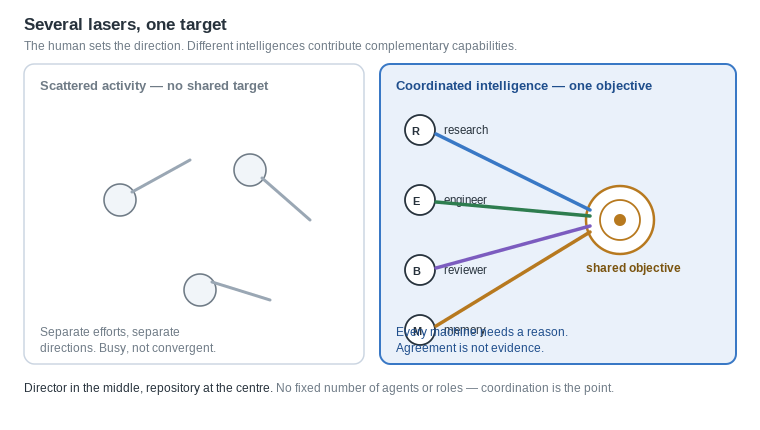
The chapter’s governing image is focusing several lasers on one point: the
important thing is not the number of beams but that they converge. That is the
difference between a team and a crowd. It also insists on a person in the middle
(you know the problem, values, budget, what useful looks like; machines plan and
recommend but consequential actions need you), on tuning like a racing car (a
current dependable version plus continuing possibility of a better one), on
letting machines challenge one another (agreement among machines is not evidence;
it may be the same blind spot counted several times), on discoveries staying on
trial, and on a living product (a metaphor, not biology) that keeps a dependable
version while the next is explored.
Several lasers, one target
Several capable machines without a shared direction produce incompatible
suggestions, duplicated work and expensive confusion: one rewrites what another
just built, a reviewer critiques a design nobody chose, research piles up that
answers a question no one asked. The same machines aimed at one clearly stated
objective can each contribute something the others cannot.
The direction is yours. Not the implementation plan — the machines can propose
that — but the objective: what you are trying to make, for whom, and what would
count as success. Everything else on the team takes its bearings from that.
This book was written this way
The chapter describes this from experience, because the book you are reading was
made by a small team of machines. The author set the direction (what each chapter
is for and what it must argue). One AI system helps develop those ideas and turns
them into detailed commissions. Other systems draft chapters from those
commissions; one of them also acts as an editor, reviewing drafts and sometimes
reshaping a commission before writing because the plan repeats what an earlier
chapter already said. The repository holds the shared record — an editorial
index, evidence notes for every chapter, an instruction file — so whichever
machine picks up the work next starts from the same place. The author reads what
comes out and decides what stays.
It works, and it also fails in instructive ways. One night two separate
sessions were working in the same folder at once. The author gave one of them a
chapter to write, and it found a finished draft of that chapter already waiting
— written minutes earlier by the other. Nothing was lost, but the lesson was
plain. A team of machines needs the same thing a team of people needs: someone
to decide who is doing what, and a shared record everyone actually reads.
Learn what you need along the way
The deepest change: in traditional development you learned a technology before
you could use it (language, framework, library, method). With a team of
machines, much of that learning can happen inside the work.
Suppose you want to build an unusual interface between people and AI — something
you speak to while you walk. You know nothing about speech recognition, audio
processing or the research on conversational interfaces. You do not need to study
them first. A machine can research the concepts and explain them at the level you
need, find the existing tools, compare their trade-offs and propose a first
experiment. Another can build it. You try it, and only then do you understand
what you actually want — which sends the research off in a better direction.
Learning, researching, experimenting and creating become one loop rather than a
sequence with years of study at the front.
You are not limited to the tools you knew existed yesterday.
Two precisions keep this honest. First, when the team researches a skill or
installs a library, the underlying model has not learned anything; its weights
are unchanged. What has grown is the combined working system — you, your records,
your tools and the machines you direct. Second, a capability the team has read
about is not a capability you can trust. A new technique becomes part of your
working method when it has been tried on real work and evaluated, not when it
has been described convincingly.
One direction, several machines
Chapter 18 showed that one machine can take on several roles — researcher,
collaborator, engineer, reviewer, organiser — through different instructions and
context. A team simply distributes those roles, and adds a couple that matter
more once there is more than one machine: an evaluator that compares results
against the objective and the evidence, and a recorder that keeps decisions,
experiments and discoveries so the next session can continue.
These are responsibilities, not an architecture. You do not need six agents.
Roles can be combined; a role can exist for one afternoon; a single capable
model, used in clearly separated sessions, can be the whole team for a long
time. Separate machines earn their place when they contribute something a single
one cannot: a different capability, a cheaper way to do routine work (Chapter
19), or — most valuable of all — a genuinely independent view.
Teams also cost something. Each additional machine adds expense, delay,
permissions to manage and more chances for the parts to disagree. So the rule
the author holds himself to is simple: every machine should have a reason to
be involved. If you cannot say what a member of the team contributes that the
others do not, it is decoration.
The person in the middle
None of this asks you to approve every technical decision. The machines can
plan, research, identify what is missing and recommend changes, and routine
choices can be delegated outright. Your part is different, and it is not small.
You know the problem, what you value, what you are willing to spend, and what
useful looks like. You decide what the team may touch and which consequential
actions — spending money, publishing, deleting, changing anything that matters to
other people — need you. And you direct the work in ordinary language: “I want
this to be easier to use.” “Find out what other approaches exist.” “See whether
a different model would do this better.” “Build me a version I can try.” “Get
someone else to challenge it.” “I don’t like where this has gone — let’s try
another direction.”
The test is not how many decisions you made personally. It is whether the team
is still pursuing your goals, or has quietly substituted its own.
Tune it like a racing car
A racing team does not build a car, declare it finished and never touch it
again. The car is driven. The data is examined. Engineers find where it loses
time; mechanics change the set-up; specialists look at particular components; the
driver says how it feels. The car goes back out, and the results decide what
happens next.
A product developed with a team of machines can follow the same rhythm. You use
the application. A research role looks for possible improvements. A builder
makes a change. Review and evaluation investigate it. You use the new version.
The results are kept, and the next experiment begins.
That is not a new method. It is the loop this book has used from the start —
communicate, build, evaluate, improve — with different parts of it handed to
different machines. Directing sets the goal; investigating and equipping find
the knowledge and the right tools; building makes something usable; challenging
tests it independently; experiencing is your judgement of the real thing, as in
Chapter 15; improving changes it; remembering keeps what was learned. Small tasks
need only some of these. The value is in the rhythm, not the ritual.
And a racing team always has a car that can race. The analogy does not mean
software is never finished or never stable. It means there is a current version
people can rely on, and a continuing possibility of a better one.
Let the machines challenge one another
The most dangerous illusion in a team of machines is agreement.
Three models can share the same mistake. A reviewer can confidently approve a
defect. Five agents can produce a great deal more work without producing a
better application. A newer model can do worse on precisely the task where you
expected it to shine. In the author’s more technical work he has run
comparisons where adding models or more elaborate prompting strategies did not
improve the verified results. Agreement among machines is not evidence; it may
just be the same blind spot, counted several times.
So be careful what you call independent. Asking the same model to “now act as a
reviewer” can be useful, but it is not independent review: it shares the
original’s assumptions and often its affection for its own work. Independence
comes from a different model, a different provider, real tests that run the
thing, or a human with relevant expertise.
The team must be judged by what it accomplishes, not by how much intelligence
or activity it appears to contain. Evidence depends on the purpose: the
application doing what it should, a test catching a regression, a user finishing
a task more easily, a measurable saving in time or cost, a new capability shown
working in a real experiment, an experience that is clearly better. Useful
systems keep the last accepted version, can undo changes that turned out worse,
and only promote an improvement when there is enough evidence that it is one.
When the team discovers something new
This is the part of the arrangement the author finds most exciting, so it
deserves care.
Suppose the research role finds a library or technique you had never heard of,
and that the coding machine would never have reached for. Suddenly there is a
new possibility. The team can investigate it, read its source and documentation,
work out what using it would require, and propose a bounded experiment. If you
agree, it can try it and evaluate the result. If the result holds up, your
working system now has a capability it did not have yesterday, and you can
attempt things you could not before — without first mastering the technology
underneath.
That is real amplification. It is also exactly where a team of machines can do
the most damage if nobody is directing it. A discovery is not a licence. The
team must not install arbitrary code, expose credentials, grant itself new
permissions or deploy changes because something interesting turned up. New
capabilities come in through the same boundaries as everything else — your
permissions, the project’s limits, the purpose of the work — and they stay on
trial until they have earned trust.
Try Machine Coding — Build With a Team
This exercise uses the AI Frontier Scout from Chapter 17. That application is
proposed rather than built for this book, so treat this as an illustrative
exercise; if you have not built a scout, use the arcade game from Chapter 13
instead, described at the end. You do not need a multi-agent framework. You can
play every role with one capable AI in clearly separate sessions, or use
different models if you have them and are permitted to. Nothing below reports
results from a run of the author’s own. Seven prompts plus an experience step:
- Give the team a direction — “I want to improve my AI research application so
it finds developments relevant to my work and helps me decide which are worth
investigating. Help me work out the single most useful improvement to make
first.”
- Ask a researcher — “Before changing anything, research how other systems
approach this. Find a few methods or tools, explain their advantages and
limitations, and give me the sources. Don’t change the application yet.”
- Equip the team — “Based on that research, which tools or models would suit
this improvement? Check whether I can use them, what they cost and what
restrictions apply. Recommend a simple approach I can actually use.”
- Hand the work to the builder — “Implement a small version of the approach we
chose. Keep everything that already works. Show me what changed and give me a
version I can try.”
- Get it challenged — “I want a critical review of this change — from a
different model or real tests if we have them. Look for wrong assumptions,
defects, missing functionality and regressions. Tell me exactly what was
checked and what remains uncertain.” (If the only reviewer available is the
same model in a new session, say so in your notes: it is a second look, not
an independent one.)
- Experience it — “Show me the new version next to the old one. I want to use
both and decide whether this actually improves my research. Ask me what I
think, and don’t assume the change is better.”
- Keep what was learned — “Record what we tried, why, what worked, what didn’t
and what we decided to keep. Preserve the working version and the evidence, so
I can return later and understand how this evolved.”
You have done the exercise when you can say: what the objective was, what the
research contributed, which tool was chosen and why, what the builder changed,
what the review actually established, what you decided to keep, and what is
recorded for next time.
With the arcade game instead. Set the direction as “I want the game to feel
better to play.” Ask a research role for a few basic principles of what makes
simple arcade games satisfying, with sources. Have a builder propose and make
one or two changes based on them. Ask for a review that looks for anything
broken. Then play it, describe what you feel, and let that feedback shape the
next round. One AI, clearly separated sessions, no subscriptions required.
Your team, not mine
The author’s own team reflects what he does: programming, writing, research and
building AI systems. Yours should reflect what you do. A historian would
assemble different roles from a musician. A teacher would need different
expertise from a small-business owner concentrating on customers and accounts.
Someone who mostly wants a better personal routine might need nothing more than
a good researcher and a reliable organiser. Some projects need one model; some
need several specialised tools; some need a human expert at a particular point;
and some operations, as Chapter 19 said, need no AI at all. There is no
optimal team. There is only the team that fits your work. The objective is
not to copy my machinery. It is to develop machinery suited to your own
ambitions.
The product grows with you
Something happens when you work this way for long enough. Three things begin to
develop together.
You develop: you learn more about the domain, the technology and what you
actually want. Your working environment develops: it gains better records,
sharper instructions, more suitable tools and, as Chapter 17 described, better
models as they arrive. And your product develops: it absorbs the experiments
that worked and moves closer to an objective that has itself become clearer.
Each feeds the others. You find a new idea because of something the team
researched. The team gains a capability because you asked it to look into a
limitation. The product reveals a problem that changes what you wanted in the
first place.
The author calls the result a living product. He means that as a metaphor,
not a biology: software capable of continuing, directed change, not software
that changes itself or is somehow alive. Not every change is an improvement, and
a living product is not an unstable one. It keeps a dependable version while the
next one is explored, and it changes when there is reason and evidence to change
it.
You are not simply building something with AI. You are developing a way of
working in which you, your machines and your creations can keep improving
together. What that relationship looks like over months and years — as models
change, as you learn, as old experiments are reconsidered and the product keeps
evolving — is where the next chapter, ALIVE — Living Technology, begins:
software that takes part in its own continuing improvement.
The central distinction
a team (converging on one objective)  ≠  a crowd (capable machines, no shared direction)
direction (yours: what, for whom, success)  ≠  implementation plan (machines may propose)
one machine, several roles (Ch 18)  ≠  a team (distributed roles, possibly several machines)
roles as responsibilities  ≠  a fixed architecture
a genuinely independent view  ≠  asking the same model to "now act as a reviewer"
agreement among machines  ≠  evidence (may be the same blind spot, counted several times)
a discovery (new possibility)  ≠  a licence (to install/run/deploy without boundaries)
a living product (metaphor)  ≠  software that changes itself or is alive
a current dependable version  ≠  finished/never-changing software
- Team vs crowd (DEFINED): several capable machines without a shared
direction produce incompatible suggestions, duplicated work and expensive
confusion. The same machines aimed at one clearly stated objective can each
contribute something the others cannot. The difference is convergence on an
objective, not the number of beams.
- Direction is yours (DEFINED): not the implementation plan (machines may
propose that) but the objective — what you are trying to make, for whom, and
what would count as success. Everything else on the team takes its bearings
from that.
- This book as a team (OBSERVED, author-supplied): author sets direction;
one AI develops ideas and turns them into detailed commissions; others draft;
one also acts as editor, reviewing drafts and sometimes reshaping a commission
before writing because the plan repeats what an earlier chapter already said;
repository holds shared record (editorial index, evidence notes, instruction
file) so whichever machine picks up next starts from the same place; author
reads and decides what stays. Concurrent-session collision (2026-11-10): two
sessions in the same folder; one given a chapter found a finished draft already
waiting, written minutes earlier by the other. Nothing lost; lesson: a team of
machines needs someone to decide who is doing what and a shared record everyone
actually reads.
- Learning inside the work (DEFINED): traditional development required
learning a technology before using it; with a team of machines, much of that
learning can happen inside the work (research concepts at the level you need,
find existing tools, compare trade-offs, propose a first experiment, build it,
try it, understand what you actually want, send research in a better
direction). Learning, researching, experimenting and creating become one loop.
You are not limited to the tools you knew existed yesterday. Two
precisions: the underlying model’s weights are unchanged when the team
researches or installs a library — what grows is the combined working system
(you, records, tools, machines directed); a capability read about is not a
capability you can trust — it becomes part of your working method when tried on
real work and evaluated, not when described convincingly.
- Roles as responsibilities, not architecture (DEFINED): Chapter 18’s roles
(researcher, collaborator, engineer, reviewer, organiser) are distributed;
added for teams: an evaluator (compares results against objective and
evidence) and a recorder (keeps decisions, experiments, discoveries for the
next session). You do not need six agents; roles can be combined; a role can
exist for one afternoon; a single capable model in clearly separated sessions
can be the whole team for a long time. Separate machines earn their place by
contributing something a single one cannot: a different capability, a cheaper
way to do routine work (Chapter 19), or a genuinely independent view.
- Cost of teams (DEFINED): each additional machine adds expense, delay,
permissions to manage, more chances for parts to disagree. Rule: every machine
should have a reason to be involved; if you cannot say what a member
contributes that others do not, it is decoration.
- Person in the middle (DEFINED): you know the problem, values, budget, what
useful looks like; decide what the team may touch and which consequential
actions (spending money, publishing, deleting, changing anything that matters
to other people) need you. Machines can plan, research, identify what is
missing, recommend; routine choices delegated outright. You direct in ordinary
language. Test: whether the team is still pursuing your goals, or has quietly
substituted its own — not how many decisions you made personally.
- Racing-car tuning (DEFINED analogy): drive the car, examine data, find where
it loses time, change set-up, specialists look at components, driver says how
it feels, car goes back out, results decide what happens next. Product
developed with a team of machines follows the same rhythm (you use; research
looks for improvements; builder makes a change; review and evaluation
investigate; you use the new version; results kept; next experiment). It is the
book’s loop (communicate, build, evaluate, improve) with parts handed to
different machines: directing sets the goal; investigating and equipping find
knowledge and tools; building makes something usable; challenging tests
independently; experiencing is your judgement of the real thing (Chapter 15);
improving changes it; remembering keeps what was learned. Small tasks need only
some. Value is in the rhythm, not the ritual. A racing team always has a car
that can race: there is a current version people can rely on and a continuing
possibility of a better one; software is not never-finished or never-stable.
- Independent challenge (DEFINED): the most dangerous illusion in a team of
machines is agreement. Three models can share the same mistake; a reviewer can
confidently approve a defect; five agents can produce more work without a better
application; a newer model can do worse on precisely the task where you
expected it to shine. Author’s more technical work: comparisons where adding
models or more elaborate prompting strategies did not improve verified results.
Agreement among machines is not evidence; it may be the same blind spot counted
several times. Asking the same model to “now act as a reviewer” can be useful
but is not independent review: it shares the original’s assumptions and often
its affection for its own work. Independence comes from a different model, a
different provider, real tests that run the thing, or a human with relevant
expertise. The team must be judged by what it accomplishes, not by how much
intelligence or activity it appears to contain. Evidence depends on purpose:
application doing what it should; a test catching a regression; a user
finishing a task more easily; a measurable saving in time or cost; a new
capability shown working in a real experiment; an experience clearly better.
Useful systems keep the last accepted version, can undo changes that turned out
worse, and only promote an improvement when there is enough evidence that it is
one.
- Discovery is not a licence (DEFINED): a research role may find a library or
technique you had never heard of that the coding machine would never have
reached for; the team can investigate it, read source and documentation, work
out what using it would require, propose a bounded experiment; if you agree, try
and evaluate; if it holds up, your working system has a capability it did not
have yesterday, and you can attempt things you could not before without first
mastering the technology underneath. That is real amplification. It is also where
a team can do the most damage if nobody is directing it. A discovery is not a
licence. The team must not install arbitrary code, expose credentials, grant
itself new permissions or deploy changes because something interesting turned
up. New capabilities come in through the same boundaries as everything else —
your permissions, the project’s limits, the purpose of the work — and stay on
trial until they have earned trust.
- Living product (DEFINED metaphor): software capable of continuing, directed
change, not software that changes itself or is somehow alive. Not every change
is an improvement; a living product is not an unstable one. It keeps a
dependable version while the next one is explored, and changes when there is
reason and evidence to change it. Three things develop together: you (domain,
technology, what you want); your working environment (better records, sharper
instructions, more suitable tools, better models as they arrive, Chapter 17);
your product (absorbs experiments that worked, moves closer to an objective
that has itself become clearer). Each feeds the others.
- Your team, not mine (DEFINED stance): the author’s team reflects what he
does (programming, writing, research, building AI systems); yours should
reflect what you do. Historian vs musician; teacher vs small-business owner;
someone wanting a better personal routine might need only a good researcher and
a reliable organiser. Some projects need one model; some several specialised
tools; some a human expert at a point; some operations (Chapter 19) need no AI
at all. There is no optimal team. There is only the team that fits your work.
The objective is not to copy the author’s machinery but to develop machinery
suited to your own ambitions.
Why the naive approach fails
- A crowd instead of a team (DIAGNOSED): several capable machines without a
shared direction produce incompatible suggestions, duplicated work and
expensive confusion — one rewrites what another built, a reviewer critiques a
design nobody chose, research piles up answering a question no one asked.
- Confusing direction with implementation plan (DIAGNOSED): the direction
(what, for whom, success) is yours; the machines may propose the
implementation plan.
- Adding machines without a reason (DIAGNOSED): each additional machine
adds expense, delay, permissions to manage and more chances to disagree; if you
cannot say what a member contributes that others do not, it is decoration.
Every machine should have a reason to be involved.
- Treating roles as a fixed architecture (DIAGNOSED): roles are
responsibilities; you do not need six agents; roles can be combined; a role can
exist for one afternoon; a single capable model in clearly separated sessions
can be the whole team for a long time.
- Approving every technical decision yourself (DIAGNOSED, opposite error):
none of this asks that; routine choices can be delegated; your part is knowing
the problem, values, budget, what useful looks like, what the team may touch,
and which consequential actions need you.
- Letting the team substitute its own goals (DIAGNOSED): the test is whether
the team is still pursuing your goals, or has quietly substituted its own.
- Treating agreement as evidence (DIAGNOSED): three models can share the same
mistake; a reviewer can confidently approve a defect; five agents can produce
more work without a better application; a newer model can do worse where you
expected it to shine. Agreement among machines is not evidence; it may be the
same blind spot counted several times.
- Calling same-model review independent (DIAGNOSED): asking the same model to
“now act as a reviewer” shares the original’s assumptions and often its
affection for its own work. It is a second look, not an independent one. Say so
in your notes. Independence comes from a different model, a different provider,
real tests that run the thing, or a human with relevant expertise.
- Judging by apparent intelligence or activity (DIAGNOSED): the team must be
judged by what it accomplishes, not by how much intelligence or activity it
appears to contain.
- Promoting improvements without enough evidence (DIAGNOSED): useful systems
keep the last accepted version, can undo changes that turned out worse, and only
promote an improvement when there is enough evidence that it is one.
- Treating a discovery as a licence (DIAGNOSED): a discovery is not a licence
to install arbitrary code, expose credentials, grant itself new permissions or
deploy changes because something interesting turned up. New capabilities come
in through the same boundaries as everything else and stay on trial until they
have earned trust.
- Treating “learn along the way” as the model learning (DIAGNOSED): when the
team researches a skill or installs a library, the underlying model’s weights
are unchanged. What grows is the combined working system — you, records, tools,
machines directed.
- Treating a read-about capability as trusted (DIAGNOSED): a capability the
team has read about is not a capability you can trust; it becomes part of your
working method when tried on real work and evaluated, not when described
convincingly.
- Treating a living product as self-changing or alive (DIAGNOSED): “living
product” is a metaphor, not biology; software capable of continuing, directed
change, not software that changes itself or is somehow alive. Not every change
is an improvement; a living product is not an unstable one.
- Treating software as never finished (DIAGNOSED): the racing-car analogy does
not mean software is never finished or never stable. There is a current version
people can rely on and a continuing possibility of a better one.
- Copying the author’s machinery (DIAGNOSED risk): there is no optimal team;
only the team that fits your work. The objective is not to copy the author’s
machinery but to develop machinery suited to your own ambitions.
- Letting models change without you changing the team (DIAGNOSED): when
something better becomes available, you change the machines you use and the way
they work together.
Important boundaries
- The multi-AI workflow described (author directs; ChatGPT develops ideas and
commissions; DeepSeek and Claude draft; Claude also reviews/edits) is real from
this project; the author asks readers to confirm the wording. Systems are not
named in the chapter. VERIFIED from repository records (commit history
2026-11-06 to 2026-11-10; Ch12 review 2026-11-09; editorial assessments
before Ch15–Ch20).
- Concurrent-session collision (2026-11-10, Ch14 commission reached this session
after another session had written 14-chapter.md at 00:05:53) is real from this
project; author to confirm wording.
- Lasers analogy, racing-car tuning analogy, “you are not limited to the tools
you knew existed yesterday”, living product: from the author (labelled).
- Applied AI comparisons where adding models or more elaborate prompting
strategies did not improve verified results: stated as the author’s technical
work; not detailed or verified here. Do not invent details.
- “Living product” is a metaphor, not biology; do not treat as a technical
claim about self-modifying software.
- Roles are responsibilities, not an architecture; no multi-agent framework
required; one capable AI in clearly separated sessions can be the whole team.
- The exercises (“Build With a Team”, arcade-game variant) are reader-run and
illustrative; the Scout and arcade game are proposed/unbuilt for this book; no
multi-agent framework needed; nothing reports results from a run of the
author’s own.
- “There is no optimal team” is a book position, not a measured claim.
- ALIVE is evidence for the method, not the subject (carried from AGENTS.md);
do not treat as a product endorsement.
- The author’s “nearly thirty years of programming experience” is
author-supplied, not independently verified (carried).
- No frozen runs, benchmarks, or numbers in this chapter.
Things that are easy to confuse
- A team (converging on one objective) vs a crowd (capable machines, no shared
direction).
- Direction (yours: what, for whom, success) vs implementation plan (machines may
propose).
- One machine, several roles (Chapter 18) vs a team (distributed roles, possibly
several machines).
- Roles as responsibilities vs a fixed architecture.
- A genuinely independent view (different model/provider/real tests/human expert)
vs asking the same model to “now act as a reviewer” (second look).
- Agreement among machines vs evidence (may be the same blind spot, counted
several times).
- A discovery (new possibility) vs a licence (to install/run/deploy without
boundaries).
- A living product (metaphor for continuing, directed change) vs software that
changes itself or is alive.
- A current dependable version vs finished/never-changing software.
- The model learning vs the combined working system growing (weights unchanged).
- A read-about capability vs a trusted capability (tried and evaluated on real
work).
- Judging by what the team accomplishes vs by how much intelligence or activity
it appears to contain.
- Copying the author’s machinery vs developing machinery suited to your own
ambitions.
Where this sits in the book
LATE (internal classification). Follows Chapter 19 (different tools for
different jobs) and is the capstone of Part 4: directing several intelligences
towards one objective and keeping what works. Hands Chapter 21 (ALIVE — Living
Technology) its precondition: what that relationship looks like over months and
years — as models change, as you learn, as old experiments are reconsidered and
the product keeps evolving — software that takes part in its own continuing
improvement. Points back to Chapter 13 (build to find out), Chapter 14 (think
with the machine; communicate/build/evaluate/improve loop), Chapter 15 (read the
product, not the code; experiencing is your judgement of the real thing), Chapter
16 (purpose decides what kind of product you are building and how fast to move),
Chapter 17 (keeping up; better models as they arrive), Chapter 18 (one machine,
several roles through instructions and context; durable records), Chapter 19
(choosing the right intelligence; some operations need no AI at all). Closes
Part 4 before Part 5 (ALIVE).
Evidence status
- Multi-AI workflow (author directs; ChatGPT develops ideas/commissions;
DeepSeek and Claude draft; Claude reviews/edits; repository records as shared
state): REAL from this project; author to confirm wording; systems not named in
the chapter; commit history 2026-11-06 to 2026-11-10; VERIFIED from
repository records.
- Concurrent-session collision (2026-11-10, Ch14): REAL from this project; author
to confirm wording; see conversation record / Ch14 evidence note.
- Lasers analogy; racing-car tuning analogy; “you are not limited to the tools
you knew existed yesterday”; living product: from the author (labelled).
- Applied AI comparisons where added models or prompting strategies did not
improve verified results: stated as the author’s technical work; not detailed
or verified here. Do not invent details.
- Living product: metaphor, not biology; not a technical claim about
self-modifying software.
- Roles as responsibilities, not architecture; no multi-agent framework required:
PROPOSED (book position), argued from practice.
- Try Machine Coding exercise (Build With a Team, Scout and arcade-game
variants): READER-RUN/ILLUSTRATIVE; both applications unbuilt; not run; nothing
reports results.
- “There is no optimal team; only the team that fits your work”: PROPOSED (book
position), argued from practice.
- No frozen runs, benchmarks, or numbers in this chapter.