Stop Slopping
Stay in control of what the machine creates without taking over its work.
The hardest thing about machine coding may not be getting the machine to produce something. It may be remaining in control while it produces far more than you can personally inspect.
I have seen the same pattern repeatedly. You begin brilliantly: a clear idea, a capable machine, rapid progress. Features arrive, interfaces improve, demonstrations dazzle. Then, almost without noticing, you have talked your way into something you never intended — something sophisticated, polished, and wrong. Not wrong in the way a bug is wrong. Wrong in the way a stranger is wrong: technically functional, and not yours.
I call that slop. Stopping it does not mean returning to manual programming, inspecting every line, or strangling the machine with specifications. It means staying in control of what is being created while the machine does the creating.
Stop slopping
Vibing your way into a solution is tempting because it works, right up until it doesn’t. Each individual step feels like progress. The AI proposes; you agree; the product grows. The trap is that agreement compounds. Twenty reasonable acceptances later, you own an application nobody designed — least of all you. The original intention is buried under layers of plausible additions, each defensible alone, incoherent together.
The failure is not necessarily bad code. The code may be excellent. The tests may pass. The demo may impress. The project has drifted away from its purpose while every local decision looked correct. Generating output is not creating a coherent product. What matters here is not supervision of every line the machine writes, but ownership of the thing those lines are becoming.
The three superpowers
Three capabilities make machine coding particularly powerful. Each brings a corresponding risk.
Translation. You describe what you want in ordinary language, and the machine does much of the work of turning it into software. The distance between intention and execution shrinks. The risk is misinterpretation: a plausible translation that does not faithfully represent what you meant, accepted because it reads convincingly.
Amplification. One person can direct far more work than they could personally implement, taking on projects that might once have required a team. But mistakes amplify too. A misunderstood requirement can produce not one wrong function but an entire wrong subsystem, quickly, confidently, and consistently. A machine can build the wrong thing extraordinarily fast.
Exploration. Given enough context, the machine introduces possibilities you had not considered. It participates in discovering what the finished product might become. The risk is uncontrolled expansion: each new idea is attractive, yet together they lead the project away from its purpose.
All three demand direction, but direction must not become rigidity. Prescribe every detail and you sacrifice much of the fluency, scale, and discovery that make machine coding valuable. The machine needs freedom to work; the human needs control over what that work becomes.
How you slop your way into something
The mechanism is gradual, which is why it escapes notice. Start with a reasonably clear goal. The AI proposes a feature. You agree — it is genuinely useful. Another feature follows. An interface gets redesigned, reasonably. A convenient subsystem grows elaborate, justifiably. The machine adds complexity to accommodate its previous complexity, each layer rational. You approve each step because each step, taken alone, makes sense.
Eventually the original application is buried. Twelve screens where two would do. Six workflows for a task with one user. Dashboards nobody reads. Configuration for contingencies that never occur. The implementation may be superb throughout. I call this conversational drift: the accumulation of individually plausible decisions that collectively undermine the product. You will recognise it when you catch yourself defending a feature you never wanted to a person you never built it for.
Technical competence disguises the problem perfectly. Successful local execution is not proof of global coherence. A polished interface is not proof of a good product. A completed work package is not proof of progress towards the original objective. Every one of those statements feels obvious written down, and every one of them is easy to forget at the pace machine coding moves.
You need a goal, not a prison
One tempting response is exhaustive specification: define everything before the machine starts and permit no deviation. But prescribing every implementation detail sacrifices discovery and reduces much of the machine’s contribution to executing decisions you have already made. You gain control over the mechanism at the expense of the freedom that made delegation attractive.
The alternative is not vagueness but a different kind of clarity: what I call a stable intention. I need a firm understanding of what I am trying to accomplish and what I care about, without having to decide in advance exactly how the finished product will achieve it.
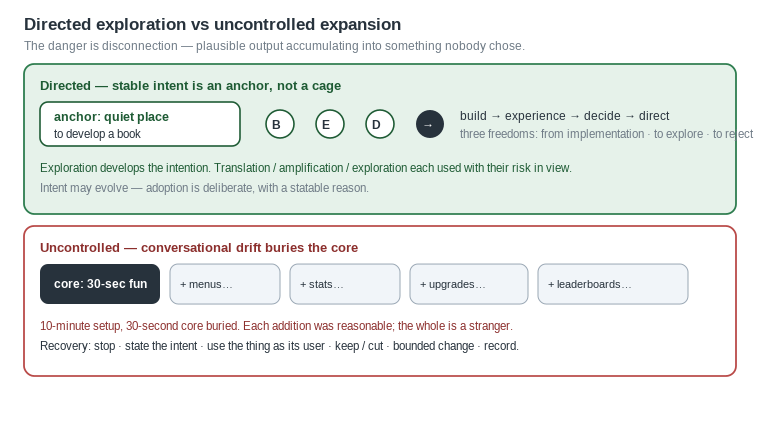
Consider a writing application. A fixed specification says: exactly six screens, four navigation tabs, these tables, these predefined workflows. A stable intention says: I want a quiet place to develop a book through conversation. I want to see the manuscript, recognise my own voice, recover earlier decisions, and move naturally between thinking and writing. The machinery must not intrude on the writing.
The second brief gives the machine more creative freedom and gives me a better way to judge the result. When the AI proposes a complex dashboard, I ask whether it improves the writing experience, not whether it is well built. An unexpected improvement deserves consideration; an impressive feature with no place in the product deserves rejection. The intention is the anchor, not the cage: firm enough to judge by, flexible enough to change deliberately when a better idea earns its place.
Everything that comes out has to be you
Everything that comes out has to be you. That is the deepest claim I want to make about creative work with AI.
I do not mean you must write the code, originate every suggestion, or preserve your first idea unchanged. I mean the finished creation must reflect an intention you have recognised, considered, and deliberately embraced.
The machine may invent something surprising and better. You may initially disagree with it. You explore it, try it, and eventually realise it improves on what you imagined. It becomes yours by adoption rather than authorship. That is creative influence: the machine expands your sense of what is possible, and you choose. Passive acceptance is something else entirely: the machine’s direction replaces your judgement while you are busy approving. Did I make a judgement, or did I merely fail to object?
Other crafts already understand this. A fashion designer does not weave every thread or stitch every garment, yet the collection has a coherent identity because someone recognises what belongs and what does not. Machine coding brings this relationship to software. Much of the evaluation can be delegated too: machines increasingly check, compare, and judge work against criteria. What I cannot delegate is responsibility for what I choose to create. The result remains mine in the sense that matters here — deliberately chosen, understood, and stood behind.
Use the thing you are building
Use the result as its intended user would. Not the code. Not the test report. The thing itself.
If you are building a game, play it. If you are building a website, navigate through it. If you are writing a book, read it as a reader. If you are creating a workflow, perform the real user journey. If you are building a tool, attempt the task it was created to accomplish.
Use realistic tasks and expectations. Does the experience serve its purpose? Does it feel coherent? What gets in the way? Has something unexpected emerged that deserves to stay? Has the machine solved the wrong problem particularly well?
This does not require reviewing every line of generated code. Machines can increasingly assist with code inspection, security checks, and technical verification. For safety-critical or high-consequence systems, experiencing the product cannot replace rigorous assurance. The point is that tests cannot establish properties they never measured, and the properties slop destroys first — flow, coherence, fitness to purpose, the feeling of the thing — can be difficult to capture in a test. You cannot judge the quality of a user experience solely from the machine’s description of that experience. Someone has to meet the result where it lives. I do that myself where I can, and where the users’ experience differs from mine, I need to learn from them too.
Let the machine flex
Once the foundations and boundaries are established, let the machine explore, improvise, and generate unexpected improvements. Do not hover or dictate implementation details it can handle. Do not reject an approach merely because you would have implemented it differently. Constant interference is another way to lose the amplification this book exists to enable.
Welcome surprises that improve the creation, discard those that do not, and reconsider the intention when a genuinely better direction emerges. But creative freedom is not tool authority. Security, permissions, and consequential external actions remain governed by the enforceable boundaries from Chapter 05. Exploration needs room; it does not need root.
Chapter 09 argued for leaving a productive machine alone. The principle holds at product level too: you do not need to control every operation to maintain control of the creation. Direct the intention and judge the outcome.
Recognise when the whole is going wrong
A machine can behave productively — obedient, industrious, passing tests — while the resulting product gradually deteriorates. The warning signs are visible in the product itself:
- Features accumulate without improving the central use case.
- The original purpose becomes difficult to explain.
- Screens, functions, and workflows multiply without clear benefit.
- Every addition demands several supporting additions.
- Secondary problems get solved while the primary experience stays weak.
- The result impresses in demonstration but disappoints in ordinary use.
- You catch yourself defending features you never wanted.
These are signals to investigate, not proof of failure. Some valuable systems are necessarily complex; the question is whether the complexity serves the purpose. Keep the two levels distinct: Chapter 09 diagnoses a machine losing its way through its behaviour; this chapter diagnoses a product losing coherence through its use. One may call for redirecting the machine. The other calls for re-examining the product — and sometimes for removing work rather than adding it.
A game that slopped, then recovered
Imagine the recurring arcade-game project. The developer begins with a straightforward shooter: movement, enemies, scoring, restart behaviour. The machine produces a genuinely playable game. Then come the improvements: menus, a statistics screen, an upgrade system, configuration screens, additional mechanics, visual effects, a leaderboard with categories nobody asked for. Individually, many of these features impress. The developer approves them one by one, each decision defensible.
Then the developer plays the game — really plays it, not the demo path — and the straightforward experience is gone. It takes ten minutes to configure a session. The core thirty seconds of dodging and shooting, the entire point, now compete for attention with the systems around them. The result is sophisticated but no longer enjoyable in the intended way. Nothing need be broken in the conventional sense. The tests may all pass. The diagnosis is not a bug, but drift.
Feature work stops. The developer writes down the purpose — fast, readable arcade action — and describes the mismatch in concrete terms: setup time, menu depth, time-to-first-shot. The improvements that still serve the game, including tighter enemy patterns and a better restart transition, are kept. Other additions are candidates for removal or shelving. The machine simplifies one part at a time, and the developer plays again before choosing the next change. The aim is a game faster to start, closer to the original feel, and better in the ways the detour genuinely taught. The lesson is not that additional features are bad. It is that playing the game reveals which ones belong.
The same shape appears outside games. A documentation site gains analytics dashboards, version pickers, and feedback widgets while its core pages grow stale — the fix is navigating it as a stranger would. A book chapter accumulates arguments, examples, and asides until its point disappears — the fix is reading it aloud as a reader, not reviewing its tracked changes. Slop is not unique to code. It is what happens to any created thing when production outruns intention, and the remedy travels with it: meet the result where it lives.
Recover the intention
When drift is detected, do not seize the keyboard and do not pile on more prompts. Return to the intended result. The recovery sequence I use is simple, and deliberately small:
- Stop adding features, temporarily.
- State what the product was supposed to accomplish.
- Use the actual product and describe the mismatch, concretely.
- Identify what remains valuable and what has become unnecessary.
- Ask the machine to propose simplification, correction, or removal.
- Make one bounded change and experience the result again.
- Record deliberate changes to the intention, so continuity survives.
The machine that expanded the product can also shrink it. Removal is progress when it restores coherence. A previously accepted direction can be reconsidered without invalidating the entire project. The records and version history from Chapters 06 and 10 help make this reversible, provided changes to external state are accounted for separately. A process that cannot undo cannot afford to experiment freely. Use this recovery sequence when the product has drifted, not as a bureaucratic gate on ordinary work.
Try Machine Coding — Does This Still Belong? Take an application, website, game, or document you have developed with AI. State its purpose in two sentences. Use it as the intended user would. Identify one addition that genuinely improved the experience and one whose value you now question. Ask the AI to propose what to retain, simplify, or remove. Direct one bounded change and experience the result again. Success is not measured by how much changed, but by whether the creation more closely fulfils its intention.
Stay in control without taking over
Machine coding gives me three freedoms: freedom from implementation, freedom to explore, and freedom to reject what no longer belongs. They work together. The working discipline is four moves, repeated: build something, experience it, decide what belongs, direct the next change. That is the product-level expression of the book’s master loop — communicate, build, evaluate, improve — with evaluation taking place where slop becomes visible: in the encounter with the result.
I don’t want to spend my time writing the code. I want the machine to do that. I don’t want to tell it how to solve every problem, because then I lose much of what makes this approach powerful. But I do want to recognise the thing we’re building. I want to use it, understand what it offers, and know when it has become something I never intended. The machine can do the work. It can even surprise me with better ideas. But I must not confuse everything it can produce with everything I want to create.
Let the machine do the coding. Let it amplify your capabilities. Let it surprise you. But don’t let it slop your project out of your control.